



Samsung Biologics labor dispute raises concerns over production stability
Nov 23, 2026, 10:36 am


 |
As the labor dispute at Samsung Biologics drags on, production stability, a key competitive strength in the global contract development and manufacturing organization (CDMO) business, has emerged as a major issue. Although a court has restricted industrial action in certain critical production processes, the standoff continues, with partial strikes ongoing and the union's affiliation with the Federation of Korean Trade Unions (FKTU) now confirmed.
Concerns are growing that a prolonged dispute could place an increasing burden on Samsung Biologics, which is expanding its global manufacturing facilities, as stable production operations and meeting delivery deadlines are directly linked to customer trust.
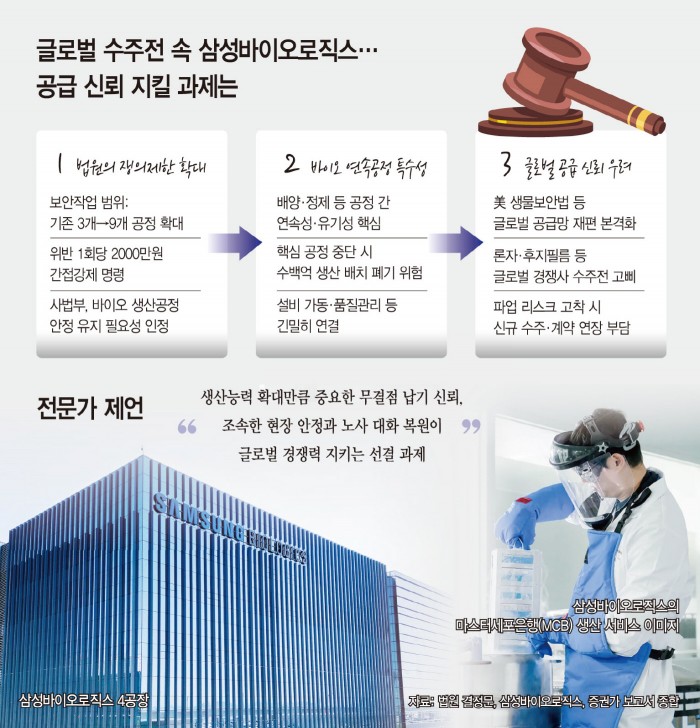
According to industry sources on November 22, a key turning point in the labor dispute at Samsung Biologics was the court's decision to restrict industrial action. On October 16, the Seoul High Court expanded the scope of essential protective work exempt from strikes from three to nine processes in an appeal filed by management over an injunction against industrial action. The court also issued an indirect enforcement order requiring the union to pay 20 million won for each violation.
The decision recognized major cell culture and purification processes as essential protective work necessary to prevent the deterioration or spoilage of raw materials and products. In effect, the court gave weight to the unique nature of biopharmaceutical production processes and the need to maintain stable operations.
The nature of biopharmaceutical manufacturing explains why management emphasizes the need for an approach different from that used in conventional manufacturing. While production lines in conventional manufacturing can be restarted relatively easily after a shutdown, continuity between processes is critical in biopharmaceutical manufacturing, which involves living cells. Interruptions to critical processes can affect the quality of batches under production and pose risks of reprocessing, disposal or delivery delays. According to management, equipment operations, quality control and preparations for inspections by global regulatory authorities are all closely interconnected.
The importance of production stability is also evident in the scale of the company's operations. According to its third-quarter report, Samsung Biologics has a total global production capacity of 845,000 liters, comprising 785,000 liters across Plants 1 through 5 in Songdo, Incheon, and 60,000 liters at its Rockville plant in the United States. Its cumulative production output through the third quarter of this year reached 595 batches, with a capacity utilization rate of 73.3%.
The company continues to operate Plants 1 through 4 steadily while ramping up operations at Plant 5. Commercial production is also underway at its Rockville plant in the United States. As the number of production sites increases, maintaining process continuity and quality control is becoming increasingly important.
The union, meanwhile, argues that the court's decision excessively restricts the constitutionally guaranteed right to collective action and is responding through a further appeal and efforts to pursue legislative changes. It has established a strike fund of up to 1.2 billion won and continues to stage partial strikes, mainly in areas such as logistics that are not covered by the injunction. The union has also sought to strengthen its bargaining power by joining the FKTU. However, concerns remain that a prolonged standoff could increase uncertainty over workforce deployment and production process management.
Another factor is the rapidly changing landscape for contracts in the global CDMO market. U.S. moves to regulate Chinese biotechnology companies are increasing the need for global pharmaceutical companies to diversify their supply chains. As competitors such as Switzerland's Lonza and Japan's Fujifilm expand their facilities, Samsung Biologics is also increasing its production capacity. Beyond the scale of manufacturing facilities, the ability to supply pharmaceuticals on schedule and in accordance with quality standards is becoming increasingly important.
Supply reliability is one of the key criteria that global pharmaceutical giants consider when selecting a CDMO provider. Because pharmaceutical contract manufacturing involves long-term agreements closely tied to regulatory approvals, switching production sites is difficult. Even if there are no immediate shipment disruptions, persistent labor-related risks could be perceived by customers as a potential threat to supply stability, making it more difficult to secure new contracts or renew existing ones.
Hong Ki-yong, professor emeritus of business administration at Incheon National University, said, "CDMO is a business in which customers entrust companies with their core assets. If supply stability and trust collapse, neither technology nor facilities will mean anything."
Samsung Biologics plans to continue negotiations with the union while maintaining stable operations in essential production processes. Wi Hae-joo, an analyst at Korea Investment & Securities, said in a recent report, "Given the nature of contract manufacturing (CMO) orders, supply chain stability and labor relations stability from an ESG perspective are factors that potential customers consider in their evaluations. Therefore, whether management and the union can reach an agreement will also have a positive impact on securing contracts."
Moon Jeong-woo
Most Read
-
1
AMD's Lisa Su floated as potential Nvidia successo..

-
2
China President Xi's Keynote Speech at the APEC C..

-
3
Iran resumes attacks after two months, targeting U..

-
4
Alice Huang, affair partner of Jensen Huang, repor..

-
5
Inside Kylin Villa, the symbol of China's reform h..

-
6
Xi secures fourth term as China reshuffles next-ge..

-
7
Trump, Xi, Putin call for security cooperation at..

PEOPLE






-
Address : In-Young Bldg., 34, Uisadang-daero 1-gil, Yeongdeungpo-gu, Seoul
Copyright by ASIATODAY CO., LTD. All rights resereved