



China, Australia agree to establish AI dialogue mechanism
Nov 23, 2026, 10:11 am


China has reached an agreement with Australia to establish a dialogue mechanism to discuss artificial intelligence (AI) safety, governance and applications. China will thus establish an AI dialogue mechanism with Australia, following a similar arrangement with the United States. China appears likely to continue expanding the number of countries with which it reaches such agreements. South Korea is also expected to be no exception.
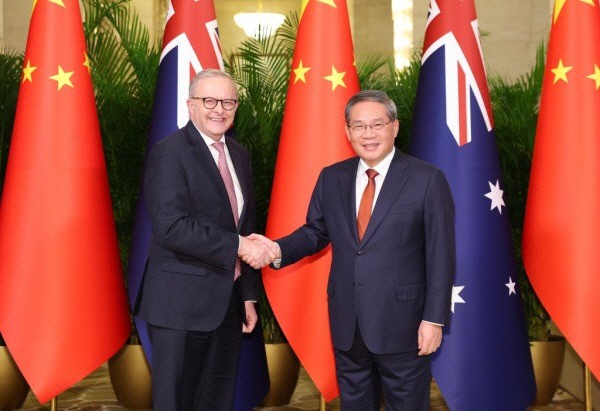 |
| Chinese Premier Li Qiang and Australian Prime Minister Anthony Albanese. The two leaders agreed to establish an AI dialogue mechanism during their meeting on November 20. / People's Daily |
According to China's Ministry of Foreign Affairs on November 21, Premier Li Qiang of the State Council held the 11th China-Australia Annual Leaders' Meeting with Prime Minister Anthony Albanese at the Diaoyutai State Guesthouse in Beijing the previous afternoon and issued a joint statement that included the agreement. The statement first said, “The two sides agreed on the establishment of an AI dialogue, to exchange respective views on AI safety, governance and application.” It also included an agreement to cooperate on climate change and the clean energy transition. For instance, this could be taken to mean that the two countries agreed to continue cooperation on methods for calculating carbon emissions while expanding the market for low-carbon steel products.
The two countries also designated 2027, the 55th anniversary of the establishment of diplomatic relations, as the “Australia-China Year of Tourism” during their meeting the previous day. This has considerably increased the likelihood that China's unilateral visa-free policy for Australians, which is due to expire at the end of this year, will be extended for a certain period. It seems safe to say that similar visa-free policies for the other 47 countries will naturally receive favorable consideration as well.
Before the meeting, Albanese attended the Asia-Pacific Economic Cooperation (APEC) summit held over two days beginning November 18 in Shenzhen, Guangdong Province. He then met with Xi Jinping, General Secretary of the Communist Party of China and President of China, and expressed his intention to strengthen practical cooperation with China in trade, investment and AI.
Relations between China and Australia were arguably at their lowest point before Albanese took office in 2022. This was because the previous Liberal Party government had pursued an anti-China policy while leaning excessively toward the United States. As a result, trade friction between the two countries intensified dramatically. However, after Albanese came to power in 2022 and introduced a more conciliatory policy toward China, relations gradually began to improve. The results were very positive. Most notably, China lifted its import restrictions on Australian coal, wine and lobsters.
China, Australia's largest trading partner, subsequently responded even more actively to Albanese's China-friendly approach. A prime example is its proposal to expand and revise the bilateral free trade agreement (FTA) concluded a decade ago to strengthen cooperation in areas such as agriculture and mining. China is expected to continue making every effort to bring these efforts to a successful conclusion. Relations between the two countries are expected to remain fairly smooth for the foreseeable future.
Hong Soon-do
Most Read
-
1
AMD's Lisa Su floated as potential Nvidia successo..

-
2
China President Xi's Keynote Speech at the APEC C..

-
3
Iran resumes attacks after two months, targeting U..

-
4
Alice Huang, affair partner of Jensen Huang, repor..

-
5
Inside Kylin Villa, the symbol of China's reform h..

-
6
Xi secures fourth term as China reshuffles next-ge..

-
7
Trump, Xi, Putin call for security cooperation at..

PEOPLE







-
Address : In-Young Bldg., 34, Uisadang-daero 1-gil, Yeongdeungpo-gu, Seoul
Copyright by ASIATODAY CO., LTD. All rights resereved