



Wall Street braces for 'Black Monday' fears after tech stock rout
Nov 23, 2026, 09:19 am


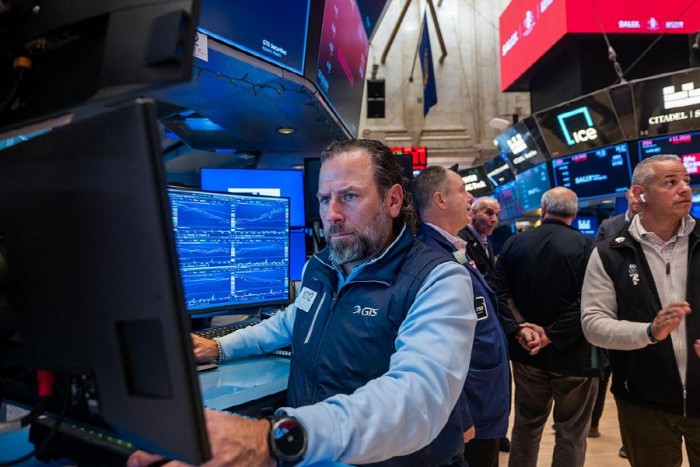 |
| Traders work on the floor of the New York Stock Exchange (NYSE) in New York City. / Getty Images |
Following a sharp decline on Wall Street last week amid concerns over the profitability of the artificial intelligence (AI) industry and a sell-off in technology stocks, fears of a repeat of the 1987 “Black Monday” crash are growing ahead of the market opening on November 23 (all dates local time). The S&P 500 and Dow Jones Industrial Average have entered correction territory, while the Nasdaq Composite has erased all its gains for the year.
On November 20, the S&P 500 closed at 6,910.39, down 3.70% from the previous session, while the Dow fell 1.93% to 48,147.33. The Nasdaq Composite plunged 5.28% to 22,617.73. The S&P 500 fell for the seventh consecutive trading session, dropping 11.6% from its October peak, while the Dow also declined more than 10% from its peak. The Nasdaq's weekly loss of approximately 10% was its steepest since March 2020.
Selling was concentrated in AI-related stocks. The Philadelphia Semiconductor Index plunged 10.73% in a single session, while Nvidia fell about 14%. Investor sentiment weakened further following reports that the U.S. Securities and Exchange Commission (SEC) was investigating Nvidia's accounting practices. However, the investigation is still examining potential accounting issues, and no wrongdoing by Nvidia has been established.
Questions also remain over whether increased investment by major technology companies will translate into actual profits. Massive capital expenditures, the costs of securing electricity supplies and transmission networks, U.S.-China semiconductor export restrictions and the possibility of further U.S. interest rate hikes also weighed on the market. The fact that AI company Anthropic rose 17.1% above its initial public offering (IPO) price on its first trading day but fell 9.1% the following day also pointed to cooling investor enthusiasm.
Interest rate expectations are another major factor influencing the market. Reuters reported that growing concerns about an economic slowdown could lead to further tightening by the Federal Reserve (Fed). Further interest rate hikes will also be discussed at the Federal Open Market Committee (FOMC) meeting scheduled for December 8–9.
The revised third-quarter gross domestic product (GDP) figures and the October personal consumption expenditures (PCE) price index are also due to be released on November 25. Both reports will be published at 8:30 a.m. Eastern Time. The New York Stock Exchange will be closed on November 26 for Thanksgiving and will close early at 1 p.m. Eastern Time on November 27.
Cheon Hyun-bin
Most Read
-
1
AMD's Lisa Su floated as potential Nvidia successo..

-
2
China President Xi's Keynote Speech at the APEC C..

-
3
Iran resumes attacks after two months, targeting U..

-
4
Alice Huang, affair partner of Jensen Huang, repor..

-
5
Inside Kylin Villa, the symbol of China's reform h..

-
6
Xi secures fourth term as China reshuffles next-ge..

-
7
Trump, Xi, Putin call for security cooperation at..

PEOPLE







-
Address : In-Young Bldg., 34, Uisadang-daero 1-gil, Yeongdeungpo-gu, Seoul
Copyright by ASIATODAY CO., LTD. All rights resereved