



[Exclusive] HUG conducts undercover bank inspections over reluctance to handle policy loans
Nov 19, 2026, 03:25 pm


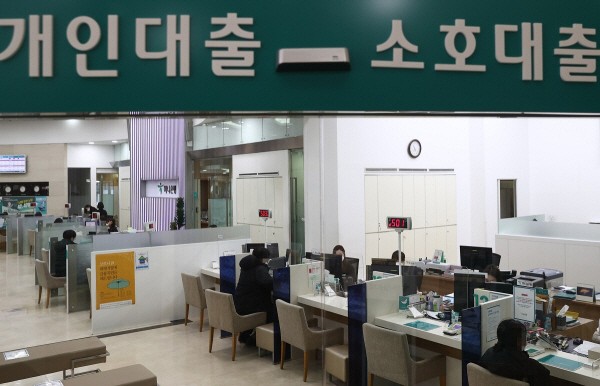 |
| A loan service counter at a commercial bank branch. /Yonhap News Agency |
Major commercial banks that have been reluctant to handle government-backed loans are undergoing undercover branch inspections by the Korea Housing & Urban Guarantee Corporation (HUG). HUG has stepped up direct oversight of bank branches following a series of cases in which banks referred customers seeking policy loans under the National Housing and Urban Fund (NHUF), such as Didimdol and Beotimmok loans, to other banks or refused to handle such loans without any particular reason. As the inspection results are also used to determine individual banks' fees for administering fund operations, banks could face a reduction in fee income.
According to banking industry sources on Nov. 19, HUG has been conducting on-site evaluations of branches of nine banks entrusted with NHUF operations since last year, using a mystery shopping approach. Employees of an agency contracted by HUG pose as ordinary customers and visit bank branches to assess everything from consultations on fund-backed loans to customer service and administrative procedures.
The inspections cover nine banks selected in 2023 to administer NHUF operations. They include the five major banks — KB Kookmin Bank, Shinhan Bank, Hana Bank, Woori Bank and NH NongHyup Bank — as well as iM Bank, BNK Busan Bank, BNK Kyongnam Bank and the Industrial Bank of Korea (IBK). As their contracted responsibilities differ, each bank is evaluated primarily on the housing subscription savings and lending services it is responsible for.
Major NHUF loan products include Didimdol home purchase loans, which help people who do not own a home purchase one, and Beotimmok jeonse deposit loans, which help tenants cover their lump-sum rental deposits. Beotimmok jeonse deposit loans exclusively for young people and home purchase and jeonse deposit loans for newlyweds are also key government-backed loan products. In addition to administering NHUF operations, HUG offers its own guarantee products, including guarantees covering both jeonse deposit loans and deposit refunds, as well as standalone jeonse deposit return guarantees.
HUG's undercover inspections assess the courtesy, speed and accuracy with which banks perform their contracted duties for the fund. In particular, HUG examines whether banks refer customers to other lenders or refuse to handle loans without legitimate reasons during consultations on major NHUF policy loans, including Didimdol loans, Beotimmok loans and Beotimmok jeonse deposit loans for young people. Rather than simply assessing lending performance, the inspections focus on whether customers seeking government-backed loans receive proper financial services at bank branches.
The evaluation results are used to determine how much each bank receives in fees for administering fund operations. HUG has long conducted annual evaluations of participating banks' performance and added on-site assessments involving direct visits to bank branches last year. As the fees paid to individual banks vary depending on their evaluation results, banks that neglect their fund-related duties face a financial penalty in the form of reduced fee income.
However, the results of on-site evaluations do not immediately lead to the disqualification of participating banks or directly affect the next selection process. Banks entrusted with fund operations are selected every five years, with the most recent selection taking place in March 2023. The nine currently selected banks will administer fund operations through 2028. HUG oversees the banks by assessing their performance annually and reflecting the results in the fees it pays them.
"On-site evaluations are one of the criteria used to assess banks entrusted with fund operations. They are designed to determine whether fund-related services, including housing subscription savings and lending, are provided courteously, promptly and accurately," a HUG official said. "We introduced the evaluations last year and have been conducting them since."
Banks' reluctance to actively handle government-backed loans stems from a combination of profitability concerns and administrative burdens. Unlike banks' own loan products, government-backed loans must be processed in accordance with the fund's lending requirements and procedures, while consultations and document verification place considerable demands on branch employees. However, as handling such loans contributes relatively little to employees' performance assessments based on the banks' internal key performance indicators (KPIs), frontline employees have little incentive to actively handle them.
The risk of loan defaults and the additional responsibilities that may arise after loan origination are also cited as reasons for banks' reluctance. When borrowers fail to repay their loans and banks file claims with guarantors, they must revisit the documentation and review procedures from the time the loans were originally processed.
"Government-backed loans contribute relatively little to employees' performance evaluations considering the workload involved. If a loan subsequently goes bad, we also have to review the original loan documentation, which adds to the burden," an official at a commercial bank branch said. "To encourage employees to actively handle government-backed loans, banks need internal systems that reduce the risks involved in processing them and give employees due credit for their work."
Lee Jae-hee
Most Read
-
1
AMD's Lisa Su floated as potential Nvidia successo..

-
2
Iran resumes attacks after two months, targeting U..

-
3
China President Xi's Keynote Speech at the APEC C..

-
4
Alice Huang, affair partner of Jensen Huang, repor..

-
5
Xi secures fourth term as China reshuffles next-ge..

-
6
Hegseth rejects calls for impeachment over Iran wa..

-
7
Nvidia executive Kimberly Powell at center of Jens..

PEOPLE







-
Address : In-Young Bldg., 34, Uisadang-daero 1-gil, Yeongdeungpo-gu, Seoul
Copyright by ASIATODAY CO., LTD. All rights resereved