



Xi stresses free trade, multilateralism ahead of summit with U.S.
Nov 18, 2026, 05:19 pm


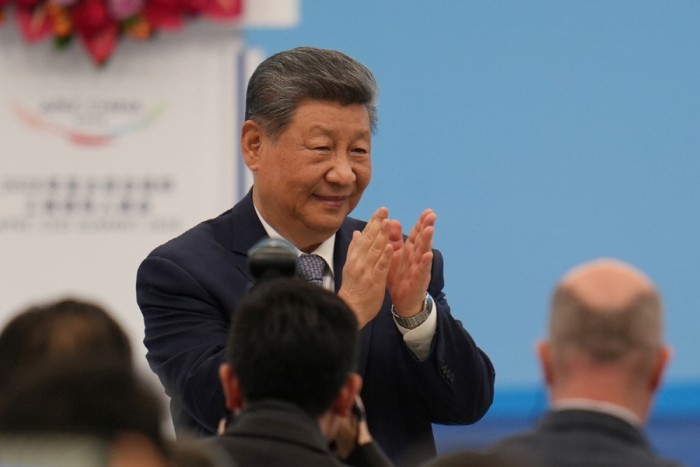 |
| Chinese President Xi Jinping applauds as he welcomes attendees at the 2026 APEC CEO Summit in Shenzhen, Guangdong Province, China, on Nov. 18. /EPA-Yonhap News Agency |
Chinese President Xi Jinping emphasized free trade and multilateralism a day ahead of his summit with U.S. President Donald Trump. His remarks are seen as targeting U.S. tariff policies. Amid ongoing U.S.-China trade tensions, China appears to be seeking to establish its leadership in global trade by championing openness and cooperation on the international stage.
"Openness brings progress, while isolation inevitably leads to backwardness," Xi said in his keynote address at the opening ceremony of the Asia-Pacific Economic Cooperation (APEC) CEO Summit at the Qianhai International Conference Center in Shenzhen, China, on Nov. 18.
"The international landscape is currently marked by intertwined changes and turmoil, global economic growth lacks momentum, and unilateralism and protectionism are rampant," he said, emphasizing the need to safeguard the multilateral trading system centered on the World Trade Organization (WTO).
Xi also expressed support for free and open trade and investment, proposing efforts to advance the Free Trade Area of the Asia-Pacific (FTAAP), stabilize global industrial and supply chains, and promote cooperation in cross-border e-commerce and trade digitalization.
His latest remarks are interpreted as a direct criticism of the Trump administration's tariff policies. China has taken a firm stance against high U.S. tariffs and export controls on advanced semiconductors. Beijing appears intent on expanding its diplomatic influence in the international community by positioning itself as a central player in the free trade system.
Xi also emphasized the role China should play on the international stage, advocating an equal and orderly multipolar world while safeguarding the postwar international order. He called for resolving global issues, including wars and trade disputes, through dialogue and negotiations. He also identified cooperation in artificial intelligence (AI), the digital economy and green industries as key drivers of growth.
Xi failed to narrow differences over tariffs during his summit with Trump in September. Although the two countries extended their tariff truce through January 2027, tensions persist in key areas, including advanced semiconductors and export controls.
China's Foreign Ministry described the upcoming U.S.-China-Russia summit as an important meeting for world peace and strategic stability, Reuters reported. Trump plans to put the war in Iran and the war in Ukraine on the negotiating agenda, while China is expected to emphasize regional peace and stability. Beijing appears intent on highlighting its image as a mediator capable of managing international crises.
Cheon Hyun-bin
Most Read
-
1
AMD's Lisa Su floated as potential Nvidia successo..

-
2
Iran resumes attacks after two months, targeting U..

-
3
Alice Huang, affair partner of Jensen Huang, repor..

-
4
Xi secures fourth term as China reshuffles next-ge..

-
5
Hegseth rejects calls for impeachment over Iran wa..

-
6
Democrats flip U.S. Congress in historic midterm s..

-
7
Nvidia executive Kimberly Powell at center of Jens..

PEOPLE







-
Address : In-Young Bldg., 34, Uisadang-daero 1-gil, Yeongdeungpo-gu, Seoul
Copyright by ASIATODAY CO., LTD. All rights resereved