



[Exclusive] Uber acquires 66.6% stake in Baemin parent
Nov 18, 2026, 03:26 pm


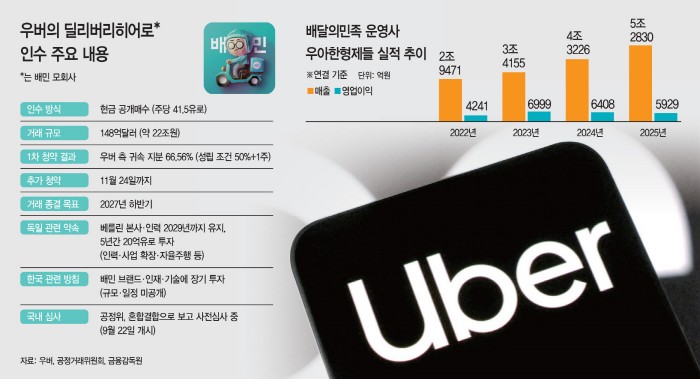 |
U.S. ride-hailing giant Uber has secured well over a majority of the shares and voting rights in its tender offer to acquire Germany's Delivery Hero (DH), the parent company of South Korean food delivery platform Baedal Minjok (Baemin). Following the initial acceptance period, the proportion of shares and voting rights attributable to Uber reached 66.56%, approaching two-thirds of the total. Having exceeded the minimum threshold required for the acquisition, Uber has established an equity base that would underpin its control after the transaction closes. With ownership shifting from DH, which has grown primarily through delivery services, to Uber, which operates both mobility and delivery services, Baemin's investment and business strategies are also expected to undergo changes.
AsiaToday found on Nov. 16 that the proportion of shares and voting rights attributable to Uber stood at 66.56%, according to the initial results of the DH tender offer announced by Uber's acquisition vehicle on Nov. 10. This exceeds the minimum acceptance threshold of 50% plus one share required for the tender offer to succeed. Uber is conducting an all-cash tender offer at 41.50 euros per share, with an additional acceptance period running through Nov. 24.
While 50% plus one share represents the threshold for the tender offer to succeed, 66.56% illustrates the extent of influence Uber could wield following the acquisition. If this percentage translates into its final shareholding, Uber's stake would be approximately twice the combined 33.44% held by all other shareholders. Rather than securing a narrow majority, Uber is laying the groundwork for leading major corporate decisions at DH. The transaction is targeted for completion in the second half of 2027, subject to approvals from competition authorities in relevant jurisdictions, among other conditions.
The key question is what business changes Uber will pursue on the basis of this ownership stake. DH indirectly controls Woowa Brothers, the operator of Baemin, through its subsidiary Woowa DH Asia. If Uber secures management control of DH, Baemin's investment and growth strategies will become intertwined with Uber's global business plans. Unlike DH, which has grown primarily through food delivery and quick commerce, Uber operates both ride-hailing and food delivery services and focuses on connecting customers across the two services.
According to Uber's acquisition plans, the number of markets in which it offers both mobility and delivery services will increase from 34 to 58 after the transaction closes. The core of the integration strategy is to link membership benefits to encourage ride-hailing customers to order food as well, while expanding advertising and promotional opportunities for merchants on the platforms. The impact of the acquisition could vary depending on whether Uber continues to operate Baemin solely as a South Korean delivery business or uses it as a platform for integrating its domestic mobility services.
"We respect the competitiveness and value that Baedal Minjok has built in the Korean market, and we will invest in Korea over the long term and grow together," an Uber official said. "Following the acquisition, we will invest in Baedal Minjok's exceptional talent, brand and locally tailored technological capabilities, providing all the support and resources needed to ensure that it continues to deliver world-class services to Korean users."
Potential scenarios in South Korea include incorporating Uber Taxi discounts into Baemin's paid membership program, Baemin Club, or running joint promotions between the two services. Baemin's customer base could help Uber expand its taxi business in South Korea, while Uber's mobility services could provide Baemin with a means of retaining customers.
"Just as Coupang has bundled shopping and delivery services, Uber could bundle delivery and taxi services and offer them to consumers at lower prices," said Lee Eun-hee, a professor in the Department of Consumer Science at Inha University. "For customers who use both taxi and delivery services, using Baemin could become more advantageous."
Investment in South Korean operations and the decision-making structure will also be key issues. When Uber announced the acquisition, it pledged to maintain DH's headquarters in Berlin and its local workforce structure until at least 2029 and invest 2 billion euros in Germany over the next five years.
However, how authority over investment, services and organizational operations will be divided between South Korean management and global headquarters after the acquisition has yet to be confirmed. "The tender offer is a procedure for implementing the acquisition agreement and is separate from the issue of whether Baemin will retain management independence," a Woowa Brothers official said. "At this point, we are not aware of how the company will be managed after the acquisition or whether there are plans to integrate services with Uber Taxi."
The Korea Fair Trade Commission's (KFTC) merger review is another variable. The KFTC launched a preliminary review of Uber's acquisition of DH in September. Viewing the transaction as a conglomerate merger between a ride-hailing platform and a delivery platform, the regulator is examining how service integration could affect competitors' business activities and the choices available to users and merchants on the platforms. "It is difficult to comment on the specifics of the case or the review process," a KFTC official said.
Jang Ji-young
Most Read
-
1
AMD's Lisa Su floated as potential Nvidia successo..

-
2
Iran resumes attacks after two months, targeting U..

-
3
Alice Huang, affair partner of Jensen Huang, repor..

-
4
Xi secures fourth term as China reshuffles next-ge..

-
5
Hegseth rejects calls for impeachment over Iran wa..

-
6
Democrats flip U.S. Congress in historic midterm s..

-
7
Nvidia executive Kimberly Powell at center of Jens..

PEOPLE






-
Address : In-Young Bldg., 34, Uisadang-daero 1-gil, Yeongdeungpo-gu, Seoul
Copyright by ASIATODAY CO., LTD. All rights resereved