



Singapore assumes ASEAN chairmanship
Nov 18, 2026, 01:29 pm


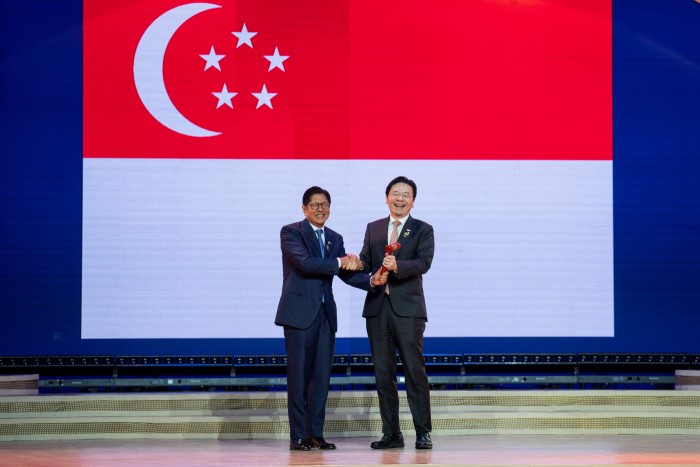 |
| Philippine President Ferdinand Marcos Jr. and Singaporean Prime Minister Lawrence Wong pose for a photo during the closing ceremony of the 49th ASEAN Summit and the handover of the ASEAN chairmanship to Singapore in Pasay, the Philippines, on Nov. 17 (local time). /Reuters-Yonhap News Agency |
Singapore has taken over the chairmanship of the Association of Southeast Asian Nations (ASEAN) from the Philippines for next year, which marks the bloc's 60th anniversary. While Singapore is expected to make substantive progress in areas of its strength, including digital economic integration, artificial intelligence (AI) governance and trade expansion, the prevailing view is that breakthroughs will be difficult to achieve on longstanding security and political issues, such as concluding a code of conduct (COC) in the South China Sea and resolving Myanmar's humanitarian crisis.
According to the South China Morning Post (SCMP) and other media outlets on Nov. 18 (local time), Philippine President Ferdinand Marcos Jr. handed the chairmanship gavel to Singaporean Prime Minister Lawrence Wong at the closing ceremony of the 49th ASEAN Summit in Manila the previous day. Singapore, assuming the chairmanship for the first time in nine years since 2018, will lead ASEAN for one year starting Jan. 1 next year. Wong said that although ASEAN could not control U.S.-China rivalry itself, it could strengthen cooperation among member states and expand its network of external partners, adding that "a more integrated ASEAN will be a more valuable partner to the world."
Digital integration and AI governance are widely seen as areas where Singapore is likely to deliver the most tangible results during its chairmanship. On Nov. 14, ASEAN member states signed the Digital Economy Framework Agreement (DEFA), ASEAN's first legally binding agreement encompassing regional digital trade rules on areas including e-commerce and data protection. The agreement laid the groundwork for expanding the region's digital economy to $2 trillion (approximately 2,670 trillion won) by 2030, compared with the $1 trillion projected without the agreement.
Joanne Lin, a senior fellow at the ASEAN Studies Centre of Singapore's ISEAS – Yusof Ishak Institute, said Singapore could accelerate DEFA implementation in areas such as cross-border digital payments, electronic transactions and regulatory interoperability. Hunter Marston, director of the Southeast Asia Program at Australia's Lowy Institute, also predicted that Singapore would make "the greatest progress" in regional AI governance and DEFA implementation, adding that it would seek to introduce regional AI policies to shield member states from the direct impact of U.S.-China technological rivalry.
Efforts to translate economic and technological cooperation with China into tangible results are also expected to gain momentum. The ASEAN-China Free Trade Area (ACFTA) 3.0 Upgrade Protocol, signed in October last year, is set to enter into force on Dec. 1. At the ASEAN-China Summit attended by Chinese Premier Li Qiang on Nov. 16, next year was also designated the "ASEAN-China Year of AI Cooperation." Lin said Singapore could translate these agreements into concrete outcomes, such as facilitating digital trade and strengthening AI capabilities.
However, the situation is different when it comes to energy infrastructure and diplomatic and security issues, which require substantial capital and complex coordination of interests. Marston said Singapore could also play a leading role in developing the ASEAN Power Grid and establishing strategic petroleum reserves, but noted that "both remain closer to rhetoric than reality." The ASEAN Power Grid, which has remained at the planning stage for decades, is expected to take several more years to produce tangible results, as massive infrastructure investment and regulatory coordination among member states are prerequisites.
Negotiations on the COC, aimed at preventing armed clashes among parties to territorial disputes in the South China Sea, pose an even more challenging task. ASEAN and China had set a goal of concluding negotiations by the end of this year but ultimately missed the deadline. Philippine Foreign Secretary Theresa Lazaro said on Nov. 15 that provisional agreement had been reached on approximately 80% of the paragraphs in the draft, adding that "we are handing over a document that is nearly 80% complete to Singapore, the next ASEAN chair." Experts say that despite Singapore's longstanding friendly relations with China, it remains uncertain whether it can persuade Beijing to finalize the COC or ease tensions between China and the Philippines.
A breakthrough in the Myanmar crisis, now in its fifth year, also remains elusive. According to Reuters, ASEAN leaders agreed on Nov. 15 to continue excluding Myanmar's high-ranking political figures from summits and foreign ministers' meetings until the military junta meaningfully implements the Five-Point Consensus agreed upon following the 2021 coup. Although they left open the possibility of gradually restoring Myanmar's representation if "sustained and concrete" progress is made, Marston said progress would be difficult unless Myanmar's military stopped bombing civilians and entered into negotiations with the People's Defence Force (PDF) and the Steering Committee for the Emergence of a Federal Democratic Union (SCEF), an anti-junta coalition, among others. He predicted that Singapore would maintain ASEAN's current stance, saying, "Progress is unlikely unless Myanmar's military is made to pay a meaningful price."
Ultimately, with member states pursuing divergent strategic alignments and national interests, Singapore faces clear structural constraints in expanding the scope of ASEAN's external cooperation amid major-power rivalry. Lin predicted that "Singapore's contribution will lie in building internal consensus and translating existing commitments into tangible results rather than resolving longstanding challenges within a single term as chair."
Jeong Ri-na
Most Read
-
1
AMD's Lisa Su floated as potential Nvidia successo..

-
2
Iran resumes attacks after two months, targeting U..

-
3
Alice Huang, affair partner of Jensen Huang, repor..

-
4
Xi secures fourth term as China reshuffles next-ge..

-
5
Hegseth rejects calls for impeachment over Iran wa..

-
6
Democrats flip U.S. Congress in historic midterm s..

-
7
Nvidia executive Kimberly Powell at center of Jens..

PEOPLE







-
Address : In-Young Bldg., 34, Uisadang-daero 1-gil, Yeongdeungpo-gu, Seoul
Copyright by ASIATODAY CO., LTD. All rights resereved