



Lee outlines vision for peaceful coexistence on Korean Peninsula at ASEAN summits
Nov 18, 2026, 10:44 am


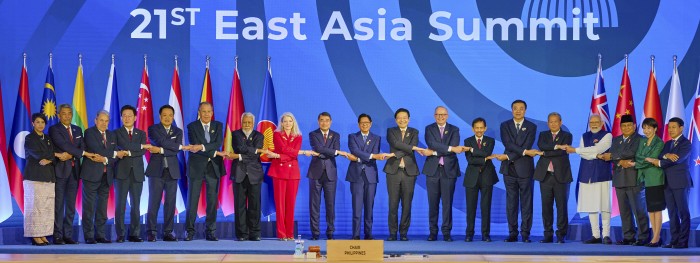 |
| South Korean President Lee Jae-myung (fourth from left) poses for a group photo with leaders and representatives of participating countries at the 21st East Asia Summit at the Philippine International Convention Center (PICC) in Manila, the Philippines, on Nov. 17 (local time). From left are Myanmar Ambassador to the Philippines Daw Aye Aye Thin, Malaysian Foreign Minister Mohamad Hasan, New Zealand Deputy Prime Minister and Foreign Minister Winston Peters, Lee, Thai Prime Minister Anutin Charnvirakul, Russian Foreign Minister Sergey Lavrov, Timor-Leste Prime Minister Xanana Gusmão, U.S. Under Secretary of State for Political Affairs Allison Hooker, Vietnamese Prime Minister Le Minh Hung, Philippine President Ferdinand Romualdez Marcos Jr., Singaporean Prime Minister Lawrence Wong, Australian Prime Minister Anthony Albanese, Brunei Sultan Hassanal Bolkiah, Chinese Minister of Agriculture and Rural Affairs Zhang Zhu, Cambodian Prime Minister Hun Manet, Indian Prime Minister Narendra Modi, Indonesian President Prabowo Subianto, Japanese Prime Minister Sanae Takaichi and Lao Prime Minister Saleumxay Kommasith. /Yonhap News Agency |
South Korean President Lee Jae-myung presented his vision for peaceful coexistence on the Korean Peninsula at the East Asia Summit (EAS) on Nov. 17 (local time), seeking support from major regional countries for the resumption of inter-Korean and U.S.-North Korea dialogue. The initiative aims to ease tensions and create conditions conducive to resuming dialogue through cooperation with neighboring countries amid the breakdown of inter-Korean communication.
According to Cheong Wa Dae, Lee attended the EAS in Manila, the Philippines, that afternoon for the first time since taking office and outlined his administration's policy direction for establishing peace on the Korean Peninsula. He emphasized the need for dialogue and de-escalation at a multilateral diplomatic forum involving countries with influence over affairs on the Korean Peninsula, including the United States, China, Japan and Russia.
The government's initiative begins with easing hostile relations between the two Koreas and restoring severed channels of dialogue. Lee presented his vision for peaceful coexistence in his Liberation Day address in August and subsequently called for international cooperation in his keynote address to the United Nations General Assembly in September. At the EAS, he focused on building a foundation of support among major countries surrounding the Korean Peninsula.
The vision for peaceful coexistence consists of three pillars: "inclusive peaceful coexistence," which respects each other's systems; "stable peaceful coexistence," which prevents accidental clashes and manages conflicts; and "responsible peaceful coexistence," which involves cooperation with the international community. The initiative seeks to break the vicious cycle in which mutual distrust and military tensions further deepen the breakdown in dialogue and lay the groundwork for transitioning from the armistice regime to a peace regime by restoring mutual trust.
The aim is to lower barriers to dialogue by respecting each other's systems, maintain conditions for improving relations by preventing clashes and managing conflicts, and support the establishment of peace through international cooperation. Underlying this initiative is the assessment that support and constructive contributions from neighboring countries are increasingly important when direct communication between the two Koreas has been cut off.
On the North Korean nuclear issue, Lee has proposed a phased approach. It begins with halting further advances in North Korea's nuclear and missile capabilities, followed by reductions and, in the long term, achieving a "nuclear-free Korean Peninsula." The aim is to create conditions for negotiations by seeking progress at each stage and gradually reducing threats through dialogue.
Lee has also emphasized South Korea's role in supporting the resumption of U.S.-North Korea dialogue. The challenge is to secure diplomatic space so that progress in inter-Korean relations and U.S.-North Korea negotiations can reinforce each other. His latest appeal for support is an extension of efforts to create an environment conducive to the resumption of dialogue.
In a briefing ahead of Lee's overseas trip, National Security Adviser Wi Sung-lac said the government would explain its efforts to resume inter-Korean and U.S.-North Korea dialogue and establish lasting peace on the Korean Peninsula, while calling for continued support and constructive contributions from regional countries. The aim is to strengthen cooperation not only with countries directly concerned but also with the Association of Southeast Asian Nations (ASEAN), among others.
South Korea reaffirmed its foundation of diplomatic support at the South Korea-ASEAN summit the previous day. According to Cheong Wa Dae, after Lee explained his policy of peaceful coexistence and requested cooperation, ASEAN leaders expressed their unwavering support for the South Korean government's policy on the Korean Peninsula.
Cheong Wa Dae said leaders attending the EAS that day also shared the understanding that peace and stability on the Korean Peninsula are important. Lee shared his three blueprints for peaceful coexistence on the Korean Peninsula and called for active interest and cooperation from major regional countries in resuming inter-Korean dialogue and establishing lasting peace.
"Even amid intensifying geopolitical competition, countries must acknowledge their differences, identify common agendas and continue pursuing substantive cooperation," Lee added.
The leaders also agreed to strengthen cooperation on major regional issues through dialogue. With major countries holding differing interests regarding peace on the Korean Peninsula gathered in one place, the meeting is seen as having reaffirmed the importance of continued dialogue and cooperation.
Park Young-hoon
Most Read
-
1
AMD's Lisa Su floated as potential Nvidia successo..

-
2
Iran resumes attacks after two months, targeting U..

-
3
Alice Huang, affair partner of Jensen Huang, repor..

-
4
Xi secures fourth term as China reshuffles next-ge..

-
5
Hegseth rejects calls for impeachment over Iran wa..

-
6
Democrats flip U.S. Congress in historic midterm s..

-
7
Nvidia executive Kimberly Powell at center of Jens..

PEOPLE






-
Address : In-Young Bldg., 34, Uisadang-daero 1-gil, Yeongdeungpo-gu, Seoul
Copyright by ASIATODAY CO., LTD. All rights resereved