



Takaichi invites Lee to visit Japan next year
Nov 18, 2026, 10:40 am


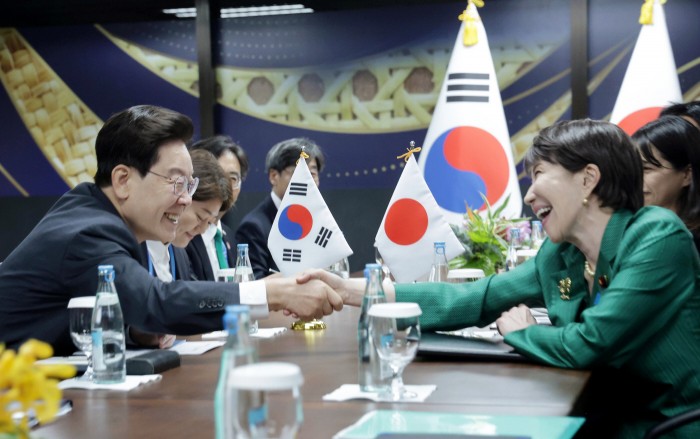 |
| South Korean President Lee Jae-myung shakes hands with Japanese Prime Minister Sanae Takaichi during their summit at the Philippine International Convention Center (PICC) in Manila, the Philippines, on Nov. 17 (local time). /Yonhap News Agency |
South Korean President Lee Jae-myung held a summit with Japanese Prime Minister Sanae Takaichi in Manila, the Philippines, on Nov. 17 (local time) and expressed his willingness to visit Japan next January. The move is seen as an effort to strengthen strategic communication by maintaining shuttle diplomacy between the two leaders amid growing uncertainty in international affairs ahead of the U.S.-China-Russia summit.
In his opening remarks at the meeting, Lee said, "I appreciate Prime Minister Takaichi's invitation to visit Japan next January and would be happy to accept it. I am also grateful for the special consideration given to the choice of venue."
The meeting marked the first summit between the two leaders in approximately six months since their talks in Andong in May. The leaders, who first met in Gyeongju in October last year, met again in Japan's Nara Prefecture in January and in Andong in May this year before sitting down together once more on the sidelines of the ASEAN-related summits. If Lee's visit to Japan materializes next January, shuttle diplomacy involving reciprocal visits between the two countries will continue.
The meeting took place two days ahead of the U.S.-China-Russia summit scheduled for Nov. 19 in Shenzhen, China. With concerns emerging that issues concerning the Korean Peninsula could be discussed among major powers without South Korea's participation, there is a growing need for South Korea and Japan to strengthen communication on regional affairs.
Regarding the U.S.-China-Russia summit, Cheong Wa Dae said, "Our position and interests must be fully reflected in matters directly affecting our national interests, including issues concerning the Korean Peninsula. We are maintaining close communication with the countries concerned." The remarks reflect concerns over discussions dominated by major powers while excluding a country directly concerned with Korean Peninsula issues.
Japan is also facing growing diplomatic pressure as Takaichi's remarks on Taiwan have strained China-Japan relations. South Korea, for its part, faces the challenge of maintaining stable relations with China while continuing cooperation with Japan. Maintaining this diplomatic balance is expected to remain a key challenge during Lee's visit to China following the South Korea-Japan summit.
South Korea and Japan have also maintained cooperation in economic security, including energy and supply chains. At their summit in Andong in May, the two countries agreed to expand mutual supplies of crude oil, petroleum products and liquefied natural gas (LNG) and jointly respond to supply chain disruptions. In September, they held a consultation meeting on the implementation of their supply chain partnership to discuss ways to diversify critical mineral supply chains and stabilize energy supply and demand.
Advanced industries, including artificial intelligence (AI) and biotechnology, are also areas of cooperation. The aim is to translate cooperation initiatives discussed at previous summits into concrete action by leveraging the two countries' technological competitiveness.
Meanwhile, Lee will travel to Shenzhen, China, after concluding his schedule of ASEAN-related summits that day. On Nov. 18, he is scheduled to attend the Asia-Pacific Economic Cooperation (APEC) CEO Summit and a welcome dinner hosted by Chinese President Xi Jinping.
Park Young-hoon
Most Read
-
1
AMD's Lisa Su floated as potential Nvidia successo..

-
2
Iran resumes attacks after two months, targeting U..

-
3
Alice Huang, affair partner of Jensen Huang, repor..

-
4
Xi secures fourth term as China reshuffles next-ge..

-
5
Hegseth rejects calls for impeachment over Iran wa..

-
6
Democrats flip U.S. Congress in historic midterm s..

-
7
Nvidia executive Kimberly Powell at center of Jens..

PEOPLE






-
Address : In-Young Bldg., 34, Uisadang-daero 1-gil, Yeongdeungpo-gu, Seoul
Copyright by ASIATODAY CO., LTD. All rights resereved