



[Market Power] Samsung Medison surpasses last year's profit in three quarters
Nov 18, 2026, 10:24 am


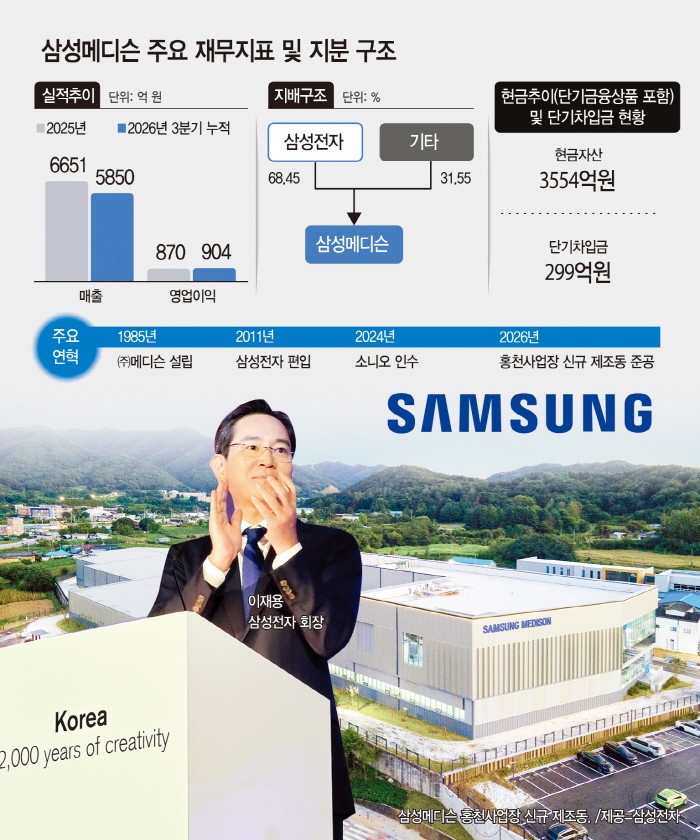 |
Samsung's medical device business, which late Samsung Chairman Lee Kun-hee identified as a new growth business, is gaining momentum under Executive Chairman Lee Jae-yong, with operating profit for the first three quarters of this year already surpassing last year's full-year figure. Samsung Medison, which spearheads Samsung's medical device business, is a medical device subsidiary in which Samsung Electronics holds a 68.45% stake. Since its acquisition by Samsung, the company has strengthened the foundation of its medical device business and is now rapidly improving its profitability.
In 2010, Lee Kun-hee identified medical devices, biotechnology and automotive batteries, among others, as new growth businesses. Under Lee Jae-yong's leadership, Samsung is strengthening its presence in the medical device industry by increasing investment, including acquiring overseas startups to secure artificial intelligence (AI) technology and expanding production facilities.
According to the Financial Supervisory Service on Nov. 17, Samsung Medison posted cumulative consolidated operating profit of 90.4 billion won for the first three quarters of this year, exceeding last year's full-year operating profit by 3.9%.
Sales have been particularly strong in the United States. According to the company's report, sales to Samsung's U.S. subsidiary, Samsung HME America, reached 25.1 billion won during the period, up 250.3% year-on-year. "This reflects increased sales in the U.S. market," a Samsung Medison official said. "We are expanding customer touchpoints and strengthening sales through our local sales network."
Production facilities are also operating at full capacity. The average capacity utilization rate at the company's Hongcheon plant stood at 115% through the third quarter, well above 100%. In response, Samsung Medison recently undertook its largest capacity expansion since its acquisition by Samsung, completing a new manufacturing building for diagnostic ultrasound systems at the Hongcheon plant. The company invested 50 billion won in the facility.
The company appears to have relatively ample cash assets to support large-scale investments. Its combined cash and cash equivalents and short-term financial instruments stood at 355.4 billion won on a consolidated basis at the end of the third quarter, far exceeding its short-term borrowings of 29.9 billion won.
One area of concern, however, is Sonio, a French AI startup acquired by Samsung Medison in 2024. Samsung Medison had extended approximately 35.2 billion won in loans to Sonio as of the end of the third quarter, more than triple the amount at the end of last year.
Sonio recorded cumulative revenue of approximately 2.2 billion won for the first three quarters of this year but posted a net loss of 21.6 billion won. As Sonio is a wholly owned subsidiary of Samsung Medison, its financial performance is believed to be weighing on its parent company. Indeed, Samsung Medison's cumulative operating profit on a separate basis exceeded 100 billion won, reaching 110.9 billion won through the third quarter, while consolidated operating profit remained in the 90 billion won range. This appears to partly reflect Sonio's losses, among other factors.
"Loans to Sonio have increased for investment purposes, allowing us to expand research and development through its highly skilled AI development personnel and strengthen technological competitiveness across our ultrasound business," a Samsung Medison official said. "Sonio is currently expanding sales to clients including Unified Women's Healthcare, a U.S. medical network specializing in women's health, and HCA Healthcare, a major hospital operator." The official added, "We plan to further strengthen sales activities and secure new clients, particularly university hospitals."
Ahn So-yeon
Most Read
-
1
AMD's Lisa Su floated as potential Nvidia successo..

-
2
Iran resumes attacks after two months, targeting U..

-
3
Alice Huang, affair partner of Jensen Huang, repor..

-
4
Xi secures fourth term as China reshuffles next-ge..

-
5
Hegseth rejects calls for impeachment over Iran wa..

-
6
Democrats flip U.S. Congress in historic midterm s..

-
7
Nvidia executive Kimberly Powell at center of Jens..

PEOPLE







-
Address : In-Young Bldg., 34, Uisadang-daero 1-gil, Yeongdeungpo-gu, Seoul
Copyright by ASIATODAY CO., LTD. All rights resereved