



Shenzhen buzzes with festive mood ahead of APEC summit
Nov 17, 2026, 03:03 pm


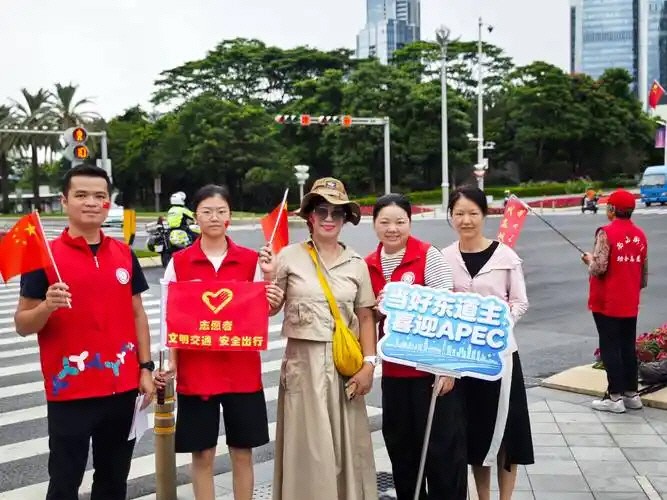 |
| Residents of Shenzhen, Guangdong Province, celebrate the APEC summit, which kicks off its two-day schedule on Nov. 18. The scene captures the growing excitement surrounding the event. /People's Daily |
The Asia-Pacific Economic Cooperation (APEC) summit in Shenzhen, Guangdong Province, China, will finally kick off its two-day schedule on Nov. 18. During this period, a trilateral summit among the United States, China and Russia and a separate U.S.-China summit will also take place, both of which have attracted intense attention and threatened to overshadow the main event. Although there is a sense that the main event and its sidelines have completely switched roles, this will inevitably draw even more global attention to the APEC summit. It is only natural that some are already jumping to the conclusion that the summit will become an event forever etched in world history.
Well aware of this, the Chinese government and media have virtually completed preparations for the historic event, with greater enthusiasm than when China hosted the summits in Shanghai in 2001 and Beijing in 2014. It is no coincidence that a festive atmosphere began building several days ago not only in the host city of Shenzhen but also across Guangdong Province and in the capital, Beijing. The same can be said of a report by Hong Kong's South China Morning Post (SCMP) on Nov. 17, which assessed that "China has now emerged as a key player in the global order."
That is not all. The excitement expressed in recent reports by media outlets including People's Daily, which said, "The APEC summit is being held in the year that marks the beginning of the 15th Five-Year Plan (2026-2030). This shows that this year belongs to China," should be viewed in the same context. The atmosphere on the ground in Shenzhen strongly suggests that this assessment has hit the mark.
A prime example is the steady stream of visitors eager to experience the summit atmosphere firsthand at its main venue, the Shenzhen International Exchange Center, which already seems destined to become a historic landmark. In particular, a street installation near the center bearing the words "APEC CHINA 2026" has emerged as a popular photo spot. At one point, so many people gathered to take pictures with the installation in the background that crowd control measures had to be imposed.
Commenting on the situation, Shenzhen journalist Xu Zhihua said, "It would be no exaggeration to say that Shenzhen residents have the strongest sense of civic responsibility in China. Yet crowds have gathered around the venue and other locations, occasionally descending into chaos. Perhaps this is because people are fully aware of the significance of this event." He described the atmosphere as extraordinary.
However, the characteristically tight security measures maintained by China can be seen as a blemish on the event. Above all, police officers have been deployed in such large numbers around the International Exchange Center that one could almost say half the people there are visitors and the other half are security personnel. Barricades have even been erected at entrances, and access is restricted to authorized personnel carrying passes. Restrictions on drone flights have also reportedly been significantly tightened since Nov. 11. As a result, organizations and individuals without approval are prohibited from flying drones in the city through Nov. 21. This can be seen as a prime example of rigid measures that throw cold water on the festive atmosphere.
The summit also presents challenges for China, as evidenced by how the extramarital affair between Nvidia CEO Jensen Huang (Huang Renxun) and Alice Huang (Huang Le) has escalated into an espionage case involving Chinese intelligence services. The possibility that the affair could constrain the words and actions of Xi Jinping, general secretary of the Communist Party of China and China's president, cannot be ruled out. In this respect, a report by The Wall Street Journal (WSJ) on Nov. 16 (local time) hit the mark when it said that "Xi Jinping's message emphasizing improved relations with the United States and China's diplomatic standing could lose its luster. A cloud has also been cast over the diplomatic choreography surrounding the U.S.-China-Russia summit."
Nevertheless, given that the possibility of another U.S.-North Korea summit between President Donald Trump and North Korean leader Kim Jong-un is once again being quietly raised, some of the negative perceptions and expectations surrounding the summit may well be tempered. The excitement is also likely to persist until the closing stages of the summit.
Hong Soon-do
Most Read
-
1
AMD's Lisa Su floated as potential Nvidia successo..

-
2
Iran resumes attacks after two months, targeting U..

-
3
Alice Huang, affair partner of Jensen Huang, repor..

-
4
Hegseth rejects calls for impeachment over Iran wa..

-
5
Xi secures fourth term as China reshuffles next-ge..

-
6
Democrats flip U.S. Congress in historic midterm s..

-
7
Nvidia executive Kimberly Powell at center of Jens..

PEOPLE







-
Address : In-Young Bldg., 34, Uisadang-daero 1-gil, Yeongdeungpo-gu, Seoul
Copyright by ASIATODAY CO., LTD. All rights resereved