



Thailand-Cambodia border tensions resurface ahead of Trump's Manila visit
Nov 17, 2026, 01:17 pm


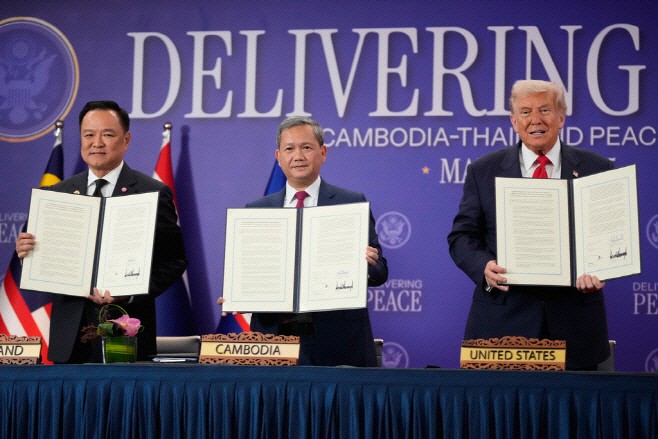 |
| U.S. President Donald Trump (right), Cambodian Prime Minister Hun Manet (center) and Thai Prime Minister Anutin Charnvirakul (left) pose for a photo after the signing of an agreement on the border dispute during the ASEAN Summit in Kuala Lumpur, Malaysia, on Oct. 26 last year. /AP-Yonhap News Agency |
Thailand and Cambodia have launched a diplomatic battle outside the negotiating table over their border dispute. Tensions have resurfaced as the two countries, which signed a joint peace declaration last year in the presence of U.S. President Donald Trump, each seek to portray themselves as the party honoring the agreement. Trump will attend the summit of the Association of Southeast Asian Nations (ASEAN) in Manila, the Philippines, on Nov. 17.
According to Reuters and the South China Morning Post (SCMP) on Nov. 17 (local time), Trump is scheduled to arrive in Manila that day and attend the ASEAN-U.S. Summit, among other meetings. At last year's ASEAN Summit, Trump brokered a ceasefire agreement between Thailand and Cambodia by linking it to tariff reductions. The White House has promoted the agreement as one of his signature achievements in peace mediation.
Ahead of Trump's visit to Manila, Cambodian Prime Minister Hun Manet expressed gratitude to French President Emmanuel Macron in the Cambodian capital of Phnom Penh on Nov. 15 for supporting a peaceful resolution to the border dispute. At the Francophonie Summit, a gathering of French-speaking countries held in Phnom Penh, Hun Manet also maintained that Cambodia had not initiated the armed clashes, saying, "Cambodia reaffirmed its firm commitment to pursuing a peaceful resolution based on international law and existing agreements." He praised the efforts of France and Macron, among other remarks.
Thai Prime Minister Anutin Charnvirakul immediately responded on social media the same day. Anutin said, "Thailand has always respected all agreements reached with Cambodia and will continue to abide by international law," while maintaining that Thailand's actions were intended to protect its sovereignty, territorial integrity and the safety of its people. In particular, he made clear that "Thailand will not raise bilateral disputes, including territorial and humanitarian issues, with countries that are not parties to those disputes." His remarks reflected the Thai government's claim that Cambodia's territorial encroachment triggered the clashes and were aimed at Cambodia's diplomatic efforts to garner international support.
The two countries have long been at odds over their land border, which was drawn during Cambodia's French colonial period. After armed clashes killed dozens of people on both sides last year, the two countries signed a peace agreement in Kuala Lumpur, Malaysia, on Oct. 26 of the same year in Trump's presence. However, fighting resumed in December, just two months after the agreement was signed. The two sides agreed to a new ceasefire late that month and have since remained in an uneasy standoff.
The conflict has extended beyond land to a maritime boundary dispute involving vast energy reserves. In June, Cambodia referred the dispute over overlapping maritime claims in the Gulf of Thailand to compulsory conciliation proceedings under the United Nations Convention on the Law of the Sea (UNCLOS). The area, covering approximately 26,000 square kilometers, is estimated to contain 340 billion cubic meters of natural gas and up to 700 million barrels of crude oil. Cambodia maintains that it had no choice but to resort to the UN procedure after Thailand unilaterally terminated in May a 2001 memorandum of understanding (MOU) that had left open the possibility of joint development. Anutin said at the time that the termination of the MOU "has nothing to do with the border dispute and is part of my policy." He had pledged to terminate the MOU while campaigning for the February general election.
For now, the maritime dispute is being addressed through international proceedings. Under compulsory conciliation, once one party initiates the proceedings, the other is also required to participate, but the outcome is limited to non-binding recommendations. The conciliation commission held its first meeting in Singapore in September. Thai Foreign Minister Sihasak Phuangketkeow said at the time that Thailand was "engaging in the conciliation process in good faith," while maintaining that the scope of the proceedings was limited to maritime boundary delimitation. Cambodia, by contrast, maintains that boundary delimitation and joint resource development should be discussed together.
The ASEAN Summit, which opened on Nov. 15, has been addressing issues including Myanmar's civil war and haze from Indonesian forest fires that has spread as far as Singapore and Malaysia. SCMP predicted that the tensions between the two countries could become an unsightly sideshow at the summit with Trump's arrival. After completing his engagements in Manila, Trump will attend the Asia-Pacific Economic Cooperation (APEC) summit in Shenzhen, China.
Jeong Ri-na
Most Read
-
1
AMD's Lisa Su floated as potential Nvidia successo..

-
2
Iran resumes attacks after two months, targeting U..

-
3
Alice Huang, affair partner of Jensen Huang, repor..

-
4
Xi secures fourth term as China reshuffles next-ge..

-
5
Hegseth rejects calls for impeachment over Iran wa..

-
6
Democrats flip U.S. Congress in historic midterm s..

-
7
Nvidia executive Kimberly Powell at center of Jens..

PEOPLE







-
Address : In-Young Bldg., 34, Uisadang-daero 1-gil, Yeongdeungpo-gu, Seoul
Copyright by ASIATODAY CO., LTD. All rights resereved