



S. Korea's exports to reach $1 trillion, but gaps across industries remain
Nov 17, 2026, 10:25 am


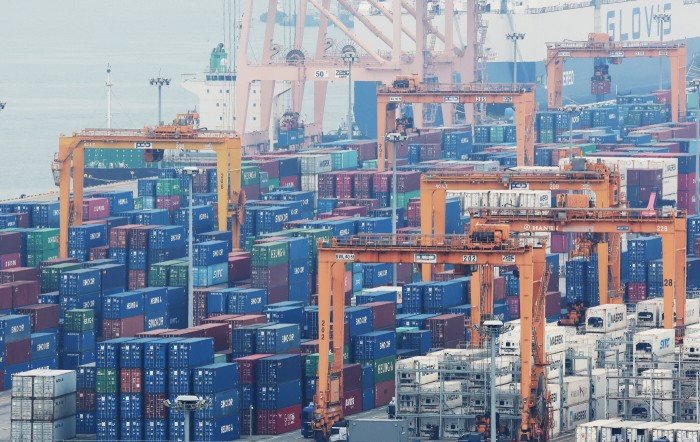 |
| Shipping containers are stacked at Pyeongtaek Port in Gyeonggi Province. /Yonhap News Agency |
South Korea is on the verge of reaching $1 trillion in annual exports. Buoyed by strong exports led by semiconductors, the country is expected to hit the $1 trillion milestone as early as this week, becoming the fourth country in the world to do so after the United States, Germany and China. It would mark a historic achievement 62 years after South Korea's exports first surpassed $100 million in 1964.
However, behind the record-breaking export figures lies the challenge of uneven performance across industries. While semiconductors are surging ahead and driving overall export growth, traditional key industries such as automobiles, steel and shipbuilding are posting mixed results depending on industry conditions and external factors. Critics argue that rather than resting on the growth in export value, South Korea needs to reduce its heavy reliance on semiconductors, diversify its growth engines and broaden the base of its export competitiveness.
According to the Ministry of Trade, Industry and Resources and the Korea Customs Service on Nov. 17, cumulative exports from Jan. 1 to Nov. 10 this year reached $963.7 billion, up 62.0% from the same period last year. That leaves $36.3 billion to reach the country's first-ever annual export milestone of $1 trillion. Given the recent pace of export growth, some expect the target to be reached around Nov. 19 or 20.
Exports have continued to grow rapidly in November. According to the Korea Customs Service, exports totaled $33.5 billion from Nov. 1 to 10, up 111.9% from a year earlier. Imports during the same period rose 45.0% to $24.7 billion, resulting in a trade surplus of $8.8 billion. Average daily exports, adjusted for the number of working days, reached $4.46 billion, up 97.7% from the same period last year.
Semiconductors are at the center of the export boom. According to October trade data released by the Ministry of Trade, Industry and Resources, semiconductor exports surged 259.4% from a year earlier to $56.44 billion. The increase was driven by rising demand and prices for memory chips as global Big Tech companies continued capital spending to secure leadership in the artificial intelligence (AI) industry. Semiconductor exports exceeded $50 billion for the second consecutive month.
Semiconductor exports remained strong in early November. From Nov. 1 to 10, semiconductor exports reached approximately $16.6 billion, up 331.2% from the same period last year. They accounted for about 49.7% of total exports during the period. In other words, semiconductors were responsible for roughly half of the country's exports in early November.
Exports of other products also generally increased. In October, automobile exports rose 18% from a year earlier to $6.5 billion, while steel exports climbed 38% to $1.7 billion and general machinery exports increased 24% to $4.1 billion. Secondary battery exports also grew 38%. Exports increased in 18 of the 20 major export categories, showing that the export recovery was not confined to semiconductors.
However, differences between industries were also pronounced. Ship exports fell 44% from a year earlier to $2.6 billion in October. Although monthly ship export figures fluctuate considerably depending on shipbuilding and delivery schedules, the decline shows that not all industries are growing at the same pace even as overall exports surge. Passenger car exports from Nov. 1 to 10 also fell 4.3% from a year earlier.
The heavy dependence of export growth on semiconductors also poses a potential challenge. While overall exports grew 93.7% in October, the growth rate drops to 34% when semiconductors are excluded. This means that a slowdown in the semiconductor industry or an adjustment in the pace of global AI investment could affect overall export growth.
U.S. tariff policies, protectionism in major economies and the restructuring of global supply chains are also variables. For industries such as automobiles and steel in particular, it is necessary to examine not only export volumes but also changes in profitability resulting from tariff burdens and increased local production. As overseas production expands, companies' global sales may rise while diverging from export figures based on domestic customs clearance.
The government also believes that expanding export volumes must be accompanied by efforts to strengthen the competitiveness of small and medium-sized enterprises (SMEs) and mid-sized companies. Minister of Trade, Industry and Resources Kim Jung-kwan said during the release of October trade data earlier this month that South Korea was virtually certain to achieve $1 trillion in annual exports in November. At the same time, he emphasized the need to support SMEs and mid-sized companies struggling with uncertainty in the trade environment.
Reaching $1 trillion in exports is expected to become a symbolic milestone demonstrating the competitiveness of South Korea's manufacturing industry. However, whether the record export growth is translating into balanced growth across industries and improvements in corporate profitability needs to be assessed separately.
"Achieving $1 trillion in exports is an enormous accomplishment," said Kim Jung-ho, a specially appointed professor at Yonsei University. "However, we must bear in mind that this is the result of entirely unexpected circumstances — the AI trend and U.S.-China tensions — and that it carries the vulnerability of insufficient growth in other industries."
Ultimately, maintaining semiconductor-led growth while strengthening the competitiveness of key industries such as automobiles, shipbuilding and steel, and expanding the base of exporting companies, is likely to become the new challenge for South Korea in the $1 trillion export era.
Han Dae-ui
Most Read
-
1
AMD's Lisa Su floated as potential Nvidia successo..

-
2
Iran resumes attacks after two months, targeting U..

-
3
Alice Huang, affair partner of Jensen Huang, repor..

-
4
Xi secures fourth term as China reshuffles next-ge..

-
5
Hegseth rejects calls for impeachment over Iran wa..

-
6
Democrats flip U.S. Congress in historic midterm s..

-
7
Nvidia executive Kimberly Powell at center of Jens..

PEOPLE







-
Address : In-Young Bldg., 34, Uisadang-daero 1-gil, Yeongdeungpo-gu, Seoul
Copyright by ASIATODAY CO., LTD. All rights resereved