



S. Korean banks' financed emissions exceed reduction target by 9.3%
Nov 17, 2026, 10:21 am


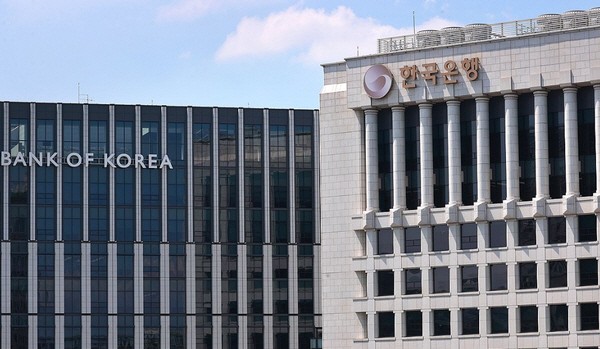 |
| The Bank of Korea. |
According to data submitted by the Bank of Korea to Rep. Han Chang-min of the Social Democratic Party of Korea, the financed emissions of 20 domestic banks were estimated at 149.1 million metric tons last year. This was 12.7 million metric tons, or 9.3%, higher than the target of 136.4 million metric tons, calculated based on the carbon reduction targets disclosed by the banks. Although financed emissions themselves have been declining, the amount of annual reductions has also been shrinking, prompting criticism that banks' carbon reduction efforts are falling short of their targets.
Financed emissions refer to the portion of greenhouse gas emissions generated by companies and other entities financed through loans, investments and other activities that is attributable to a financial institution's financing. Because these emissions vary depending on which companies and industries banks provide funding to, they serve as a key indicator for assessing the financial sector's progress toward carbon neutrality. The latest estimate covered corporate loans, bonds and equities held by 20 domestic banks, including nine commercial banks, five specialized banks and six regional banks.
Financed emissions at domestic banks have steadily declined from 172.4 million metric tons in 2021 to 168 million metric tons in 2022, 159 million metric tons in 2023, 152 million metric tons in 2024 and 149.1 million metric tons last year. However, the amount of year-on-year reductions fell from 9 million metric tons in 2023 to 7 million metric tons in 2024 and 2.9 million metric tons last year. While emissions have continued to decline, the pace of reductions has slowed noticeably in recent years.
The Bank of Korea calculated the target level of financed emissions by taking the arithmetic mean of the reduction targets set by financial holding companies that had disclosed interim reduction targets, then assuming a pathway under which emissions would decline by a constant amount each year. Based on this approach, the target for last year was 136.4 million metric tons. Actual financed emissions at domestic banks were 12.7 million metric tons higher, suggesting that the banks were falling short of the reduction pathway needed to achieve their self-imposed targets.
International standards are also being developed to support the measurement and disclosure of financed emissions and the implementation of reduction targets. In its Guidance for Climate Target Setting for Banks, published last October, the United Nations Environment Programme Finance Initiative (UNEP FI) recommended that banks publicly disclose medium- and long-term reduction targets and annually measure and report emissions associated with their lending, investment and other activities. IFRS S2, the climate-related disclosure standard issued by the International Sustainability Standards Board (ISSB), also requires financial institutions, including banks, to disclose information related to their financed emissions.
"Although financed emissions at domestic banks are declining, their efforts remain woefully inadequate to achieve the carbon reduction targets they have set for themselves," Han said. "Banks must develop detailed, year-by-year and sector-by-sector plans to implement emissions reductions and expand financial support that helps companies achieve actual carbon reductions and transition to low-carbon operations."
He added, "Financial authorities must also improve the framework for calculating and disclosing financed emissions and review banks' progress against their targets."
Lee Jae-hee
Most Read
-
1
AMD's Lisa Su floated as potential Nvidia successo..

-
2
Iran resumes attacks after two months, targeting U..

-
3
Alice Huang, affair partner of Jensen Huang, repor..

-
4
Xi secures fourth term as China reshuffles next-ge..

-
5
Hegseth rejects calls for impeachment over Iran wa..

-
6
Democrats flip U.S. Congress in historic midterm s..

-
7
Nvidia executive Kimberly Powell at center of Jens..

PEOPLE







-
Address : In-Young Bldg., 34, Uisadang-daero 1-gil, Yeongdeungpo-gu, Seoul
Copyright by ASIATODAY CO., LTD. All rights resereved