



[Market Power] INVENI Vice Chairman Koo Bon-hyuk faces sole leadership test amid profitability concerns
Nov 17, 2026, 09:54 am


 |
 |
INVENI Vice Chairman Koo Bon-Hyuk, a third-generation member of LS Group's founding family, faces a new test as sole CEO after leading the company's transformation into an investment-focused holding company.
While the shift away from a stable cash-generating structure built around the city gas business toward financial investments as a future growth driver has demonstrated the potential for expansion, recent deterioration in investment gains and losses has raised questions about his ability to manage profitability.
According to industry sources on Nov. 16, Koo has been serving as INVENI's sole CEO since fellow CEO Choi Se-young resigned on Nov. 5.
The eldest son of the late Koo Ja-myung, former chairman of LS MnM, and a nephew of LS Group Chairman Ja-Eun Koo through a fifth-degree family relationship under Korean kinship conventions, Koo has built experience in business strategy and new ventures within LS Group.
He joined LS Cable & System in 2003 and subsequently served on the group's business strategy team and as head of the business division at LS-Nikko Copper.
His management responsibilities expanded significantly in 2020 when he became head of the Future Business Division at YESCO HOLDINGS. At the time, he was tasked with developing investment operations into a new growth engine as the company sought to move beyond its city gas-centered business structure.
After becoming CEO the following year, he accelerated the transformation by formally designating investment operations as the company's principal business in 2022.
In 2024, he became the first third-generation member of LS Group's founding family to be promoted to vice chairman. Last year, the company changed its name to INVENI, further establishing its identity as a specialized investment company.
The business restructuring led by Koo has, at least in terms of scale, delivered results.
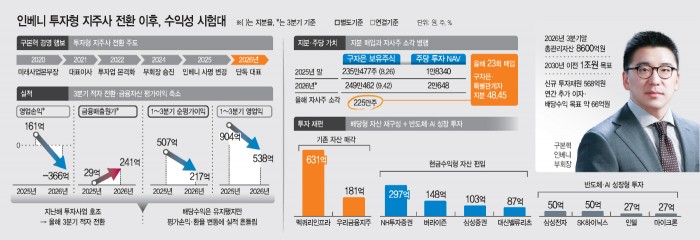
INVENI diversified its income sources by investing cash generated from its city gas business in financial assets. Consolidated operating profit reached 111.7 billion won last year, more than quadrupling from 24.3 billion won a year earlier. Of that amount, 107.4 billion won came from the investment and holding company division.
The strategy of turning cash generated by existing operations into investment income contributed to the improvement in earnings.
However, as investment operations have grown in importance, earnings stability has emerged as a new challenge.
INVENI recorded a consolidated operating loss of 36.6 billion won in the third quarter of this year, swinging into the red from an operating profit of 16.1 billion won in the same period last year.
Cumulative operating profit for the first three quarters also declined 40.5 percent year-on-year to 53.8 billion won.
Deteriorating gains and losses related to financial assets weighed on the company's performance.
On a separate financial statement basis, the cost of financial revenue rose more than eightfold in the third quarter, from 2.9 billion won to 24.1 billion won.
Cumulative net valuation gains on financial assets for the first three quarters fell from 50.7 billion won to 21.7 billion won on a separate basis, while foreign currency translation losses widened from 3.8 billion won to 20 billion won.
Dividend income remained relatively stable, rising slightly from 35 billion won to 35.3 billion won. However, this was insufficient to offset losses arising from asset valuation changes and exchange rate fluctuations.
Bridging the gap between asset values and actual earnings is another challenge Koo must address.
Investment net asset value (NAV) per share rose 12.6 percent, from 18,340 won at the end of last year to 20,648 won at the end of September this year.
However, the impact of the reduction in outstanding shares following the cancellation of 2.25 million treasury shares this year must also be taken into account.
Since rising asset values do not necessarily translate directly into operating performance, the ability to convert increases in the value of investment holdings into actual cash income has become increasingly important.
Koo is seeking a breakthrough by reshaping INVENI's investment portfolio.
In the first half of this year, the company sold 81.2 billion won worth of shares in Macquarie Korea Infrastructure Fund and Woori Financial Group and invested in NH Investment & Securities, Samsung Securities and Verizon, among other companies.
It also expanded its investments into semiconductor and artificial intelligence (AI)-related companies, including Samsung Electronics, SK hynix and Nvidia.
The strategy is aimed at securing stable interest and dividend income while generating additional growth-related returns from assets associated with advanced industries.
INVENI is also working to secure investment funds and expand its asset base.
Last year, the company set a target of generating annual interest and dividend income of around 10 percent and approximately 6.6 billion won in additional annual earnings by deploying some 56.8 billion won raised through treasury share disposals and the issuance of exchangeable bonds.
Assets under management (AUM) stood at approximately 860 billion won at the end of the third quarter this year, and the company is seeking to reach 1 trillion won before 2030.
The key will be not merely to increase the scale of investments but also to improve asset quality and investment returns.
As Koo's management responsibilities grow, members of LS Group's founding family have continued to increase their stakes in INVENI.
Chairman Ja-Eun Koo purchased INVENI shares on 23 occasions this year.
His holdings rose from 2,354,775 shares at the end of last year to 2,490,462 shares at present, while his ownership stake increased from 8.26 percent to 9.48 percent.
The combined ownership stake of the chairman and his specially related parties stands at 48.45 percent.
The reduction in outstanding shares resulting from treasury share cancellations also contributed to the increase in ownership percentages.
The founding family has also received substantial cash income through dividends.
INVENI's total cash dividend payments fell from 37.3 billion won in 2023 to 17.1 billion won in 2024 before rising to 24 billion won last year.
Its dividend payout ratio declined over the same period, from 109.6 percent to 58.9 percent and then to 27.6 percent.
Based on last year's year-end dividend and their disclosed shareholdings, Chairman Koo and his relatives are estimated to have received approximately 13.4 billion won in dividends.
That represents about 56 percent of the total dividend payments.
INVENI has also announced plans to maintain a minimum regular dividend of 600 won per share through the dividend attributable to fiscal 2028.
Lee Seo-yeon
#Inveni #Profitability #Leadership #Investment portfolio
Copyright by Asiatoday
Most Read
-
1
AMD's Lisa Su floated as potential Nvidia successo..

-
2
Iran resumes attacks after two months, targeting U..

-
3
Alice Huang, affair partner of Jensen Huang, repor..

-
4
Hegseth rejects calls for impeachment over Iran wa..

-
5
Xi secures fourth term as China reshuffles next-ge..

-
6
Democrats flip U.S. Congress in historic midterm s..

-
7
Nvidia executive Kimberly Powell at center of Jens..

PEOPLE







-
Address : In-Young Bldg., 34, Uisadang-daero 1-gil, Yeongdeungpo-gu, Seoul
Copyright by ASIATODAY CO., LTD. All rights resereved