



Trump bought Nvidia stock just before lifting chip export curbs, Guardian reports
Nov 16, 2026, 10:06 am


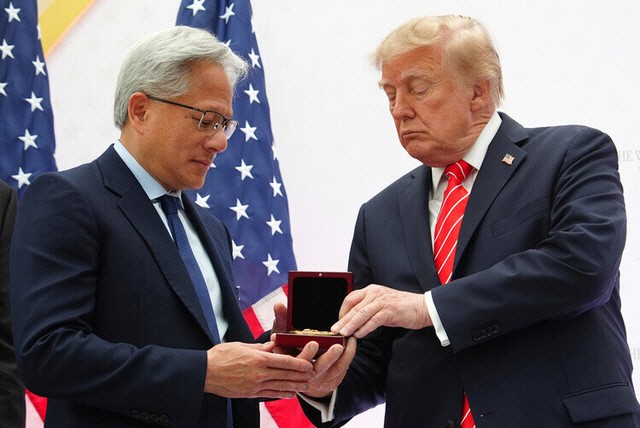 |
| U.S. President Donald Trump (right) presents the National Medal of Science to Jensen Huang, former CEO of Nvidia. /AP-Yonhap News Agency |
U.S. President Donald Trump reportedly purchased up to $5 million worth of Nvidia shares shortly before lifting export restrictions on advanced semiconductors. The revelation has sparked concerns about potential conflicts of interest, as the president had invested assets in a company that stood to benefit from policies he himself was responsible for deciding.
British newspaper The Guardian reported on Nov. 13 (local time) that the transactions had been identified through an analysis of Trump's financial disclosures by anti-corruption group DeKleptocracy.
In May last year, Trump purchased between $1 million and $5 million worth of Nvidia shares just days before announcing the repeal of semiconductor export control regulations. He also bought shares in Apple, Meta and Microsoft.
The regulations targeted for repeal were the "AI Diffusion Framework," introduced by former President Joe Biden's administration in January last year. The framework divided countries worldwide into three tiers and imposed different restrictions on exports of advanced artificial intelligence (AI) chips depending on their classification.
The Trump administration pursued the repeal, arguing that the regulations hampered innovation by U.S. companies and imposed excessive burdens on them.
According to The Guardian, Nvidia's stock price rose following the announcement that the regulations would be withdrawn.
Trump continued purchasing shares afterward. Even after announcing in December last year that Nvidia would be allowed to sell its H200 chips to China, he made at least three additional purchases of Nvidia stock.
The White House maintains that the president is not involved in investment decisions.
When Reuters reported on Trump's Nvidia stock transactions last month, the White House explained that third-party financial institutions independently managed the president's assets. It argued that there was no conflict of interest because all investment decisions were made by independent managers.
Meanwhile, the report comes amid allegations linking former Nvidia Chief Executive Officer (CEO) Jensen Huang to Chinese espionage.
Huang resigned on Nov. 12 after his relationship with a businesswoman suspected of being a Chinese spy, among other matters, came to light. Nvidia is conducting an independent investigation into the allegations.
Jang Ji-young
Most Read
-
1
China President Xi's Keynote Speech at the APEC C..

-
2
Iran resumes attacks after two months, targeting U..

-
3
Russian warship sinks in suspected drone attack at..

-
4
Inside Kylin Villa, the symbol of China's reform h..

-
5
Trump, Xi, Putin call for security cooperation at..

-
6
Trump, Putin, Zelenskyy may hold peace talks at G2..

-
7
Trump, Xi pledge cooperation on Hormuz, Iran nucle..

PEOPLE







-
Address : In-Young Bldg., 34, Uisadang-daero 1-gil, Yeongdeungpo-gu, Seoul
Copyright by ASIATODAY CO., LTD. All rights resereved