



Fallout from longest U.S. airspace 'shutdown' in 25 years lingers
Nov 16, 2026, 09:52 am


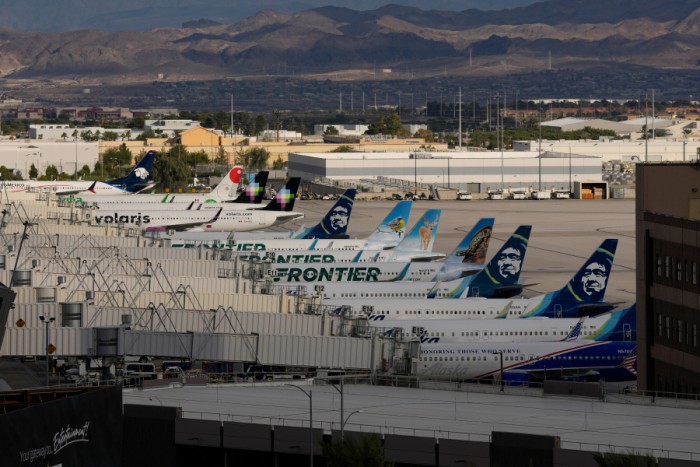 |
| Aircraft line up at Harry Reid International Airport in Las Vegas, Nevada, on Nov. 13 (local time), after a nationwide ground stop was imposed at airports across the United States. /AP-Yonhap News Agency |
The fallout from a communications network failure that grounded departing aircraft across the United States is spreading to international flights and air cargo transportation. Although domestic flights have resumed, disrupted aircraft and crew assignments have caused widespread chaos, with around 30,000 flights canceled or delayed over two days. Concerns are growing that the disruption could persist as problems with the U.S. air traffic control system ripple through international air transportation.
According to Reuters on Nov. 14 (local time), flight disruptions continued into the weekend after the Federal Aviation Administration (FAA) suspended aircraft departures at airports nationwide for approximately four hours and 23 minutes, beginning at 3:53 p.m. on Nov. 13.
On Nov. 13, approximately 9,200 flights were canceled and 7,500 were delayed. By the evening of Nov. 14, more than 6,150 flights had been canceled and around 7,300 delayed. An estimated 1.5 million passengers had been scheduled to travel by air during the disruption.
Cancellations accounted for approximately 51 percent of all canceled or delayed flights over the two days, meaning that roughly one in every two affected flights was actually canceled.
The FAA said the worst was over and expected flight operations to return to normal by Nov. 15 local time, but a full recovery remained difficult.
As the disruption entered its second day, thousands of flights across the United States were again canceled or delayed on Nov. 14. Chaos continued at major airports, where passengers faced lengthy waits for alternative flights.
With airlines needing additional time to reposition aircraft and crews and adjust their flight schedules, concerns are growing that a full return to normal operations could take considerably longer than authorities anticipate.
South Korean airlines also experienced temporary disruptions.
Korean Air and Asiana Airlines decided to cancel or considered canceling four flights departing Incheon for New York, Atlanta and Boston on Nov. 14. However, after the FAA lifted its ground stop, the airlines reversed their cancellation plans and resumed operations.
Aging communications networks and equipment failures during modernization work are considered likely causes of the disruption.
U.S. Transportation Secretary Sean Duffy explained that a router installed by government contractor L3Harris during work to replace existing copper wires with fiber-optic cables attempted to establish an excessive number of connections with other equipment, overloading the communications system.
The router was manufactured in 2001. More than 1,000 connection attempts occurred every four to five seconds, causing communications problems at 17 of the country's 22 Air Route Traffic Control Centers.
However, investigators have yet to determine whether the problem resulted from defective equipment or an error during installation.
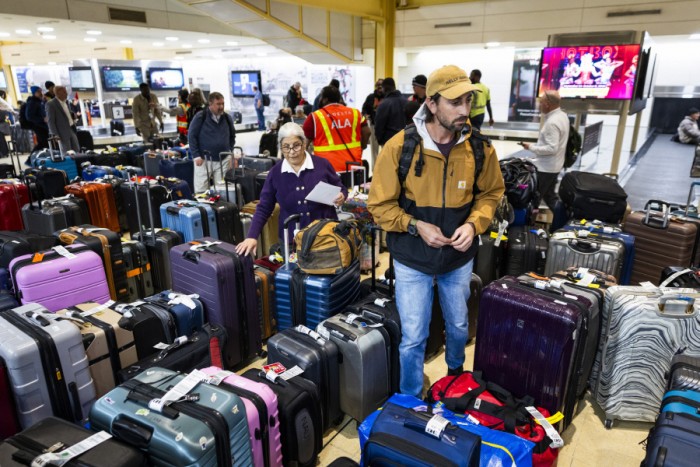 |
| Baggage from canceled flights piles up at Ronald Reagan Washington National Airport in Arlington, Virginia, on Nov. 13 (local time), after a nationwide ground stop was imposed at airports across the United States. /EPA-Yonhap News Agency |
The FAA is investigating the entire communications network replacement process.
Investigators must determine whether the existing system can operate reliably with the new equipment and whether safeguards are in place to prevent a failure at a single location from spreading to air traffic control centers nationwide.
Concerns about further disruptions are mounting as air travel demand is expected to surge ahead of the Thanksgiving holiday period beginning Nov. 26.
The U.S. Government Accountability Office (GAO) had already identified such problems in a report released in September.
The report found shortcomings in the FAA's air traffic control system modernization program, particularly in cost and schedule management.
The FAA plans to invest $12.5 billion approved by Congress in 2025 to complete the first phase of the modernization program by December 2028. However, the agency was found to have no integrated system for managing the schedules of its 11,389 individual projects.
In particular, the program's cost estimates exclude government personnel expenses and a substantial portion of operating costs, raising the possibility that actual expenditures could increase further.
International flight disruptions also continued.
At the FAA's request, European aviation authorities suspended departures of U.S.-bound flights from 5 p.m. until midnight on Nov. 13.
Even after flights resumed, delays and cancellations continued on routes between the United States and Europe as airlines rebooked passengers whose flights had been canceled and repositioned aircraft and crews.
On Nov. 14, the United Kingdom's Civil Aviation Authority (CAA) warned passengers traveling between the United States and Britain of possible further disruptions.
Some trans-Pacific flights have resumed, but restoring international flight connections and air cargo transportation to normal is expected to take more time.
The Associated Press (AP) reported that the disruption had triggered a ripple effect on flight schedules around the world, extending well beyond the United States.
Cheon Hyun-bin
Most Read
-
1
China President Xi's Keynote Speech at the APEC C..

-
2
Iran resumes attacks after two months, targeting U..

-
3
Russian warship sinks in suspected drone attack at..

-
4
Inside Kylin Villa, the symbol of China's reform h..

-
5
Trump, Xi, Putin call for security cooperation at..

-
6
Trump, Putin, Zelenskyy may hold peace talks at G2..

-
7
Trump, Xi pledge cooperation on Hormuz, Iran nucle..

PEOPLE







-
Address : In-Young Bldg., 34, Uisadang-daero 1-gil, Yeongdeungpo-gu, Seoul
Copyright by ASIATODAY CO., LTD. All rights resereved