



Boston Dynamics unveils wheeled Atlas in extreme torque test of humanoid actuators
Nov 10, 2026, 10:13 am


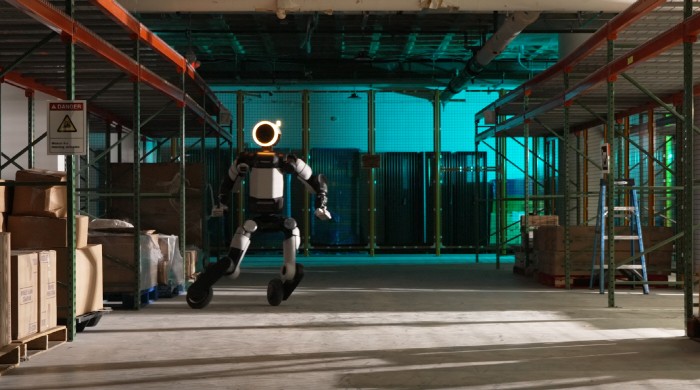 |
| A wheeled version of Boston Dynamics' Atlas humanoid robot changes direction while moving. /Courtesy of Boston Dynamics |
Boston Dynamics, the robotics subsidiary of Hyundai Motor Group, has replaced the feet of its Atlas humanoid robot with wheels to test advanced driving and turning maneuvers.
The experiment goes beyond demonstrating a new form of mobility. It uses learning-based control technology to push the performance of the robot's actuators to their limits.
By testing motor output, response speed and whole-body control under the demanding conditions of wheeled movement, the company aims to improve the technical capabilities of its next-generation humanoid robots.
On Nov. 9, Boston Dynamics released a video showing Atlas performing various advanced maneuvers with wheels instead of feet.
The experiment is a research project designed to determine whether the robot's motors and whole-body control technology can operate reliably under extreme conditions.
In particular, the wheeled version of Atlas allows engineers to place sustained heavy loads on its actuators, test their performance limits and develop highly accurate models of the physical hardware.
In the video, Atlas uses wheels mounted in place of its feet to make rapid turns and move sideways.
It also performs a 360-degree spinning jump reminiscent of a figure skater, rotating its entire body once in midair before landing while maintaining its balance.
The footage also shows Atlas lifting one leg and balancing on a single wheel, as well as getting up from the floor and immediately moving forward.
These maneuvers demonstrate the robot's ability to precisely coordinate whole-body movements even as its contact with the ground changes and its center of gravity shifts rapidly.
One particularly important aspect of the experiment is the role of the motors in Atlas' ankle joints.
During normal walking, ankle joints adjust the angle of the feet and help maintain balance.
With wheels attached, however, the motors must continuously rotate the wheels at high speeds while supporting the robot's weight and handling the inertia generated by its movements.
In other words, the actuators must do more than move individual joints. They must withstand continuous rotation and sustained heavy loads.
The experiment demonstrates how Atlas' actuators are being developed to provide not only short bursts of force but also a wide control bandwidth and greater mechanical durability.
Boston Dynamics used wheeled locomotion as a way to push the actuators to their performance limits.
During acceleration, turning, stopping and starting, the motors must repeatedly deliver high torque and rotational speed.
The experiment also incorporated learned controllers and reinforcement learning.
Under this approach, the robot repeatedly learns different movements in a virtual environment before performing them on physical hardware.
The key challenge is minimizing the gap between simulation and the real world.
To address this, Boston Dynamics developed highly accurate simulations of how its motors behave in practice.
It then used simulation-to-reality, or sim-to-real, technology to transfer movements learned in simulation to the physical robot and ensure they could be performed reliably.
Through this training process, Atlas successfully completed a 360-degree spinning jump based on human movement on its first attempt, according to Boston Dynamics.
However, the wheeled Atlas shown in the video is a research platform rather than a model intended for commercialization.
The project is designed to test the limits of the hardware under different operating conditions and improve control technology, with the ultimate goal of enhancing the mobility and reliability of future humanoid robots.
"What really stood out to me during training was seeing the robot perform side dashes, where it jumps and moves sideways," said Andy Wu, an Atlas controls engineer, in the video.
"It was amazing and exciting to see the robot figure out how to roll on its wheels through the training pipeline," he added.
Kim Jeong-kyu
Most Read
-
1
AMD's Lisa Su floated as potential Nvidia successo..

-
2
China President Xi's Keynote Speech at the APEC C..

-
3
Iran resumes attacks after two months, targeting U..

-
4
Alice Huang, affair partner of Jensen Huang, repor..

-
5
Inside Kylin Villa, the symbol of China's reform h..

-
6
Russian warship sinks in suspected drone attack at..

-
7
Xi secures fourth term as China reshuffles next-ge..

PEOPLE







-
Address : In-Young Bldg., 34, Uisadang-daero 1-gil, Yeongdeungpo-gu, Seoul
Copyright by ASIATODAY CO., LTD. All rights resereved