



Lee stresses bipartisan consensus as priority for constitutional amendment
Nov 04, 2026, 05:12 pm


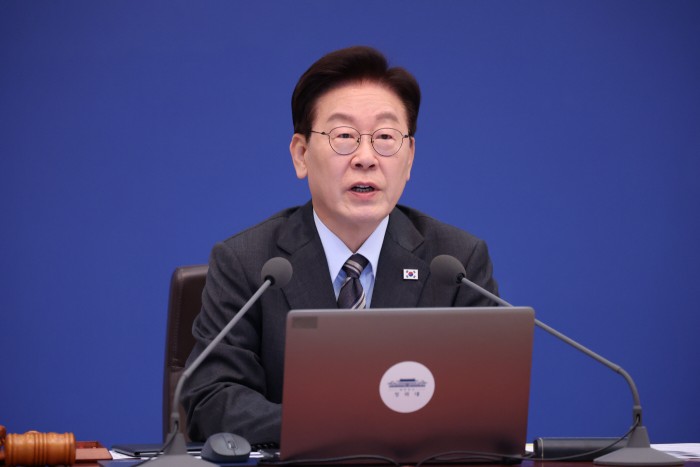 |
| President Lee Jae Myung speaks during a Cabinet meeting at Cheong Wa Dae on Oct. 27. /Yonhap News Agency |
President Lee Jae Myung on Wednesday acknowledged the need for constitutional reform but said it would be preferable for the National Assembly to reach an agreement between the ruling and opposition parties rather than have the president lead the process. He believes that while parts of the current Constitution no longer reflect changing social conditions, a presidentially led constitutional amendment could face low public acceptance.
Lee made the remarks during a luncheon meeting with the leadership and executives of The Parliamentarian’s Society of the Republic of Korea, an organization of former lawmakers, at Cheong Wa Dae, according to a written briefing by senior presidential spokesperson Kang Yu-jung.
"The requirement to secure the consent of at least two-thirds of National Assembly members for a constitutional amendment is also a major hurdle," Lee said. "It would be desirable for the ruling and opposition parties in the National Assembly to identify areas where they can reach agreement and proceed on that basis."
Earlier, Jeong Dae-cheol, chairman of the society, called on Lee in his opening remarks to take the lead in dialogue and coordination to promote politics based on mutual cooperation, bipartisan collaboration and unity. He also proposed constitutional reform during Lee's term, citing the need to shift from an imperial presidency to a power-sharing presidential system and strengthen decentralization. Jeong also conveyed his views on the transfer of wartime operational control.
During the meeting, society members also offered suggestions on national issues, including social polarization, people's livelihoods and cybersecurity.
Some participants expressed support for Lee's recent efforts to address livelihood issues, including his field visit related to the rural basic income program. Others emphasized the importance of cooperation between the ruling and opposition parties, referring to the concept of "growth for all" highlighted in his policy address to the National Assembly.
Participants also called for greater attention to social polarization and stressed the need for a "cybersecurity czar" to oversee cybersecurity functions across government agencies.
After listening to the society members' suggestions, Lee said, "Politics must be pragmatic because its purpose is to improve people's lives."
Referring to improvements in South Korea-Japan relations, which many participants had evaluated positively, Lee said, "Pragmatism, moderation and dialogue are important in national policy as well," adding, "Above all, following the path of moderation is the most important."
Regarding the economic situation, Lee said, "Since the launch of the government of popular sovereignty, we have worked to overcome difficult conditions, including national debt and negative growth, and recent economic indicators show that we are gradually gaining some breathing room."
He added, "We must not stop at improvements in economic indicators themselves. People must be able to feel the results as tangible improvements in their own lives."
Park Young-hoon
Most Read
-
1
U.S., Israel plan to resume strikes on Iran after..

-
2
Ukraine halts strikes on Russian oil refineries un..

-
3
China's fifth plenum to conclude amid expectations..

-
4
ASEAN to discuss Myanmar's return next month

-
5
AI-discovered PHP flaw triggers global cybersecuri..

-
6
Southeast Asian auto parts makers hit hard by Chin..

-
7
UK court orders worldwide asset freeze on Vietnam'..

PEOPLE







-
Address : In-Young Bldg., 34, Uisadang-daero 1-gil, Yeongdeungpo-gu, Seoul
Copyright by ASIATODAY CO., LTD. All rights resereved