



Surge in LPG prices forces Pakistan's rickshaw drivers to cut daily meals
Nov 04, 2026, 01:50 pm


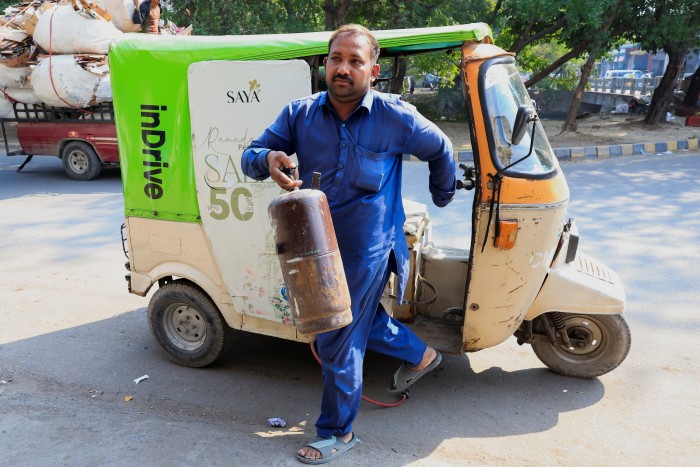 |
| An auto-rickshaw driver carries a gas cylinder to be filled with liquefied petroleum gas (LPG) for use as vehicle fuel at a shop in Lahore, Pakistan, on Oct. 30. /Reuters-Yonhap |
Rashid Ali, 33, has been driving a three-wheeled auto-rickshaw, a type of three-wheeled taxi used in India and Pakistan, in the eastern Pakistani city of Lahore for 13 years. He starts driving at 6 a.m. and sometimes stays on the road until midnight. He used to earn around $6.50 (8,700 won) a day, enough to support his family, but these days he considers himself lucky if he takes home $3 (about 4,000 won). This is because the price of liquefied petroleum gas (LPG), which he uses to fuel his vehicle, has soared since two border crossings with Iran were closed. As a result, Ali's family has had to cut back to two meals a day.
Reuters reported Tuesday that LPG prices in Pakistan had surged since the border with Iran was closed on Oct. 17. According to traders, the price of a 12-kilogram cylinder jumped 56% within days, from 4,500 rupees (about 22,000 won) to 7,000 rupees (about 34,000 won). That translates to approximately 583 rupees (about 2,800 won) per kilogram. According to the Pakistan LPG Association, the country imported about 7,000 metric tons of LPG a day from Iran before the border closures.
LPG sold in cylinders is mainly used for cooking and heating, but for thousands of rickshaw drivers, it is also the fuel that keeps their livelihoods going. Majeed Ghauri, chairman of the Awami Rickshaw Union, described LPG as "the fuel of the poor," explaining that about 70% of the union members' 43,000 auto-rickshaws and approximately 8,000 Qingqis — motorcycle-based three-wheeled shared vehicles that carry passengers along fixed routes — run on LPG.
Despite the sharp rise in fuel costs, rickshaw drivers find it difficult to pass the increase on to passengers through higher fares. Ali pays 600 rupees (about 2,900 won) a day to rent his rickshaw and refuels four or five times daily, spending 300 to 400 rupees (about 1,450 to 1,930 won) each time. By simple calculation, his daily fuel costs alone amount to 1,200 to 2,000 rupees (about 5,800 to 9,600 won). He also pays 11,000 rupees (about 53,000 won) a month for housing. Yet passengers, he said, "offer 80 to 150 rupees (about 400 to 700 won) for a trip that should cost 200 to 250 rupees (about 1,000 to 1,200 won)."
The two sides have offered conflicting explanations for the border closures that triggered the crisis. The government of Balochistan Province, which borders Iran, cited security and smuggling concerns, while Iran's Foreign Ministry attributed the closures to technical issues. Reza Amiri Moghaddam, Iran's ambassador to Pakistan, recently said that "Iran has imposed no restrictions, including on LPG exports," pointing instead to changes in Pakistan's import documentation procedures.
Reuters described the latest crisis as another energy shock following the outbreak of the U.S.-Iran war in February. Petrol prices also surged to 458 rupees (about 2,210 won) per liter on April 3 and remain about 40% above their prewar levels. Pakistan's inflation rate reached 9.6% in October, and the central bank raised its benchmark interest rate from 11.5% to 12% on Oct. 26, citing rising energy and wheat prices.
The Pakistani government is seeking alternative sources of supply. Petroleum Minister Ali Pervaiz Malik told parliament on Oct. 26 that the border closures were one of the main causes of the sharp rise in LPG prices. He said the government was exploring other sources, including seaborne imports, and preparing measures to protect low-income households.
Meanwhile, the industry is pushing back against the government's pricing methodology. Ali Haider, senior vice chairman of the Pakistan LPG Marketers Association, warned that the government's new pricing formula would drive LPG prices up by another 25% to 30%. He said the association would suspend sales and business operations nationwide from Nov. 16 if its demands were not met within 15 days.
Jeong Ri-na
Most Read
-
1
U.S., Israel plan to resume strikes on Iran after..

-
2
Ukraine halts strikes on Russian oil refineries un..

-
3
China's fifth plenum to conclude amid expectations..

-
4
ASEAN to discuss Myanmar's return next month

-
5
AI-discovered PHP flaw triggers global cybersecuri..

-
6
UK court orders worldwide asset freeze on Vietnam'..

-
7
Southeast Asian auto parts makers hit hard by Chin..

PEOPLE







-
Address : In-Young Bldg., 34, Uisadang-daero 1-gil, Yeongdeungpo-gu, Seoul
Copyright by ASIATODAY CO., LTD. All rights resereved