



S. Korea's five state power companies launch tender to prepare merger
Nov 04, 2026, 11:10 am


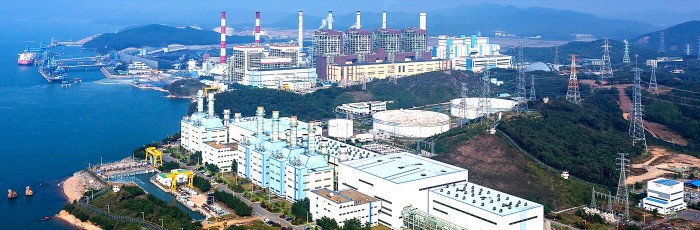 |
| Korea Midland Power's Boryeong Power Generation Site Division. |
Five state-owned power generation companies under Korea Electric Power Corp. (KEPCO) — Korea South-East Power, Korea Midland Power, Korea Western Power, Korea Southern Power and Korea East-West Power — will outsource preliminary work for their integration to an external consulting firm. They plan to allocate approximately 13.7 billion won to the project and entrust the firm with full responsibility for the work through the end of next year.
According to the power generation industry on Tuesday, the five companies posted a tender notice Monday for "Advisory and Support Services for the Integration of Five State-Owned Power Generation Companies (PMI)." The allocated budget is 13.66537 billion won, with bidding scheduled to close on Nov. 17 and bids to be opened on Nov. 20. The service period will run from the date of contract signing through December 2027.
The contract is intended to align with the government's timetable for integrating the five power generation companies. In September, Korea's Ministry of Climate, Energy and Environment announced plans to establish an integrated power generation company called Korea Power Generation as a wholly owned subsidiary of KEPCO. The government is pursuing organizational restructuring and institutional reforms with a target launch date of October next year.
The launch of Korea Power Generation is expected to streamline overlapping organizational functions. It is also expected to deliver cost savings through joint procurement of fuel and materials, while expanding and concentrating investment capacity. The plan also aims to consolidate personnel and capital currently dispersed across the five companies to respond to the energy transition, including the expansion of renewable energy and the phase-out of coal-fired power generation.
The firm awarded the contract will handle all practical aspects required for the integration of the five companies. The consulting requirements include providing legal, administrative, accounting and tax advisory and agency services necessary to establish the integrated company, supporting the enactment of a special act, and carrying out tasks required to transfer authority and legal standing related to domestic and overseas equity investment projects.
However, numerous challenges remain to be resolved before the integration. One major task is clarifying the rights associated with domestic and overseas equity investment projects held by each of the five companies and transferring those rights to the integrated entity.
According to industry officials, the five companies are engaged in overseas power generation projects as well as domestic renewable energy projects. Many of these projects involve individual participation or consortium arrangements, and there are also numerous cases involving the appointment of former executives and employees of the power generation companies. As a result, equity stakes, contractual rights and obligations, and personnel structures will need to be sorted out.
Integrating personnel and labor management systems and IT systems is another major challenge. The five companies currently operate different personnel and payroll structures and business systems. Together, they operate 575 systems, requiring work such as standardizing business processes and linking systems during the integration.
The economic benefits of the integration have also yet to be presented in concrete terms. In September, the National Assembly Budget Office (NABO) pointed out that it was difficult to assess the financial effects of the integration because the government had not calculated either the expected cost savings from merging the five companies or the costs that would arise during the integration process.
"Each power generation company has a different organizational and business structure, and their interests are complex and intertwined, making it difficult to carry out the integration smoothly if one particular company takes the lead," an industry official said. "There was likely a need for an organization capable of coordinating the process objectively."
Kim Deok-ho
Most Read
-
1
U.S., Israel plan to resume strikes on Iran after..

-
2
Ukraine halts strikes on Russian oil refineries un..

-
3
China's fifth plenum to conclude amid expectations..

-
4
ASEAN to discuss Myanmar's return next month

-
5
AI-discovered PHP flaw triggers global cybersecuri..

-
6
UK court orders worldwide asset freeze on Vietnam'..

-
7
Southeast Asian auto parts makers hit hard by Chin..

PEOPLE







-
Address : In-Young Bldg., 34, Uisadang-daero 1-gil, Yeongdeungpo-gu, Seoul
Copyright by ASIATODAY CO., LTD. All rights resereved