



One in four previously idle young jobseekers land jobs outside their major
Nov 04, 2026, 10:57 am


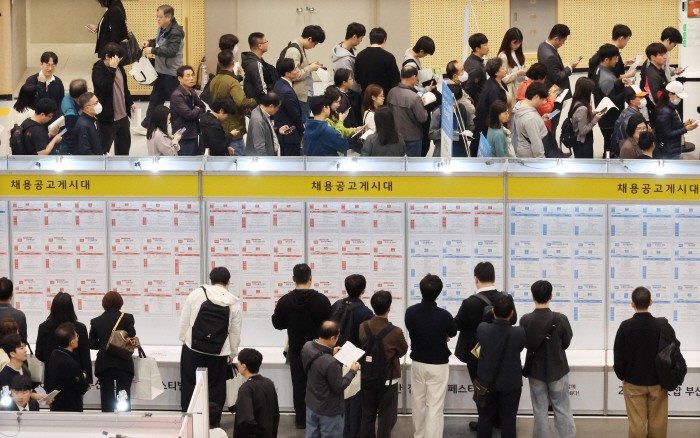 |
| Job seekers line up to register on-site at the "2026 KB Goodjob Busan JOB Festival" held at Exhibition Center 1 of BEXCO in Haeundae District, Busan, on Oct. 26. /Yonhap News Agency |
One in four young people who found employment after a period of being economically inactive without seeking work were found to be working in jobs unrelated to their fields of study. Some also entered jobs below their educational and skill levels, prompting calls for youth employment policies to consider not only whether young people find jobs but also how well those jobs match their qualifications.
According to a report titled "Do economically inactive young people find jobs that match their education, skills and fields of study?" published Wednesday in the Employment Trends Brief by the Korea Employment Information Service (KEIS), 24.3% of young people who moved from a state of "resting" into employment were working in jobs unrelated to their fields of study. This was 9.8 percentage points higher than the 14.5% recorded among young people who remained employed.
The analysis used data from 2021 to 2024 from the Youth Panel Survey, covering approximately 12,000 young people aged 19 to 28 as of 2021. The researchers divided participants into groups based on their economic activity status before entering employment and compared how well their jobs matched their education, skills and fields of study. The term "resting" refers to a state in which people are neither employed nor seeking work and are taking a break without any particular reason.
The rate of mismatch between jobs and fields of study was 19.6% among young people who found employment after actively seeking work and 21.9% among those who entered employment from other forms of economic inactivity, excluding those classified as resting. The rate was highest among young people who found jobs after a period of resting. This suggests that they face relatively greater difficulties finding jobs related to their fields of study even after entering the labor market.
Differences were also found in education and skill levels. Among young people who found employment after a period of resting, 15.3% had educational qualifications higher than those required for their jobs, 5.6 percentage points above the 9.7% recorded among those who remained employed. The proportion whose skill levels exceeded job requirements was also 15.3%, higher than the 9.4% among those who remained employed.
"The mismatch among young people who were resting takes the form of downward employment rather than a lack of capabilities," said Hwang Kwang-hoon, an associate research fellow at KEIS. "This shows that they tend to enter the labor market by accepting jobs that require lower levels of education and skills than they possess."
A substantial proportion of young people classified as resting eventually found employment, but their transition into jobs was slower than that of job seekers. Among those who were resting in 2021, the proportion who had transitioned into employment rose from 27.6% in 2022 to 46.5% in 2024. By comparison, the employment transition rate in 2024 among young people who were actively seeking work in 2021 was 71.7%. Among those who were resting in 2021, 11.1% remained in that state in 2024, while 35.5% were in other forms of economic inactivity.
There were also significant differences by educational attainment. The employment transition rate after three years among young people who were resting was 40.2% for those with a high school education or less and 73.4% for those with at least a junior college degree, a gap of 33.2 percentage points. Among young people who found employment after a period of resting, the rate of mismatch between jobs and fields of study was also higher for those with a high school education or less, at 28.0%, compared with 16.9% for those with a bachelor's degree or higher. However, the group with a high school education or less included many university students, meaning differences in the timing of labor market entry due to education, military service and other factors may have been partly reflected in the employment transition rates.
Job mismatch was also particularly evident in the Seoul metropolitan area. The employment transition rate after three years among young people who were resting in the metropolitan area was 43.7%, lower than the 49.2% in nonmetropolitan areas. After entering employment, the rate of mismatch between jobs and fields of study was 28.4% in the metropolitan area and 19.9% in nonmetropolitan areas, indicating that finding jobs related to one's field of study remained difficult even in the metropolitan area, where job opportunities are more abundant.
"A policy approach is needed that goes beyond increasing employment transition rates to consider the quality of jobs after the transition and whether young people can establish themselves in those jobs," Hwang said. "In particular, young people with a high school education or less who were resting should be considered a priority target for policy measures, as they have lower employment transition rates and face greater job mismatches after entering employment."
Kim Nam-hyung
Most Read
-
1
U.S., Israel plan to resume strikes on Iran after..

-
2
Ukraine halts strikes on Russian oil refineries un..

-
3
China's fifth plenum to conclude amid expectations..

-
4
ASEAN to discuss Myanmar's return next month

-
5
AI-discovered PHP flaw triggers global cybersecuri..

-
6
UK court orders worldwide asset freeze on Vietnam'..

-
7
Southeast Asian auto parts makers hit hard by Chin..

PEOPLE






-
Address : In-Young Bldg., 34, Uisadang-daero 1-gil, Yeongdeungpo-gu, Seoul
Copyright by ASIATODAY CO., LTD. All rights resereved