



Hyundai Motor faces mixed results across global markets
Nov 04, 2026, 10:23 am


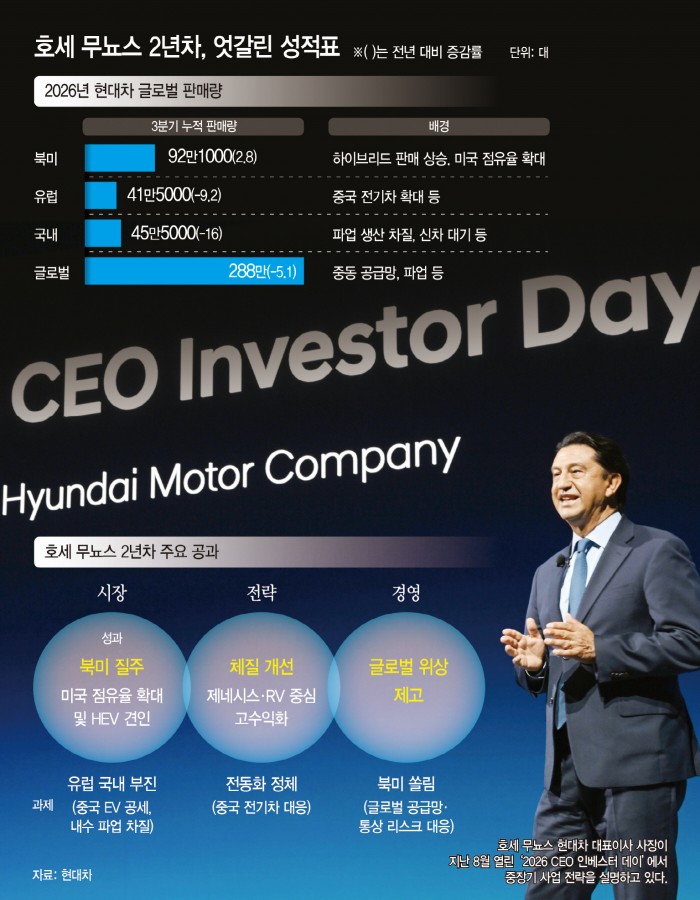 |
José Muñoz, Hyundai Motor's first foreign chief executive officer (CEO), has delivered mixed results in his second year in office. While he has demonstrated his capabilities in the United States, considered his area of expertise, by boosting sales and market share, he has been unable to avoid double-digit sales declines in South Korea and Europe. This suggests that he has yet to successfully replicate his North American growth strategy across the company's global markets. Overcoming sluggish sales in major markets and restoring balanced regional growth have emerged as key challenges for Muñoz.
According to automotive industry sources on Nov. 3, Hyundai Motor's global sales in the third quarter of this year fell 11.3% year-on-year to 920,710 vehicles. By contrast, Kia sold 846,764 vehicles during the same period, up 7.8%. The quarterly sales gap between the two companies narrowed to approximately 74,000 vehicles. While Hyundai Motor struggled with declining sales, Kia maintained its growth momentum, highlighting a clear divergence in their performance within the group.
Muñoz rose to the top of Hyundai Motor's global management on the strength of his achievements in North America. Since joining the company in 2019 as global chief operating officer (COO) and head of the Americas region, he strengthened the competitiveness of Hyundai's U.S. dealer network and led a sales strategy focused on high-value models. Recognized for repeatedly setting sales records in the U.S. market, he was appointed Hyundai Motor's first foreign CEO in November 2024 and officially took office the following January.
Growth continued in the U.S. market after he became CEO. Hyundai Motor sold 697,464 vehicles in the United States from January to September this year, up 2.8% from the same period last year. In particular, sales of hybrid vehicles, considered high-value models, surged 54%, driving performance. Despite slowing demand for electric vehicles and growing market uncertainty, the company maintained its sales competitiveness with a product lineup tailored to local consumer preferences.
However, Hyundai Motor performed poorly in other major markets. Domestic sales from January to October this year plunged 15.6% year-on-year, while European sales fell 18% in the third quarter. The declines reflected a combination of factors, including consumers delaying purchases ahead of new model launches and aggressive pricing by Chinese automakers. This has highlighted the need to improve both product and price competitiveness in response to changes in regional demand.
Declining sales also weighed on revenue growth. Hyundai Motor's third-quarter revenue fell 3.4% year-on-year to 45.1102 trillion won. However, operating profit increased 5.5% to 2.6772 trillion won, allowing the company to defend its profitability. Favorable exchange rate effects, cost reductions and increased hybrid vehicle sales supported the improvement in earnings. Nevertheless, despite maintaining profitability, the company was unable to fully offset the contraction in revenue caused by lower sales volumes.
Ultimately, Hyundai Motor lowered its annual business targets when it announced its third-quarter results. The company reduced its global sales target for this year from 4,158,300 vehicles to 4 million and cut its planned investment in the automotive division from 17.8 trillion won to 16 trillion won.
The revisions came just two months after the company outlined its medium- to long-term targets of 5.55 million vehicles in global sales and an operating profit margin of at least 9% by 2030 at its 2026 CEO Investor Day in August. Analysts say the gap between Hyundai Motor's long-term growth plans and current market conditions has increased the management pressure on Muñoz.
Muñoz has demonstrated his ability to expand sales and manage profitability in the U.S. market. However, the responsibilities of a North American business chief differ from those of a global CEO. He must rebuild the company's global growth foundation by normalizing domestic production, restoring competitiveness in Europe and introducing new models and sales strategies tailored to regional demand.
Whether Muñoz can replicate his U.S. success in other markets is expected to be a key test of his global management capabilities.
"Muñoz's achievements in North America are clear, but as a global CEO, he needs to generate growth that is not overly dependent on a particular market," an automotive industry expert said.
"Overcoming sluggish sales in South Korea and Europe and restoring regional competitiveness will be important criteria for evaluating his management capabilities going forward," the expert added.
Nam Hyun-soo
Most Read
-
1
U.S., Israel plan to resume strikes on Iran after..

-
2
Ukraine halts strikes on Russian oil refineries un..

-
3
China's fifth plenum to conclude amid expectations..

-
4
ASEAN to discuss Myanmar's return next month

-
5
AI-discovered PHP flaw triggers global cybersecuri..

-
6
UK court orders worldwide asset freeze on Vietnam'..

-
7
Southeast Asian auto parts makers hit hard by Chin..

PEOPLE







-
Address : In-Young Bldg., 34, Uisadang-daero 1-gil, Yeongdeungpo-gu, Seoul
Copyright by ASIATODAY CO., LTD. All rights resereved