



Anthropic seeks Nasdaq listing next month
Oct 27, 2026, 09:54 am


 |
| The logo of artificial intelligence (AI) company Anthropic is seen in the photo taken on Oct. 26 (local time). / Reuters, Yonhap |
[Article summary]
1. Anthropic made public its Nasdaq IPO registration statement on Oct. 26 and is pursuing a listing in November.
2. First-half revenue surged 14-fold to $16.29 billion, but the company posted a net loss of $80.748 billion.
3. Its computing contracts and purchase plans total up to $807 billion, while more than 90 pages of the filing detail risk factors, including AI-related catastrophes.
4. Some investors valued the company for its IPO at $1.4 trillion to $1.5 trillion, below its maximum target valuation of $2 trillion.
Artificial intelligence (AI) company Anthropic made public its Form S-1 registration statement for an initial public offering (IPO), filed with the U.S. Securities and Exchange Commission (SEC) on Oct. 26 (local time), as it moves ahead with plans to list on the Nasdaq next month. The filing disclosed a 14-fold increase in first-half revenue from a year earlier, computing contracts and purchase plans worth up to $807 billion (1,059.3489 trillion won), and the catastrophic risks AI could pose to humanity. With some investors' valuation expectations for the IPO falling to around $1.5 trillion (1,969.05 trillion won), below the company's maximum target of $2 trillion (2,625.4 trillion won), the offering has become a test of the AI industry's growth potential and the burden of massive infrastructure investment.
Anthropic seeks Nasdaq listing under 'ANT,' targeting valuation of up to $2 trillion and $100 billion in proceeds
Anthropic plans to list its Class A common stock on the Nasdaq Global Select Market under the ticker symbol "ANT." The company made its registration statement public on Oct. 26 after confidentially submitting its IPO application in June. It has yet to disclose the number of shares to be offered or the proposed offering price range. Anthropic is seeking to raise $100 billion (131.27 trillion won) at a valuation of up to $2 trillion, The Wall Street Journal (WSJ) reported, citing sources. If it achieves that target, the company would surpass the IPO record set by SpaceX in June. Reuters reported that SpaceX raised $75 billion in that offering, while the Associated Press (AP) put the figure at $86 billion.
Goldman Sachs and Morgan Stanley are serving as joint lead underwriters for Anthropic's IPO, with 20 additional banks participating in the underwriting syndicate. Morgan Stanley will be responsible for stabilizing the share price during the initial trading period. Anthropic is moving toward a public listing ahead of OpenAI among companies specializing in the development of frontier AI models. OpenAI is expected to go public next year.
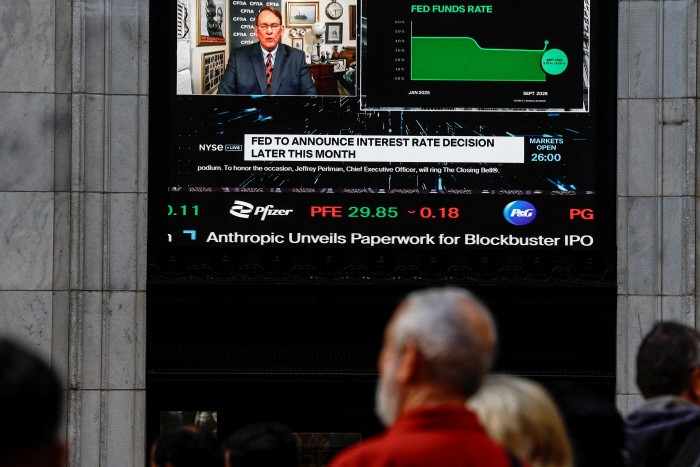 |
| News about the initial public offering (IPO) of artificial intelligence (AI) company Anthropic is displayed on a screen on the trading floor of the New York Stock Exchange (NYSE) in New York City on Oct. 26 (local time). / Reuters, Yonhap |
Anthropic's first-half revenue surges 14-fold to $16.29 billion, net loss reaches $80.748 billion
According to the filing, Anthropic recorded revenue of $16.29 billion (21.3839 trillion won) in the first half of this year, approximately 14 times the $16.29 billion (1.5227 trillion won) recorded in the same period last year. Annual revenue also surged from $41 million (53.8 billion won) in 2023 to $386 million (506.7 billion won) in 2024 and $4.59 billion (6.0253 trillion won) last year.
The company's net loss in the first half reached $80.748 billion (105.9979 trillion won). Of this, approximately $72.4 billion (95.0395 trillion won) consisted of non-cash valuation expenses resulting from changes in the fair value of convertible bonds (CBs) and other instruments. Its operating loss narrowed to $693 million (909.7 billion won) from $2.14 billion (2.8092 trillion won) in the first half of last year. Adjusted operating income turned positive, reaching $1.618 billion (2.1239 trillion won), Reuters reported.
The Financial Times (FT), a British daily, analyzed that computing and infrastructure costs, which had exceeded $2.50 for every dollar of revenue in the first quarter of last year, fell to less than 50 cents in the second quarter of this year. Anthropic recorded an operating profit of $1 billion (1.3127 trillion won) and an operating margin of 8% in the second quarter of this year. However, the company warned that its financial results could fluctuate significantly depending on the timing of computing investments. Cash and cash equivalents stood at approximately $112 billion (147.0224 trillion won) as of the end of June.
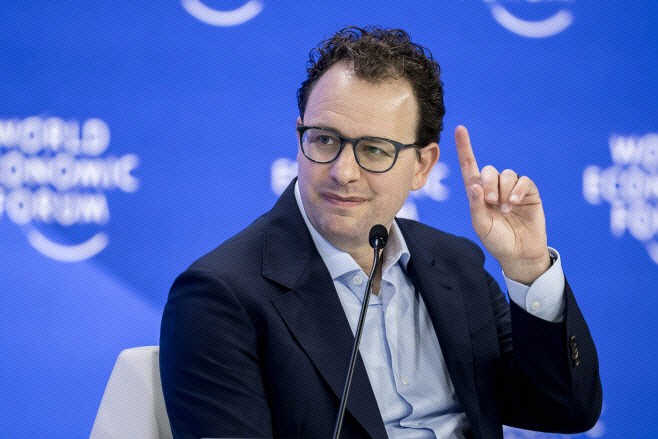 |
| Anthropic Chief Executive Officer (CEO) Dario Amodei speaks during an artificial intelligence (AI) session at the World Economic Forum (WEF) Annual Meeting in Davos, Switzerland, on Jan. 23, 2025 (local time). / AFP, Yonhap |
Anthropic has 11,900 enterprise customers, surpasses OpenAI in share of companies with paid AI subscriptions
Enterprise customers have been at the center of the surge in revenue. Anthropic said it had 11,900 customers who spent at least $100,000 (131.27 million won) on its AI model Claude during the 12 months through the end of September. Of these, 1,900 customers spent at least $1 million (1.3127 billion won), while approximately 250 spent at least $10 million (13.127 billion won). More than half of the Fortune 500 companies and over 30% of the world's 2,000 largest companies were customers spending at least $100,000 annually, Reuters reported.
Consumption-based revenue, which is generated from charges based on usage, reached $13.1 billion (17.1964 trillion won) in the first half of this year, accounting for approximately 80% of total revenue. According to the AI Index compiled by Ramp, a company that analyzes corporate spending, 43.8% of U.S. companies subscribing to paid AI services used Anthropic's services, exceeding OpenAI's 40.6%. This figure represents the proportion of companies with paid AI subscriptions using each service, rather than market share among all companies. Anthropic also accounted for 60.1% of AI token spending in the week ended Oct. 11.
However, customer concentration remains a risk, with the five largest customers accounting for 25% of revenue from January through September this year. Anthropic also said it may be unable to sustain its previous rapid growth due to market maturation, intensifying competition and restrictions on model releases resulting from efforts to ensure AI safety. Third-quarter revenue reached $16.8 billion (22.0534 trillion won), up 45% from the previous quarter, but the growth rate was below the 141% quarter-on-quarter increase recorded in the second quarter, The New York Times (NYT) reported.
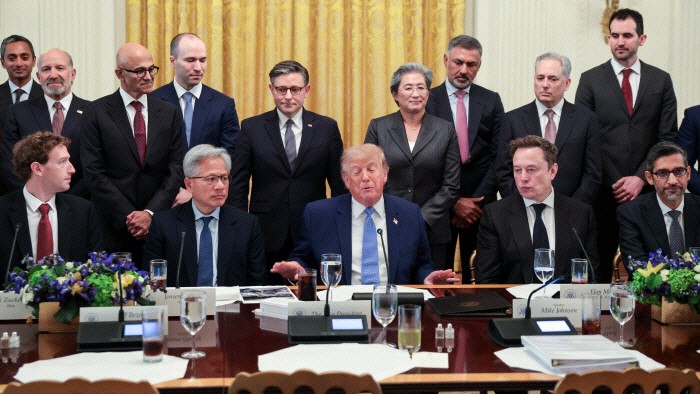 |
| U.S. House Speaker Mike Johnson (fifth from left, back row), U.S. Commerce Secretary Howard Lutnick (second from left, back row), Meta CEO Mark Zuckerberg (left, front row), SpaceXAI founder and CEO Elon Musk (second from right, front row), NVIDIA President and CEO Jensen Huang (second from left, front row), OpenAI President Greg Brockman (fourth from left, back row), Google CEO Sundar Pichai (right, front row), AMD CEO Lisa Su (fourth from right, back row) and others attend a luncheon for technology company leaders hosted by U.S. President Donald Trump (center, front row) in the East Room of the White House in Washington, D.C., on Sept. 29 (local time). / Reuters, Yonhap |
Anthropic's computing contracts and purchase plans total up to $807 billion
Anthropic described computing resources as "the critical input" to its business. The company plans to invest substantial sums in securing data centers, semiconductors and cloud computing resources in the coming years. Reuters reported that its computing spending commitments with approximately eight partners exceeded $600 billion. The Financial Times (FT) put the figure at more than $800 billion, including contractual maximum amounts and additional purchase plans, while The New York Times (NYT) estimated the total at up to $807 billion.
According to detailed figures from the FT, Anthropic's contract with Broadcom is the largest, valued at $161.2 billion (211.6072 trillion won) over five years. It is followed by $120.5 billion for a contract related to SpaceX's AI business, $114.5 billion with Google, $110 billion with Amazon, $44.9 billion with Microsoft (MS), $44.6 billion with Nscale, $41.3 billion with Lambda and $20 billion with AMD. The combined value of these eight contracts is $657 billion. Including plans to purchase up to an additional $150 billion in Google's tensor processing units (TPUs) beginning in 2028, the total reaches $807 billion.
However, some of these amounts represent contractual ceilings or future purchase plans, rather than fully committed expenditures. The contract related to SpaceXAI may also be terminated under certain conditions after the initial period. Some contracts include obligations to make payments regardless of actual usage.
Amazon and Google, two of Anthropic's major suppliers, are also key investors in the company. Amazon has invested at least $13 billion (17.0651 trillion won) and has agreed to invest up to an additional $20 billion. Google has also committed to investing up to $40 billion. Anthropic warned that these investment and supply relationships could create conflicts of interest and uncertainty over access to computing resources. The founders acknowledged that the massive investments "may seem irresponsible at first glance," but described their approach as "bold but sane."
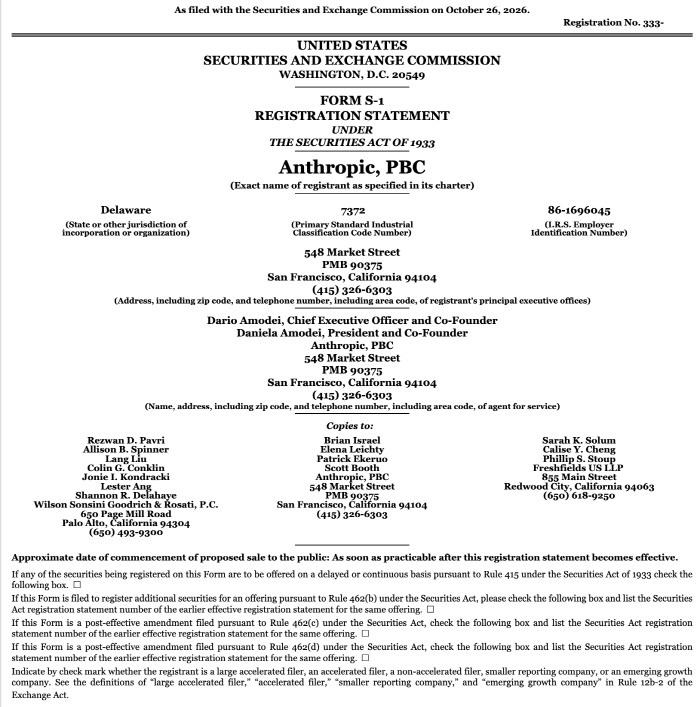 |
| A screenshot of part of the Form S-1 registration statement for an initial public offering (IPO) filed by artificial intelligence (AI) company Anthropic with the U.S. Securities and Exchange Commission (SEC) on Oct. 26 (local time). |
Over 90 pages of risk factors in Anthropic's filing warn of AI catastrophes
Anthropic devoted approximately one-quarter of its registration statement to disclosures of risk factors. The Financial Times (FT) counted 92 pages devoted to such risks, approximately three times as many as in SpaceX's filing.
Anthropic warned that highly advanced AI systems could pose "catastrophic or existential risks" to humanity if they are misused, replicated, weaponized or operated with high levels of autonomy. It also identified the possibility of AI models exhibiting self-preserving behavior, such as resisting shutdown or concealing and manipulating information. The risks also included generating outputs resembling blackmail and being exploited by malicious actors to develop chemical, biological, radiological and nuclear (CBRN) weapons.
Anthropic predicted that liability for damages arising from such catastrophic incidents could be so substantial that not only individual insurers but also the insurance industry as a whole might find it difficult to underwrite the risks. The FT analyzed that negative expressions and words related to financial constraints appeared more frequently in Anthropic's disclosures than in typical IPO filings by U.S. technology companies.
On the other hand, Anthropic emphasized that AI developed and operated with appropriate safeguards and human oversight could accelerate treatments for cancer, Alzheimer's disease and heart disease, as well as scientific discoveries. It also raised the possibility of compressing scientific advances that would otherwise take decades into just a few years.
Risks related to semiconductor supply chains and geopolitics were also disclosed in detail. Anthropic pointed out that the supply of high-bandwidth memory (HBM) is concentrated among three companies — Samsung Electronics, SK hynix and Micron — and that the manufacturing of advanced AI accelerators depends heavily on Taiwan's TSMC. Export and import controls, tariffs, military conflict across the Taiwan Strait and natural disasters could disrupt access to advanced semiconductors. Risks also included shortages in the U.S. power grid, difficulties securing cooling water and opposition from local communities to data center construction.
Disputes with the administration of U.S. President Donald Trump were also explicitly identified as business risks. In separate lawsuits following the U.S. Department of Defense (Department of War)'s designation of Anthropic as a supply-chain risk, a California court ruled in favor of Anthropic, while a Washington, D.C., court ruled in favor of the government, and both sides appealed, according to the Associated Press (AP). Anthropic warned that although revenue from contracts with government agencies accounts for only about 1% of its total revenue, disputes with the government could also adversely affect demand from private-sector customers.
Founders hold 50.1% of voting power
The IPO process also revealed an unusual corporate governance structure. The seven co-founders designed a structure under which they would exercise 50.1% of the voting power on major matters submitted to shareholders through a single Class F share held by a separate entity, Founder LLC.
A separate Long-Term Benefit Trust (LTBT) holds the authority to appoint and remove four of the seven directors. Its trustees include former Federal Reserve (Fed) Chair Ben Bernanke and Harvard University professor Christopher Stubbs. However, the trust's authority to appoint and remove the fourth director is subject to the consent of the board's nominating committee, in which co-founder Daniela Amodei participates. CEO Dario Amodei and President Daniela Amodei are also excluded from the trust's removal authority.
The FT assessed that this structure effectively leaves ordinary shareholders without control over the company's management. Anthropic's founders said that, in seeking to serve both shareholder interests and the public good, the company's decisions could differ from investors' expectations.
Market expectations for the company's IPO valuation are also declining. Some investors value the company at between $1.4 trillion and $1.5 trillion, while others believe a valuation of $1.75 trillion is possible, Bloomberg reported. These figures are below the company's maximum IPO valuation target of $2 trillion.
Matt Kennedy, senior strategist at Renaissance Capital, observed that just a few months ago, investors had not questioned AI company valuations, but Anthropic is entering an IPO market that has become far more challenging than it was this summer. Lukas Muehlbauer, a researcher at IPO specialist IPOX, predicted that Anthropic's IPO would establish a benchmark for valuing leading AI developers and influence confidence in subsequent listings and companies investing in AI infrastructure.
The New York Times (NYT) also assessed that the listing would serve as a test of whether demand for AI services can justify the enormous costs of investing in chips, data centers and electricity. On the day Anthropic's IPO registration statement was made public, the Nasdaq Composite Index closed at 26,169.38 on the New York stock market, up 214.04 points, or 0.83%.
Ha Man-joo
Most Read
-
1
Celltrion nears additional contract with major U.S..

-
2
Putin proposes trilateral U.S.-China-Russia summit..

-
3
U.S. weighs dropping MOAB, world's most powerful n..

-
4
"Aren't those foreigners on welfare?": M..

-
5
Attention centers on APEC for possible Trump-Xi-Pu..

-
6
U.S., Israel plan to resume strikes on Iran after..

-
7
China tightens grip on boosting domestic demand an..

PEOPLE







-
Address : In-Young Bldg., 34, Uisadang-daero 1-gil, Yeongdeungpo-gu, Seoul
Copyright by ASIATODAY CO., LTD. All rights resereved