



Retail investors shift to U.S. stocks as KOSPI trading slumps
Oct 23, 2026, 05:30 pm


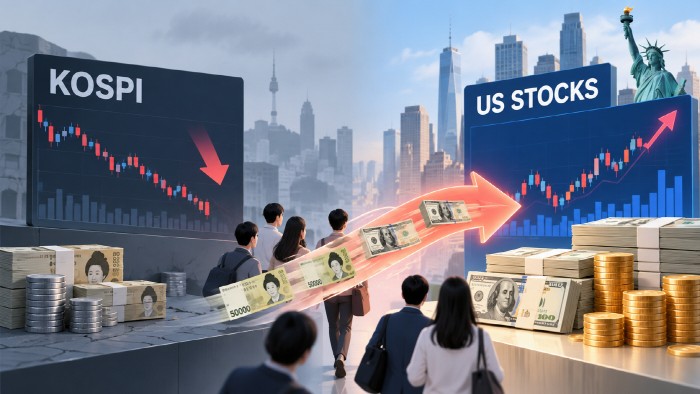 |
| This image was generated by AI. |
As trading value in South Korea's stock market has shrunk to its lowest level of the year, retail investors are once again shifting their funds to the U.S. stock market. Trading value on the KOSPI market has remained below 20 trillion won, while investor deposits have fallen below 90 trillion won. Meanwhile, South Korean investors' net purchases of U.S. stocks exceeded $4.8 billion this month, reaching their highest level in nine months.
Although volatility has also increased in the U.S. stock market amid concerns over artificial intelligence (AI) investment, investors continue to view the sharp corrections in semiconductor and technology stocks as opportunities to buy at lower prices. Market watchers believe that next week's earnings announcements from Samsung Electronics and SK Hynix, along with the possibility of additional shareholder returns, will be a turning point for the recovery of investor sentiment and market demand.
According to the Korea Exchange (KRX) on Oct. 23, trading value on the KOSPI market fell to 14.9157 trillion won the previous day, its lowest level of the year. Trading value edged up to 16.4742 trillion won on Oct. 23 but remained in the 10 trillion won range for the second consecutive day. That represents a decline of approximately 80% from the year's peak of 80.3325 trillion won recorded on May 29.
The KOSPI has also struggled to establish a clear direction amid repeated sharp swings. The index closed at 5,550.30 on Oct. 23, up 0.30% from the previous session. However, its closing levels had successively declined from 5,554.22 on Oct. 15 to 5,552.74 on Oct. 20 and 5,533.77 on Oct. 22. The latest closing level was 39.1% below the year's peak of 9,114.55 recorded on June 22.
The contraction in trading activity is attributed to heightened short-term volatility and instability in supply and demand. Persistent external uncertainties, including concerns over the profitability of AI investments and U.S. interest rates and inflation, have encouraged investors to adopt a wait-and-see approach. At the same time, the market's capacity to absorb selling pressure has weakened.
In particular, analysts say that SK Hynix's completion of its share buyback program on Oct. 21 has reduced the number of major buyers capable of absorbing shares sold by foreign investors. "With SK Hynix's share buyback program having ended, a major source of demand that had been absorbing foreign investors' selling pressure is now absent," said Lee Kyung-min, an analyst at Daishin Securities.
Funds held by retail investors in preparation for domestic stock investments are also declining rapidly. According to the Korea Financial Investment Association (KOFIA), investor deposits fell to 89.6344 trillion won as of Oct. 21, their lowest level since Jan. 14. Compared with the more than 139 trillion won recorded in early June, the figure represents a decline of approximately 50 trillion won in just over four months.
As funds awaiting investment in the domestic stock market decline, retail investors are increasingly shifting their money to U.S. equities. According to the Korea Securities Depository (KSD), South Korean investors' net settlement purchases of U.S. stocks totaled approximately $4.8 billion from Oct. 1 to 22. This was the highest level in nine months, since approximately $5 billion was recorded in January. Net purchases of U.S. stocks had declined to around $1.9 billion in August and $1 billion in September before surging again this month.
However, volatility has also increased in the U.S. stock market. Overnight, the Nasdaq Composite Index plunged 2.60% as concerns resurfaced over AI investment costs and profitability, while the Philadelphia Semiconductor Index fell 6.72%. The S&P 500 also declined 1.21%. Despite these losses, South Korean investors have continued buying U.S. stocks, apparently viewing the sharper corrections in semiconductor and technology shares as opportunities to buy at lower prices.
Buying demand from foreign and institutional investors has also yet to emerge clearly enough to fill the gap left by retail investors. According to Yuanta Securities, foreign investors were net sellers of approximately 37 trillion won worth of shares across 200 major stocks over seven consecutive weeks before turning to modest net buying only this week. Institutional investors also recorded net sales of approximately 523.2 billion won this week.
Brokerages expect next week's earnings announcements from major South Korean and overseas companies to be a turning point for the recovery of investor sentiment. "Earnings announcements from major domestic and overseas companies are concentrated next week, starting with SK Hynix on Oct. 28 and Samsung Electronics on Oct. 29, followed by Microsoft and Alphabet, and Amazon and Intel on Oct. 30," Lee said. "For Big Tech companies, investors need to assess the sustainability and profitability of AI investment, while for Samsung Electronics and SK Hynix, they need to look for signs of additional shareholder returns."
"If the two semiconductor giants announce shareholder return measures, they could help fill the demand gap and provide downside support for the stock market," he added.
Park Ju-yeon
Most Read
-
1
Celltrion nears additional contract with major U.S..

-
2
Putin proposes trilateral U.S.-China-Russia summit..

-
3
U.S. weighs dropping MOAB, world's most powerful n..

-
4
"Aren't those foreigners on welfare?": M..

-
5
Attention centers on APEC for possible Trump-Xi-Pu..

-
6
Saudi Arabia, Iran hold first diplomatic talks to..

-
7
China tightens grip on boosting domestic demand an..

PEOPLE







-
Address : In-Young Bldg., 34, Uisadang-daero 1-gil, Yeongdeungpo-gu, Seoul
Copyright by ASIATODAY CO., LTD. All rights resereved