



Australian sheep numbers hit 100-year low, driving up lamb prices
Oct 23, 2026, 02:45 pm


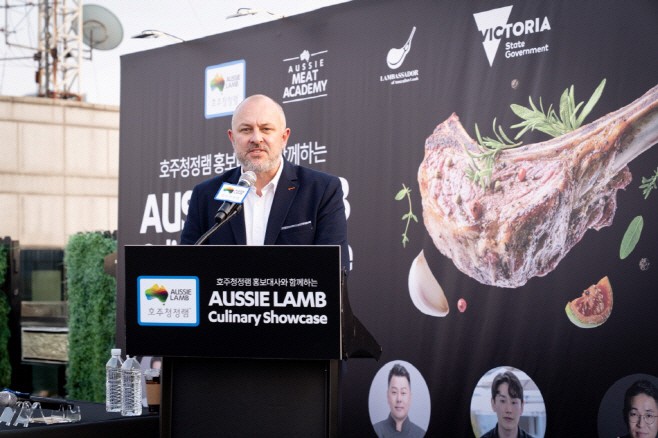 |
| Travis Brown, regional manager for Northeast Asia at Meat & Livestock Australia (MLA), delivers opening remarks at the Australian Lamb Showcase held in May 2025. / Courtesy of Meat & Livestock Australia |
Lamb prices in Australia, where the meat is a staple of the national diet, continue to climb to unprecedented levels, adding to consumers' grocery bills.
According to a report by Australia's Nine News on Oct. 22 (local time), the country's sheep flock has fallen to its lowest level in a century this year, pushing lamb prices at major supermarkets up approximately 20% to 35% compared with typical levels.
Lamb ribs, a popular cut for grilling, are selling for A$45 to A$53 per kilogram (approximately 40,500 to 47,700 won), while loin chops cost A$23 to A$27 (approximately 20,700 to 24,300 won) and traditional bone-in leg cuts are priced at A$16 to A$22 (approximately 14,400 to 19,800 won). These prices are markedly higher than typical spring prices, when lamb ribs sell for A$28 to A$38 (approximately 25,200 to 34,200 won) and loin chops for A$15 to A$19 (approximately 13,500 to 17,100 won).
The main reason for the sharp price increases is a steep decline in sheep numbers caused by years of persistent drought and unfavorable weather conditions in southern Australia.
Stuart Bull, market information manager at Meat & Livestock Australia (MLA), said, "Australia's sheep flock has fallen to its lowest level in 100 years," adding that sheep slaughter numbers in 2026 are expected to decline by more than 10% from the previous year.
"Farmers are now reducing the number of breeding ewes they sell and retaining more of them to rebuild their flocks, leaving market supplies extremely tight despite the peak selling season," he said.
Bull explained that strong export demand, particularly from the United States and China, is also pushing prices higher.
An MLA official further predicted, "With sheep numbers in short supply nationwide, flock rebuilding expected to take an extended period and global lamb supply chains remaining tight, current prices are likely to persist for some time."
Conditions are also difficult for livestock farmers. Rising production and distribution costs mean that their actual profits remain minimal.
Justin Everett, who operates Aintree Park sheep farm in New South Wales (NSW), said, "Diesel-related expenses, including tractor fuel and transportation costs, have skyrocketed, and the cost of purchasing breeding sheep has also risen too much. Even after working hard, we are left with almost nothing."
He added, "We have also been unable to rebuild our flock because of the severe losses we suffered when farmgate prices plunged two years ago."
Beef prices have also remained high. According to the Australian Bureau of Statistics (ABS), retail prices for beef and veal have risen approximately 13% over the past year. Unlike lamb, however, whose high prices are driven by a shortage of sheep, Australian beef prices remain elevated in the domestic market because of surging import demand from overseas markets, including the United States, despite production being near record levels.
Lee Dae-won
Most Read
-
1
Celltrion nears additional contract with major U.S..

-
2
Putin proposes trilateral U.S.-China-Russia summit..

-
3
U.S. weighs dropping MOAB, world's most powerful n..

-
4
"Aren't those foreigners on welfare?": M..

-
5
Attention centers on APEC for possible Trump-Xi-Pu..

-
6
Saudi Arabia, Iran hold first diplomatic talks to..

-
7
China tightens grip on boosting domestic demand an..

PEOPLE







-
Address : In-Young Bldg., 34, Uisadang-daero 1-gil, Yeongdeungpo-gu, Seoul
Copyright by ASIATODAY CO., LTD. All rights resereved