



Lee's approval rating returns to 40% range
Oct 23, 2026, 01:22 pm


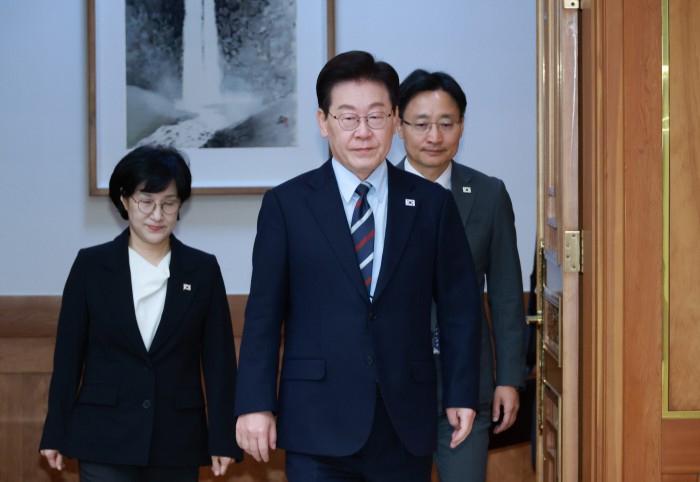 |
| President Lee Jae-myung enters a government-wide meeting on building a safer society at Cheong Wa Dae on Oct. 23. / Yonhap News Agency |
President Lee Jae-myung's approval rating has returned to the 40% range for the first time in seven weeks, according to a poll released on Oct. 23.
A Gallup Korea survey conducted from Oct. 20 to 22 among 1,001 voters aged 18 and older nationwide showed Lee's approval rating at 40%, up 1 percentage point from the previous week's survey.
Lee's approval rating reached the 40% range for the first time in seven weeks since the first week of September, when it stood at 40%.
His disapproval rating fell 2 percentage points from the previous survey to 50%, while 10% of respondents withheld their opinions.
Among respondents who approved of Lee's job performance, diplomacy was the most frequently cited reason at 21%, followed by the economy and people's livelihoods at 14% and communication at 7%.
Among those who disapproved, real estate policy was the most frequently cited reason at 18%, followed by the economy and people's livelihoods at 16% and national defense, security and North Korea policy at 10%.
"Compared with last week, mentions of economic issues increased among both the reasons for positive and negative evaluations," Gallup Korea said.
By region, approval was highest in the combined South Jeolla, Gwangju and North Jeolla region at 72%. Daejeon, Sejong and the Chungcheong provinces recorded 46%, while Busan, Ulsan and South Gyeongsang stood at 41%.
Incheon and Gyeonggi recorded 35%, followed by Seoul at 30%. Daegu and North Gyeongsang posted the lowest approval rating at 28%.
By age group, respondents in their 50s recorded an approval rating of 57%, while those in their 40s registered 49%, showing relatively high levels of support. Approval stood at 42% among those in their 60s and 38% among those aged 70 and older.
Respondents aged 18 to 29 recorded an approval rating of 24%, while those in their 30s posted the lowest figure at 22%.
In the survey of political party support, the Democratic Party of Korea and the People Power Party each gained 1 percentage point from the previous survey, reaching 37% and 28%, respectively.
The Rebuilding Korea Party recorded 3%, the Reform Party 2% and the Progressive Party 1%. Respondents with no party preference accounted for 27%.
The survey was conducted through interviews by telephone surveyors using randomly selected virtual mobile phone numbers. It had a margin of sampling error of plus or minus 3.1 percentage points at a 95% confidence level, a contact rate of 41.3% and a response rate of 10.6%. Further details are available on the website of the National Election Survey Deliberation Commission.
Hong Sun-mi
Most Read
-
1
Celltrion nears additional contract with major U.S..

-
2
Putin proposes trilateral U.S.-China-Russia summit..

-
3
U.S. weighs dropping MOAB, world's most powerful n..

-
4
"Aren't those foreigners on welfare?": M..

-
5
Attention centers on APEC for possible Trump-Xi-Pu..

-
6
Saudi Arabia, Iran hold first diplomatic talks to..

-
7
China tightens grip on boosting domestic demand an..

PEOPLE





-
Address : In-Young Bldg., 34, Uisadang-daero 1-gil, Yeongdeungpo-gu, Seoul
Copyright by ASIATODAY CO., LTD. All rights resereved