



[Expert Interview] Kim Jong-un death rumors unfounded, expert says
Oct 23, 2026, 10:54 am


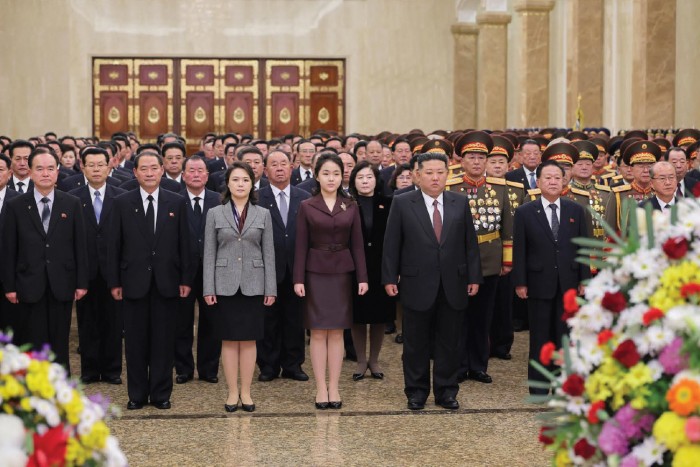 |
| North Korean leader Kim Jong-un visits the Kumsusan Palace of the Sun in Pyongyang with his wife, Ri Sol-ju, and daughter, Kim Ju-ae, on Jan. 1, 2026, to mark the New Year. Kim Ju-ae and Ri Sol-ju stand side by side to Kim Jong-un's left, with senior North Korean party, government and military officials behind them. North Korean state media released the photo the following day. / Yonhap, photo provided by the Korean Central News Agency (KCNA) |
As rumors spread that North Korean leader Kim Jong-un has died or become unable to govern due to serious health problems, Cheong Seong-chang, vice president of the Sejong Institute and an expert on North Korea's power structure, dismissed the claims as lacking credible evidence.
Cheong said the rumors about Kim's death or incapacitation were difficult to reconcile logically with North Korea's past practice of bringing in medical personnel when former leader Kim Jong-il suffered health problems, its state media's reporting practices concerning the activities of its supreme leader, and the recent movements of Kim Yo-jong, a deputy department director of the ruling Workers' Party, near the Military Demarcation Line (MDL). He argued that Kim Yo-jong's visits to frontline areas and successive statements directed at South Korea should instead be examined in the context of North Korea's border fortification efforts and its strategy of pressuring the South.
In a telephone interview with AsiaToday on Oct. 22, Cheong questioned the credibility of the source behind claims posted on social media by a Chinese dissident that Kim Jong-un had died and been transported to China.
"Such a person is not in a position to know whether Kim Jong-un is alive or dead," he said.
Cheong also compared North Korea's responses to Kim Jong-il's health problems in 2008 and his death in 2011, pointing out that if Kim Jong-un had actually suffered a serious medical emergency, the North Korean leadership would likely be displaying behavior different from what is currently being observed.
However, Cheong's assessment is an expert analysis based on publicly available circumstantial evidence and historical precedents. No medical records or intelligence agency findings independently verifying Kim Jong-un's actual health status have been presented.
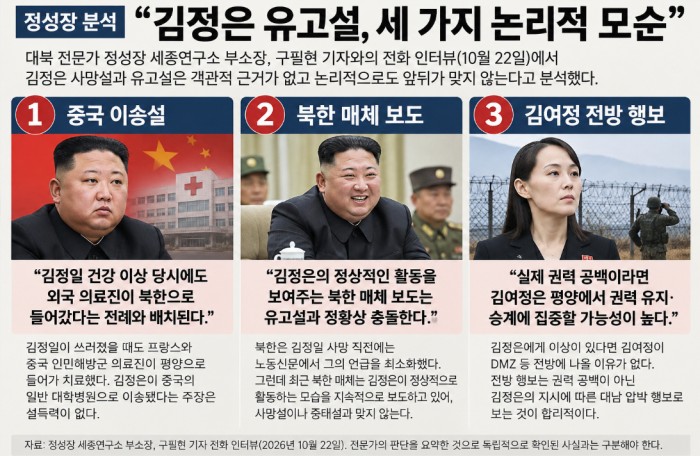 |
| Cheong Seong-chang, vice president of the Sejong Institute, dismissed the recently spreading rumors of North Korean leader Kim Jong-un's death or incapacitation as claims lacking objective evidence during an interview on Oct. 22. Cheong cited three factors in assessing the rumors as lacking credibility: ① the precedent of foreign medical personnel visiting Pyongyang when Kim Jong-il suffered health problems, ② North Korean state media reports showing Kim Jong-un carrying out normal activities, and ③ Kim Yo-jong's recent visits to frontline areas. His assessment is based on circumstantial evidence and does not independently verify Kim Jong-un's health status. / Graphic by Koo Pil-hyun, created with AI assistance |
Emergency interview with Cheong Seong-chang
Reporter Koo Pil-hyun: A Chinese dissident recently posted a claim on social media that Chairman Kim Jong-un had already died and that his body had been transported to China. Combined with Kim Yo-jong's unusual visits to frontline areas, the claim has fueled rumors that Kim Jong-un has died or become incapacitated. What is your assessment?
Cheong Seong-chang: "I do not believe that at all. First of all, a Chinese dissident is not in a position to know for certain whether Kim Jong-un is alive or dead. If such a serious situation had actually occurred, intelligence agencies, including South Korea's National Intelligence Service, would likely have detected relevant developments. It is unreasonable to conclude that North Korea's supreme leader has died based solely on claims from unclear sources."
Koo: There are also claims that Kim Jong-un was transferred to a hospital in China. How do these compare with Kim Jong-il's past health problems?
Cheong: "Even when Kim Jong-il collapsed, he did not go to China. French medical personnel and medical staff from hospitals affiliated with China's People's Liberation Army came to North Korea. The claim that North Korea's supreme leader would be transferred to an ordinary university hospital is unconvincing even from a common-sense perspective. His identity could easily be exposed at such a facility. It would be far more natural to bring the medical personnel needed to treat the supreme leader into North Korea."
Koo: How should we interpret recent North Korean state media reports on Kim Jong-un's activities?
Cheong: "If something serious had happened to Kim Jong-un, it would be difficult for Rodong Sinmun to show him carrying out normal activities as though nothing had happened. Even when Kim Jong-il died, North Korean media kept references to the situation to a minimum until his death was officially announced. It does not make logical sense to continue showing the supreme leader going about his usual activities when he is facing an emergency."
However, the dates on which North Korean state media photographs are taken and released may differ. Reports showing Kim Jong-un carrying out normal activities may therefore serve as circumstantial evidence against the rumors of his incapacitation, but they do not, by themselves, conclusively establish his current health status.
Koo: Some analysts suggest that Kim Yo-jong's visit to the area near the Military Demarcation Line indicates that she has effectively emerged as North Korea's dominant power broker. What do you think?
Cheong: "I think it should be viewed the other way around. If something had actually happened to Kim Jong-un, Kim Yo-jong should be staying in Pyongyang. In an emergency, she would need to prepare for a transfer of power or establish her own power base. Why would she go all the way down to the Military Demarcation Line? It does not make logical sense."
Koo: Are you suggesting that Kim Yo-jong was acting on Kim Jong-un's direct orders?
Cheong: "North Korea's statement uses the phrase 'by authorization.' This can be interpreted as meaning that she was acting on Kim Jong-un's instructions. If Kim Jong-un were in an emergency situation, Kim Yo-jong would not have the time to concern herself with issues involving South Korea."
The use of the term "authorization" in North Korea's official statement suggests that Kim Yo-jong is delivering messages to South Korea on the authority of the supreme leader. However, the expression alone does not establish when Kim Jong-un actually issued any instructions or what those instructions were.
Koo: North Korean media released photos and videos on Oct. 20 showing Kim Jong-un visiting a clothing and footwear exhibition in Pyongyang with his wife, Ri Sol-ju, and daughter, Kim Ju-ae. Doesn't the fact that these images were released shortly after the death rumors began spreading carry significance?
Cheong: "If something had happened to Kim Jong-un, could they really show him smiling with his family as though nothing had happened? Anyone making claims that he has died or become incapacitated needs to provide evidence that supports such claims."
The Korean Central News Agency (KCNA) and Korean Central Television (KCTV) reported on Oct. 20 that Kim Jong-un had visited the National Garment and Footwear Exhibition-2026 in Pyongyang on Oct. 19. South Korean diplomatic and security officials also said they had not obtained any information supporting the rumors of Kim Jong-un's death.
Kim Jong-il's 2008 stroke and 2011 death: What was different?
Kim Jong-il suffered serious health problems following a stroke in 2008, but the North Korean regime brought foreign medical personnel to Pyongyang to treat him. French neurosurgeon François-Xavier Roux, who treated Kim Jong-il at the time, confirmed that he had personally visited North Korea and that Kim had suffered a stroke.
By contrast, when Kim Jong-il died on Dec. 17, 2011, North Korea officially announced his death two days later, on Dec. 19. This demonstrates that North Korea can keep the death of its supreme leader undisclosed for a certain period.
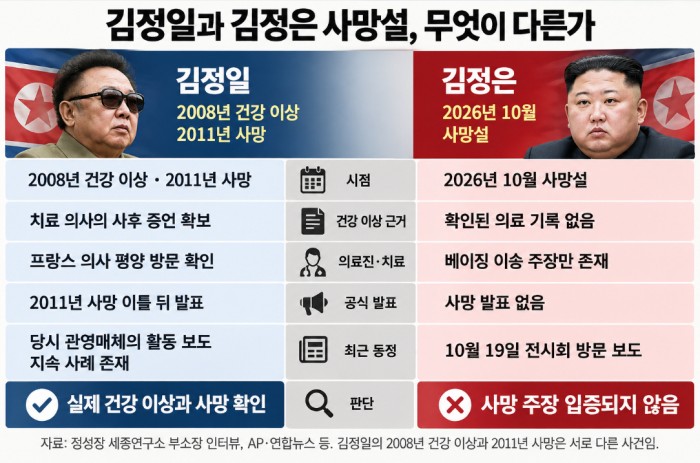 |
| "Kim Jong-il's death and rumors of Kim Jong-un's death: What is different?" During the interview, Cheong Seong-chang, vice president of the Sejong Institute, noted that French medical personnel had visited Pyongyang when Kim Jong-il suffered health problems in 2008 and that North Korean authorities officially announced his death two days after he died in 2011. By contrast, there is no evidence supporting claims that Kim Jong-un was transferred to a hospital in China, and North Korean media have recently reported on his public activities. Comparing historical precedents with the North Korean leadership's recent movements, Cheong assessed the rumors of Kim Jong-un's death as lacking credibility. / Graphic by Koo Pil-hyun, created with AI assistance |
Reporter Koo Pil-hyun: Can we conclude, then, that the recent rumors of Kim Jong-un's death are fake news lacking objective evidence? In particular, Wanjun Xie, a Chinese dissident living in the United States who has been identified as the original source of the rumors, is reportedly known for spreading unverified claims in the past, including rumors about the death of Chinese President Xi Jinping. This time, he claimed that Kim Jong-un had suffered a brain hemorrhage, been transferred to Beijing, died and had his body returned to North Korea, but provided no evidence to substantiate those claims.
Cheong Seong-chang: "A Chinese dissident is not in a position to know whether Kim Jong-un is alive or dead. If such a serious situation had actually occurred, our National Intelligence Service would probably be better positioned to detect relevant developments. Even when Kim Jong-il collapsed in the past, he did not go to China. Instead, foreign medical personnel were brought to Pyongyang to treat him. The claim that Kim Jong-un was transferred to an ordinary university hospital in China is unconvincing to begin with."
Koo: So you are saying that not only is there no objective evidence proving Kim Jong-un's death, but the rumors are also inconsistent with how North Korea's supreme leaders have been treated medically in the past and with Kim Yo-jong's recent movements.
Cheong: "That's right. If Kim Jong-un were actually facing an emergency, Kim Yo-jong should be concentrating on preparing for a transfer of power or establishing her own power base in Pyongyang. Why would she go all the way down to the Military Demarcation Line? It does not make logical sense."
Kim Yo-jong's frontline visits: A signal of power succession or pressure on South Korea?
Koo: Kim Yo-jong's recent actions are unusual compared with the past. There are also concerns that North Korea may be preparing new military actions near the Military Demarcation Line.
Cheong: "There may be an intention to divert attention from the recent landmine explosion incident by raising another issue. It reminds me of the situation in 2020, when Kim Yo-jong spearheaded the destruction of the inter-Korean liaison office. At the time, North Korean officials also publicly supported her actions. We need to watch closely because she may be trying to provoke another incident this time as well."
Koo: So you are suggesting that North Korea may seek to pressure South Korea by fueling internal divisions rather than engaging in direct military confrontation.
Cheong: "Just as North Korea repeatedly sent balloons carrying trash into South Korea over the issue of anti-North Korean leaflets during the Yoon Suk-yeol administration, causing us persistent trouble, this could also be seen as an attempt to keep pressuring the South. I also believe there may be an intention to divert attention from the landmine explosion incident by raising another issue."
Cheong's analysis is noteworthy in that it interprets North Korea's recent movements as a continuation of its existing hard-line policy toward South Korea rather than as evidence of a power vacuum at the top of the regime. However, the exact locations of Kim Yo-jong's visits and the specific circumstances surrounding the landmine explosion incident need to be verified through separate official sources.
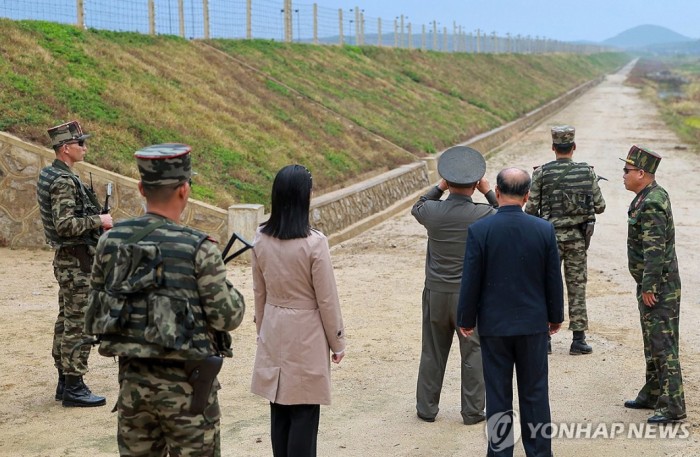 |
| The Korean Central News Agency (KCNA) reported on Oct. 21 that Kim Yo-jong, a department director of the Workers' Party of Korea, inspected key sites of fortification work along North Korea's southern border on Oct. 20, accompanied by Pak Jong-chon, an adviser to the North's Ministry of National Defense, Ri Il-hwan, a secretary of the Workers' Party, and senior commanders of the Korean People's Army General Staff. / Yonhap, photo provided by KCNA |
Fortification of N. Korea-China border largely complete, troop deployment along inter-Korean border warrants attention, Cheong says
Reporter Koo Pil-hyun: Some analysts have also linked North Korea's border fortification efforts to the possibility of Kim Jong-un's incapacitation. What is your assessment?
Cheong Seong-chang: "Fortification work along the border between North Korea and China has been underway for a long time. When I recently visited the area around the Yalu River myself, I saw that much of the work had already been completed. Fortification work is now underway along the inter-Korean border."
Koo: Could the fortification of the North Korea-China border and the inter-Korean border also affect how North Korea deploys its troops?
Cheong: "If fortification work along the inter-Korean border makes substantial progress, couldn't North Korea withdraw troops stationed there and send them to Russia?"
This raises the possibility that North Korea could reduce the burden on its existing border security forces by strengthening border controls and constructing defensive facilities, allowing it to deploy some troops to other fronts. However, this does not mean that any actual troop reductions or plans for additional deployments to Russia have been confirmed.
Focus on N. Korea's actual military actions is needed rather than on rumors of Kim Jong-un's incapacitation
The recent rumors of Kim Jong-un's death demonstrate how easily questions about the North Korean leader's health can lead to international confusion over information. The claims, which originated from a Chinese dissident's social media post, spread through overseas media outlets, but no medical evidence proving his death or confirmation from a credible intelligence agency has emerged.
Kim Jong-il's stroke in 2008 and death in 2011 demonstrate how tightly North Korea controls information about the health and death of its supreme leader. However, such information controls do not justify accepting unsubstantiated death rumors as fact.
Cheong's assessment centers on three points. Claims that Kim Jong-un was transferred to China are inconsistent with North Korea's past practice of bringing in foreign medical personnel. Recent North Korean state media reports showing Kim carrying out normal activities contradict the rumors of his incapacitation. And Kim Yo-jong's visits to frontline areas are more reasonably interpreted as a continuation of pressure on South Korea than as preparations for a transfer of power.
Ultimately, what South Korea should focus on is not unverified rumors of Kim Jong-un's death, but what military actions North Korea is actually preparing to take. Analysts say it is necessary to comprehensively examine fortification work near the Military Demarcation Line, Kim Yo-jong's hard-line messages toward South Korea, military cooperation with Russia and the possibility of additional troop deployments.
North Korean troop movements and actual military activities are therefore far more important indicators for assessing security on the Korean Peninsula than unverified rumors about whether Kim Jong-un is alive or dead.
Koo Pil-hyun
Most Read
-
1
Celltrion nears additional contract with major U.S..

-
2
Putin proposes trilateral U.S.-China-Russia summit..

-
3
U.S. weighs dropping MOAB, world's most powerful n..

-
4
"Aren't those foreigners on welfare?": M..

-
5
Attention centers on APEC for possible Trump-Xi-Pu..

-
6
Saudi Arabia, Iran hold first diplomatic talks to..

-
7
China tightens grip on boosting domestic demand an..

PEOPLE







-
Address : In-Young Bldg., 34, Uisadang-daero 1-gil, Yeongdeungpo-gu, Seoul
Copyright by ASIATODAY CO., LTD. All rights resereved