



Lula steps up crime crackdown ahead of Brazil's presidential runoff
Oct 23, 2026, 10:26 am


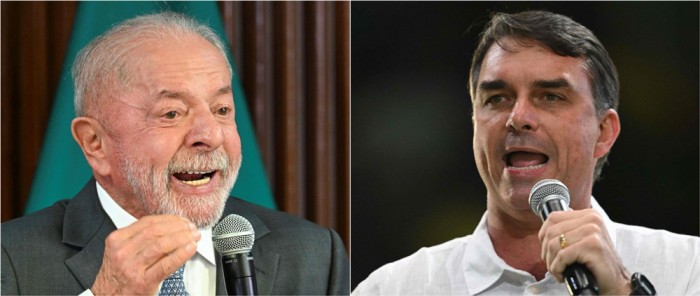 |
| Brazilian President Luiz Inácio Lula da Silva (left) and Brazilian Senator Flávio Bolsonaro. / AFP-Yonhap |
As Brazil's presidential election has become an extremely close race, President Luiz Inácio Lula da Silva, the candidate of the ruling Workers' Party (PT), is making an all-out effort to win last-minute voter support ahead of the runoff election scheduled for Oct. 25 (local time), including by bringing forward welfare benefit payments and seeking to recover illicit funds held by criminal organizations.
After finishing behind Senator Flávio Bolsonaro, the candidate of the right-wing Liberal Party (PL), in the first round of voting, Lula is seeking to rally his supporters until the final stages of the campaign and come from behind to win the runoff.
Brazilian federal prosecutors filed four civil lawsuits totaling 190.3 million reais (approximately 50 billion won) on Oct. 20 (local time) against two major international drug cartels, the First Capital Command (PCC) and Comando Vermelho (CV), under an anti-organized crime law that allows authorities to seize illicit funds without a criminal conviction, local newspaper Folha de S.Paulo reported on Oct. 21.
Brazil's deteriorating public security situation has long been regarded as one of Lula's weaknesses. The lawsuits are seen as an attempt by Lula to highlight his leadership on public security by demonstrating tough action against criminal organizations ahead of the runoff.
On Oct. 19, the Brazilian government announced that it would bring forward the distribution of welfare benefits to approximately 50 million low-income citizens, originally scheduled to be paid in stages through Oct. 30, to Oct. 21 in order to respond proactively to the risks of extreme weather and natural disasters.
Lula's rival, Senator Bolsonaro, pulled off an upset by finishing first in the initial round of voting held on Oct. 4. Bolsonaro received 47.03% of the vote, ahead of Lula's 45.16%. As neither candidate secured a majority, the two advanced to a runoff.
Various recent opinion polls have shown the two candidates in a close race within the margin of error, making the final outcome difficult to predict.
In a runoff poll released by polling firm Quaest on Oct. 21, Bolsonaro led Lula by 45% to 44%, a difference within the survey's margin of error of plus or minus 2.0 percentage points.
The two candidates are sharply divided on a wide range of policies, from the economy and welfare to public security.
BBC News Brasil recently compared the candidates' campaign pledges by examining their policy platforms as well as campaign events, interviews, online livestreams and social media posts.
Lula has proposed expanding the role of the state, strengthening social welfare policies and extending labor rights.
Senator Bolsonaro, meanwhile, advocates private-sector-led economic development, tax cuts and tougher measures against crime.
The two candidates are particularly at odds over the question of pardons for former President Jair Bolsonaro and those involved in the riots.
Senator Bolsonaro has pledged that, if elected president, he will pardon his father, former President Jair Bolsonaro, as well as those convicted over the Jan. 8, 2023, riots in Brasília, the capital, when supporters of the former president rioted while alleging election fraud.
Former President Bolsonaro was sentenced to 27 years in prison by the Supreme Federal Court in September last year on charges of attempting to stage a military coup to overthrow Lula's government after leaving office in January 2022. He was imprisoned but is now under house arrest due to deteriorating health.
Kim Hyun-min
Most Read
-
1
Celltrion nears additional contract with major U.S..

-
2
Putin proposes trilateral U.S.-China-Russia summit..

-
3
U.S. weighs dropping MOAB, world's most powerful n..

-
4
"Aren't those foreigners on welfare?": M..

-
5
Attention centers on APEC for possible Trump-Xi-Pu..

-
6
Saudi Arabia, Iran hold first diplomatic talks to..

-
7
China tightens grip on boosting domestic demand an..

PEOPLE







-
Address : In-Young Bldg., 34, Uisadang-daero 1-gil, Yeongdeungpo-gu, Seoul
Copyright by ASIATODAY CO., LTD. All rights resereved