



BOK expects stronger recovery in private consumption next year
Oct 23, 2026, 09:27 am


 |
An analysis by the Bank of Korea (BOK) suggests that large performance bonuses and dividends resulting from the semiconductor boom, along with increased government spending, will drive a recovery in private consumption next year. In particular, performance bonus payments by major companies, including Samsung Electronics and SK Hynix, are expected to reach 60 trillion to 70 trillion won next year, about six times this year's level, potentially raising the private consumption growth rate by up to 0.15 percentage points. However, concerns remain that the concentration of bonus and dividend benefits among high-income earners, persistent household debt burdens, a sluggish construction sector and stock market corrections could constrain the consumption recovery.
According to a Bank of Korea (BOK) report released on Oct. 22 examining the conditions for a future recovery in private consumption, private consumption increased 2.6% in the first half of this year from a year earlier. Although this exceeded the average growth rate of 1.4% over the past two years, the gap between private consumption growth and gross domestic product (GDP) growth widened. This was partly because the benefits of the semiconductor boom were concentrated in certain industries and income groups, limiting the spread of the consumption recovery.
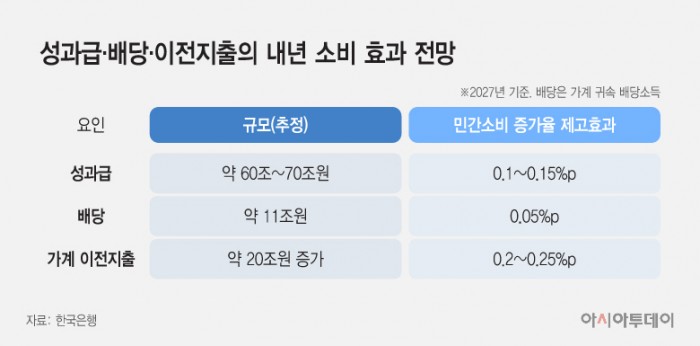
The BOK expects the spillover effects of the semiconductor boom to begin materializing in earnest next year. Performance bonuses to be paid next year by major companies, including Samsung Electronics, SK Hynix and companies in the automobile and shipbuilding industries, are estimated at approximately 60 trillion to 70 trillion won, about six times this year's 10.9 trillion won. In particular, bonuses to be paid by Samsung Electronics and SK Hynix alone in the first quarter of next year are expected to reach 60 trillion won.
The increase in performance bonuses is projected to raise next year's private consumption growth rate by 0.1 to 0.15 percentage points. Estimates based on the Korean Labor and Income Panel Study showed that an increase of 1 million won in temporary income leads to an increase of approximately 110,000 won in consumption. However, because the benefits are concentrated among high-income employees at large corporations, it is expected to take time for the consumption effects to spread to other income groups.
Large dividend payments by semiconductor companies are also expected to support the consumption recovery. The BOK expects Samsung Electronics to pay approximately 30 trillion won in special dividends this November and an additional 40 trillion to 60 trillion won next year. It estimated SK Hynix's dividend payments next year at 10 trillion to 30 trillion won. Taking into account the proportion of shares in the two companies held by individual investors and other factors, dividend income accruing to households is estimated at approximately 11 trillion won, which is projected to raise next year's private consumption growth rate by 0.05 percentage points.
Increased government transfer payments to households are expected to improve the spending capacity of middle- and low-income groups. As higher corporate tax payments by semiconductor companies expand the government's fiscal capacity, transfer payments to households are estimated to increase by approximately 20 trillion won next year. The increase in transfer payments is projected to raise the private consumption growth rate by 0.2 to 0.25 percentage points. However, uncertainty remains over the actual scale of the increase, as next year's budget has yet to be finalized.
A decline in the exchange rate is also expected to improve household purchasing power. A 10% decline in the won-dollar exchange rate is estimated to improve households' real purchasing power by approximately 0.35%, partly through lower import prices. Relative to disposable income, the improvement in purchasing power was estimated at 0.46% for households in the lowest income quintile, more than double the 0.20% estimated for those in the highest income quintile.
Meanwhile, accumulated household debt, a sluggish construction sector and stock market corrections were identified as factors that could constrain the recovery in private consumption. Last year, the debt-to-disposable-income ratio of households with debt reached 196.1%. In the third quarter of this year, stock market corrections pushed households' unrealized gains on stock holdings into negative territory, creating a reverse wealth effect that also weighed on consumption.
"The recovery in private consumption has yet to spread widely, but it is expected to gradually broaden as the effects of the semiconductor boom spread through the economy into next year," said Shin Dong-ju, a manager in the Business Conditions Team of the BOK's Economic Research Department.
Han Sang-wook
Most Read
-
1
Celltrion nears additional contract with major U.S..

-
2
Putin proposes trilateral U.S.-China-Russia summit..

-
3
U.S. weighs dropping MOAB, world's most powerful n..

-
4
"Aren't those foreigners on welfare?": M..

-
5
Attention centers on APEC for possible Trump-Xi-Pu..

-
6
Saudi Arabia, Iran hold first diplomatic talks to..

-
7
China tightens grip on boosting domestic demand an..

PEOPLE







-
Address : In-Young Bldg., 34, Uisadang-daero 1-gil, Yeongdeungpo-gu, Seoul
Copyright by ASIATODAY CO., LTD. All rights resereved