



S. Korea expands AI vaccine strategy to include clinical development
Oct 23, 2026, 09:23 am


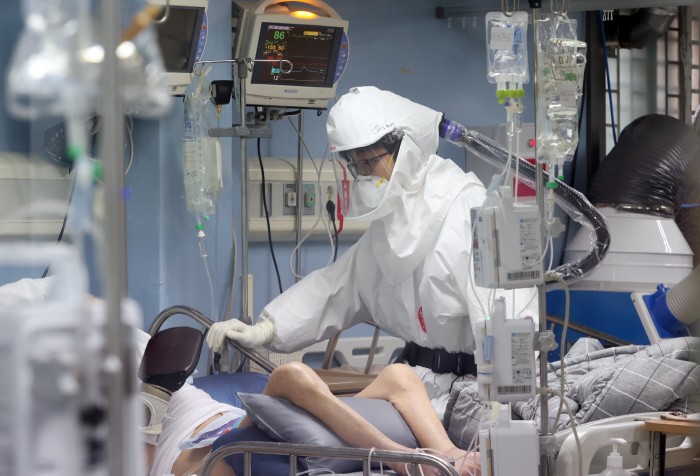 |
| Medical staff attend to a patient in the intensive care unit of a designated COVID-19 treatment hospital during the COVID-19 pandemic. / Yonhap |
South Korea's artificial intelligence (AI) vaccine strategy is expanding beyond support for individual research projects to include the establishment of a development platform linking surveillance, design, clinical trials and regulatory approval. The aim is to apply research achievements that have been concentrated on COVID-19 to other infectious diseases and shorten the time needed to secure vaccines during new outbreaks.
According to the Korea Disease Control and Prevention Agency (KDCA) on Oct. 22, the government assessed in its June plan to improve the infectious disease crisis management system that achievements in developing vaccines, therapeutics and disease prevention supplies had been concentrated on COVID-19. It also identified a lack of core technologies and rapid development platforms, as well as delays in securing vaccines and therapeutics beyond the target timelines despite government-wide support, as limitations.
Accordingly, the AI vaccine strategy is expanding beyond accelerating the discovery of vaccine candidates to linking experimental validation with clinical development. The key question is whether research capabilities accumulated in response to specific infectious diseases can be applied to new pathogens and lead from candidate discovery to actual development.
The Korean AI Pandemic Preparedness Engine (K-AI PPX), whose development plans the KDCA shared with the Coalition for Epidemic Preparedness Innovations (CEPI) the previous day, is a project aimed at supporting this shift. The platform will use AI throughout the process, from pathogen analysis and vaccine candidate design to the prediction of clinical trial outcomes, while linking research and development data with antigen design and validation.
However, the project is still in the preparation stage. A joint workshop was held and plans were shared this year, while the government's June plan indicated that the establishment of an integrated research and development platform would begin in 2027. The government's proposed budget for next year includes 8 billion won in new funding for the related National Strategic Vaccine Development Support Project.
Separately, research on a digital preclinical platform supported by the Ministry of Science and ICT began in July this year. Led by Professor Nam Ki-taek's team at Yonsei University College of Medicine, the research involves using AI to predict the efficacy, safety and immune responses of candidate substances and then comparing those predictions with actual preclinical experimental results.
The effectiveness of the two projects will depend on whether AI-identified candidates can proceed to experimental validation and clinical development. Even if AI identifies promising candidates, their immune responses and safety must still be confirmed through experiments and clinical trials.
The same question has been raised in overseas research. Reviews of AI vaccine research published in 2024 and 2025 identified data heterogeneity, model interpretability and alignment with regulatory frameworks as major challenges. Experts agree that the new strategy aims to extend research capabilities accumulated during the COVID-19 pandemic to vaccine development for other infectious diseases. They also emphasize that AI-identified candidates must be validated through experiments and clinical trials, ultimately leading to the timely availability of vaccines needed during public health emergencies.
In this regard, KDCA Commissioner Lim Seung-kwan said at a side event on the Pandemic Preparedness Engine, "We will strengthen the integrated support system for ultra-rapid antigen design and the entire vaccine development cycle to thoroughly protect the lives and safety of our people from the next pandemic crisis."
Lee Se-mi
Most Read
-
1
Celltrion nears additional contract with major U.S..

-
2
Putin proposes trilateral U.S.-China-Russia summit..

-
3
U.S. weighs dropping MOAB, world's most powerful n..

-
4
"Aren't those foreigners on welfare?": M..

-
5
Attention centers on APEC for possible Trump-Xi-Pu..

-
6
Saudi Arabia, Iran hold first diplomatic talks to..

-
7
China tightens grip on boosting domestic demand an..

PEOPLE






-
Address : In-Young Bldg., 34, Uisadang-daero 1-gil, Yeongdeungpo-gu, Seoul
Copyright by ASIATODAY CO., LTD. All rights resereved