



Profitability gap widens as 4 in 10 SMEs fail to earn enough to cover interest
Oct 22, 2026, 09:38 am


 |
| This image was generated by AI. |
Although the operating profit margin of domestic corporations climbed to a four-year high last year on the back of booms in semiconductors and shipbuilding, the profitability gap between conglomerates and small and medium-sized enterprises (SMEs) widened instead. In contrast to the earnings improvements at large corporations, the operating profit margin of SMEs dropped to an all-time low, while the proportion of companies unable to cover even their interest expenses with operating profits climbed to a record high.
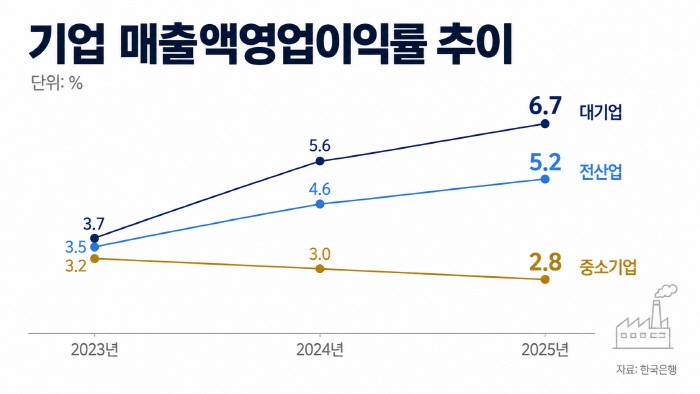
According to the 2025 Financial Statement Analysis released by the Bank of Korea on the 21st, the ratio of operating profit to revenue for large enterprises rose from 5.6% to 6.7% last year, posting the highest level since 2021. In contrast, SMEs dropped from 3.0% to 2.8%, marking their lowest level since statistics began in 2009. Consequently, the operating margin gap between large corporations and SMEs widened from 2.6 percentage points to 3.9 percentage points. In particular, the operating margin for small-sized enterprises among SMEs slipped from 1.8% to 1.5%, highlighting an even steeper deterioration in profitability.
Despite the widening gap between large corporations and SMEs, overall corporate profitability indicators improved. The ratio of operating profit to revenue across 982,767 domestic non-financial for-profit corporations stood at 5.2% last year, up 0.6 percentage points from the previous year (4.6%). This is the highest level since 2021 (5.6%). The ratio of pre-tax net profit to revenue also increased by 0.9 percentage points from 4.3% to 5.2%.
Disparities also emerged in corporate debt-servicing capacity. The overall corporate interest coverage ratio rose from 244.1% to 292.7%. However, among companies with interest expenses, the proportion of firms with an interest coverage ratio below 100%—those unable to handle even interest costs with their operating profits—inched up from 42.8% to 42.9%, reaching a record high since data collection began in 2009. The median interest coverage ratio among individual companies also dropped for the fourth consecutive year. After sliding from 356.6% in 2021 to 196.2% in 2024, it dropped further to 194.0% last year.
By industry, manufacturing operating margins rose from 5.1% to 6.3%, while non-manufacturing rose from 4.1% to 4.3%. Within manufacturing, gains were notable in electronic, visual, and communication equipment including semiconductors (8.3% to 14.0%) and shipbuilding and other transport equipment (6.4% to 11.6%). Factors such as expanded sales and price increases for high-value semiconductors, increased revenue recognition from vessels, and easing cost burdens contributed to this performance.
Corporate growth rates slowed down. Last year, the revenue growth rate stood at 2.4%, down 1.3 percentage points from the prior year (3.7%). Manufacturing slowed from 4.6% to 2.4%, and non-manufacturing dropped from 2.9% to 2.3%. Manufacturing was impacted by lower prices for petroleum products driven by falling international crude oil prices, while non-manufacturing was affected by falling maritime freight rates and a slump in the construction industry.
Financial soundness indicators improved overall. The debt-to-equity ratio across all companies declined from 119.9% to 116.2%, marking the lowest level since 2019 (115.6%). The borrowings-to-total-assets ratio also dropped from 31.0% to 30.4%.
Lee Mi-joo, head of the corporate statistics team at the Bank of Korea, explained, "When calculating the proportion of firms with an interest coverage ratio below 100%, companies without interest expenses are excluded," adding, "Rather than viewing overall profitability and stability as having deteriorated, the proportion rose slightly among companies that bear interest burdens."
She added, "Looking at the first- and second-quarter management analysis results for externally audited corporations this year, the profitability of SMEs is also improving alongside large corporations," noting, "There is a possibility that the upward trend in the share of companies with an interest coverage ratio below 100% will not persist."
Park Seo-a
Most Read
-
1
Celltrion nears additional contract with major U.S..

-
2
Putin proposes trilateral U.S.-China-Russia summit..

-
3
U.S. weighs dropping MOAB, world's most powerful n..

-
4
"Aren't those foreigners on welfare?": M..

-
5
Houthis launch successive attacks on Saudi airport..

-
6
Saudi Arabia, Iran hold first diplomatic talks to..

-
7
Attention centers on APEC for possible Trump-Xi-Pu..

PEOPLE







-
Address : In-Young Bldg., 34, Uisadang-daero 1-gil, Yeongdeungpo-gu, Seoul
Copyright by ASIATODAY CO., LTD. All rights resereved