



Hyundai Mobis targets 2029 rollout for first domestic automotive chips
Oct 21, 2026, 04:19 pm


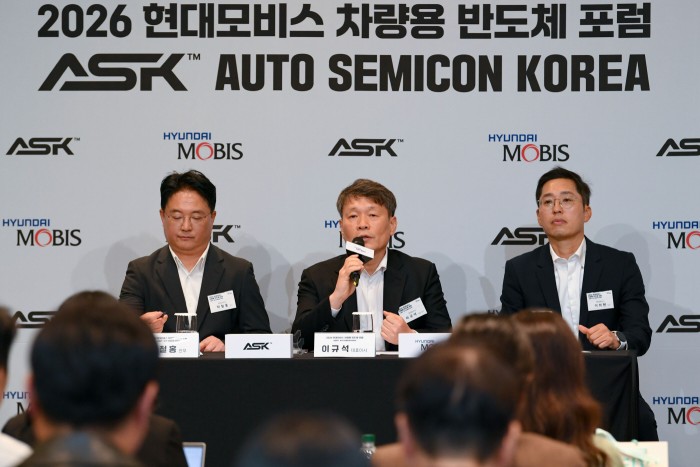 |
| Hyundai Mobis President and CEO Lee Gyu-suk (center), Senior Vice President Park Chul-hong of the Semiconductor Business Division (left), and Vice President Lee Hee-hyun of the System Semiconductor Office take questions during a press briefing at the 2nd Auto Semicon Korea (ASK) automotive semiconductor forum held at DoubleTree by Hilton Seoul Pangyo in Seongnam, Gyeonggi Province, on the 21st. / Hyundai Mobis |
Hyundai Mobis is accelerating efforts to foster a domestic automotive semiconductor ecosystem as it moves to link selected development projects, identified through its collaborative platform launched last year, to initial mass production by 2029. The plan envisions bridging the capabilities of domestic fabless design houses and foundries with end-vehicle demand to cement a foundation for domestic localization while securing long-term supply chain stability.
At a press briefing during the 2nd Auto Semicon Korea (ASK) automotive semiconductor forum held at DoubleTree by Hilton Seoul Pangyo in Seongnam, Gyeonggi Province, on the 21st, Hyundai Mobis CEO Lee Gyu-suk said, "The earliest timeline points to 2029, when we expect deployment in mass-production vehicles. Starting next year, inputs will begin from the initial vehicle development phases where these chips are to be integrated."
Hyundai Mobis launched ASK in September of last year based on the assessment that, despite the growth trajectory of the domestic automotive sector, its foundation in automotive semiconductors remains vulnerable.
While the domestic auto industry has advanced to top-tier global standing, automotive semiconductors suffer from low localization rates and an underdeveloped industrial ecosystem. In response, Hyundai Mobis conceived a collaborative model designed to link domestic chipmakers that built technological expertise in other industries with the automotive sector to accelerate joint development.
CEO Lee explained, "Korea already possesses established, verified key players including fabless firms, foundries, and design houses. We realized that if we effectively connect them and foster collaboration, we could forge a model where the semiconductor industry and the automotive industry mutually reinforce each other, just as the automotive industry grew."
Outcomes from the past year following the inaugural forum are also materializing into concrete plans. Among 19 project proposals submitted by domestic companies at the time, development for 13 projects has been confirmed, with target mass-production vehicle models determined for nine of them through consultations with Hyundai Motor and Kia.
CEO Lee stated, "Proposals were focused primarily on items where chips already developed for mobile devices or home appliances could be adapted and transitioned for automotive applications. We finalized 13 projects after determining they could be developed into automotive chips, and narrowed down target mass-production vehicles for nine of them."
The expansion of participating companies and institutions from 27 last year to 53 this year also marks a notable achievement. The scope of participation broadened beyond existing semiconductor design and manufacturing firms to encompass software, intellectual property (IP), test evaluation, and functional safety fields.
CEO Lee evaluated, "Last year's forum proved to be an operational, viable model, drawing strong engagement. This year carries added significance for building the domestic ecosystem as diverse players spanning the entire semiconductor development lifecycle joined."
Development infrastructure has also been augmented in partnership with the government. In response to industry concerns over the shortage of testing and validation facilities for automotive semiconductor reliability, the Ministry of Trade, Industry and Energy and the Korea Automotive Technology Institute (KATECH) moved to establish a comprehensive automotive semiconductor support center in Cheonan. Facility operations are slated to begin in June of next year.
Assessing the competitiveness of the domestic automotive chip sector, CEO Lee noted that "from an automotive standpoint, Korea lags significantly behind," but added that system semiconductors could rapidly gain competitiveness if domestic firms' design and commercial experience are linked with demand from Hyundai Motor Group.
He said, "While readiness in system semiconductors remains insufficient today, Korea boasts many capable players. If we clearly present semiconductor demand aligned with medium- to long-term automotive technology trends and establish collaborative frameworks, we can secure competitiveness in short order."
Conversely, regarding power semiconductors, he emphasized the need to expand the research and development foundation first, citing a lack of domestic players and design technologies. CEO Lee stated, "In power semiconductors, establishing domestic R&D fabrication facilities represents the crucial first step. If the government invests and creates an environment where domestic fabless firms can access fabs at affordable costs to reduce development burdens, we will eventually catch up with advanced nations, even if it takes time."
To be sure, the short-term impact of such automotive semiconductors on Hyundai Mobis's earnings remains limited. Developing chips alone requires two to three years, vehicle integration and validation demand an additional 18 to 30 months, and overall vehicle development schedules must also be factored in.
CEO Lee remarked, "It will be difficult to contribute meaningfully to top-line revenue right away. However, if we do not undertake such efforts and investments now, not only Hyundai Mobis but also Hyundai Motor and Kia could face immense hurdles in sustaining operations down the road. We are approaching this strictly as a long-term investment."
Looking ahead, cooperation may expand into high-performance systems-on-chip (SoCs). While initial projects focus on adapting chips used in other industries for automotive use, demand for higher-performance semiconductors will inevitably swell alongside the transition toward software-defined vehicles (SDVs).
CEO Lee explained, "As we transition toward SDVs, moving toward high-performance SoCs is imperative. We are initially pursuing the development of communication SoCs, working alongside domestic fabless partners under the government's M.AX Alliance national R&D project."
CEO Lee emphasized, "The objective of this forum is to channel the attention of key players scattered across the nation into automotive semiconductors and accelerate the pace of collaboration. We will shape this into a communication channel and collaborative platform that translates the interest and capabilities of government, academia, and research institutions into tangible execution."
Kim Jeong-kyu
Most Read
-
1
Celltrion nears additional contract with major U.S..

-
2
Putin proposes trilateral U.S.-China-Russia summit..

-
3
"Aren't those foreigners on welfare?": M..

-
4
U.S. weighs dropping MOAB, world's most powerful n..

-
5
Houthis launch successive attacks on Saudi airport..

-
6
Saudi Arabia, Iran hold first diplomatic talks to..

-
7
Saudi airport in Riyadh struck again, leaving at l..

PEOPLE






HEADLINE NEWS
- [Exclusive] U.S. military steel frame work at Gwangju Airport casts cloud over planned semiconductor industrial complex
- Momentum grows for mid-next month U.S.-China-Russia summit with mounting is..
- Elon Musk formalizes review of SpaceX-Tesla merger
- [Exclusive] 10 SNUs pledged, but three regional universities take half the..

-
Address : In-Young Bldg., 34, Uisadang-daero 1-gil, Yeongdeungpo-gu, Seoul
Copyright by ASIATODAY CO., LTD. All rights resereved