



Takaichi's conservative push in year one tests Korea-Japan pragmatism
Oct 21, 2026, 03:35 pm


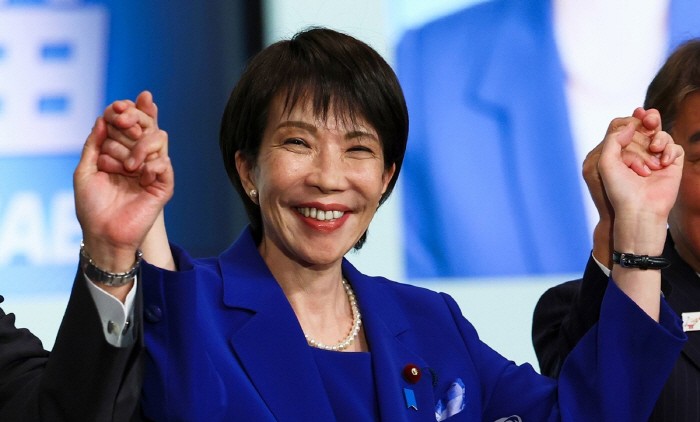 |
| Prime Minister Takaichi when she was elected president of the Liberal Democratic Party one year ago. / Yonhap, News |
Japanese Prime Minister Sanae Takaichi marked her first year in power on the 21st. Leveraging her personal popularity, she secured a landslide victory in the House of Representatives general election and secured momentum to push forward her conservative agenda. However, her intra-party foundation and coalition cohesion have not necessarily solidified. With inflation burdens and cabinet resignations compounding challenges, her approval rating in some opinion polls has dropped below 50%.
Security and economic cooperation with South Korea continue, but striking a balance between the expectations of her domestic conservative base and diplomacy with neighboring nations remains a task ahead.
A defining characteristic of the Takaichi administration is the prime minister's personal popularity extending beyond support for the LDP. In an interview with the Asahi Shimbun that day, Professor Naoko Taniguchi of Keio University explained the findings of a political perception survey of about 10,000 respondents nationwide, assessing that voters favorable toward Takaichi do not necessarily coincide with those favorable toward the LDP. Analysts point out that her personal support base, which is broader than the party's traditional base, played a key role in the LDP winning more than a two-thirds majority of all seats on its own in the lower house general election in February this year.
However, it is difficult to uniformly describe public sentiment at the one-year mark as high-flying support. In an FNN poll conducted on the 17th and 18th, the cabinet's approval rating rose by 1 percentage point from the previous month to 62.6%. In an ANN poll conducted over the same period, it dropped by 11.2 percentage points to 47.1%, marking the lowest level since the administration took office. While discrepancies across surveys are wide, signs of support attrition are also emerging.
The governing mechanism has also changed. The LDP-Komeito coalition, which lasted for 26 years, coordinated policy differences based on electoral cooperation. In contrast, the coalition between the LDP and Nippon Ishin no Kai is bonded primarily around policy implementation. Professor Koji Nakakita of Chuo University likened Komeito to a "brake" and Ishin to an "accelerator" in an interview with the Asahi.
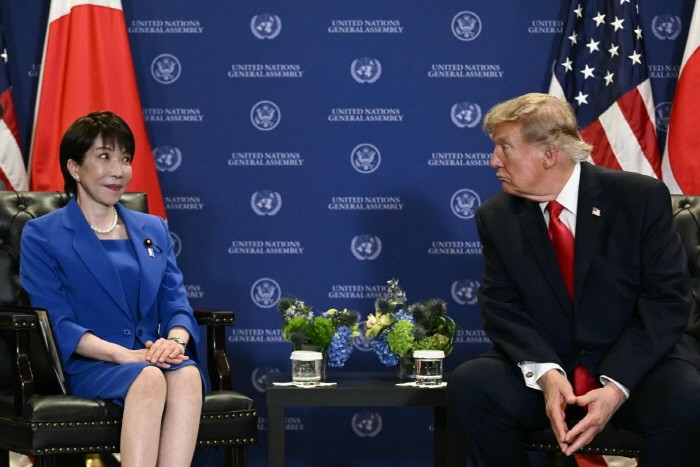 |
| One year of Takaichi closely aligned with Trump. / Yonhap News |
The two parties formed a coalition yet competed against each other in elections. In the lower house general election this past February, LDP candidates also ran in 85 of the 87 single-member districts where Ishin fielded candidates. In effect, policy agreement sustains the coalition rather than a shared electoral foundation. While this serves as a force accelerating policy implementation, it can simultaneously become a factor testing cohesion whenever achievements stall or disagreements widen.
Economic problems cannot be resolved by Takaichi's personal popularity and parliamentary seats alone
The issue that is difficult to resolve through Prime Minister Takaichi's personal popularity and legislative seats alone is the economy. To supporters, fiscal expansion and tax cuts represent a promise to ease living costs. In financial markets, however, they fuel concerns over government bond issuance and inflation. Jiji Press analyzed on the 19th that anxiety surrounding proactive fiscal policy is triggering a weaker yen and rising long-term interest rates, putting pressure on the administration to adjust course. In fact, clashes between Prime Minister Takaichi and BOJ Governor Ueda over expansionary fiscal policy are also deepening.
Public sentiment regarding improvements in living standards is also polling weak. In an ANN survey, respondents answering that their livelihood improved compared to a year ago stood at 9%, while those saying it worsened reached 34%. Personnel vetting and crisis response capabilities were also called into question during the resignation of Minister of Agriculture, Forestry and Fisheries Kazuo Yana. Whether electoral victory can translate into tangible changes in people's daily lives is the core task facing Takaichi in her second year in office.
In diplomacy, opposition parties are also urging the prime minister to play an active role. Yuichiro Tamaki, leader of the Democratic Party for the People, cited shifts in the international order during a radio broadcast on the 21st, arguing that it would be fine for the prime minister to dedicate more than half her time to diplomacy. While expressing a willingness to cooperate on parliamentary scheduling, he added that because the ruling coalition falls short of a majority in the House of Councillors, the government should listen flexibly to opposition voices.
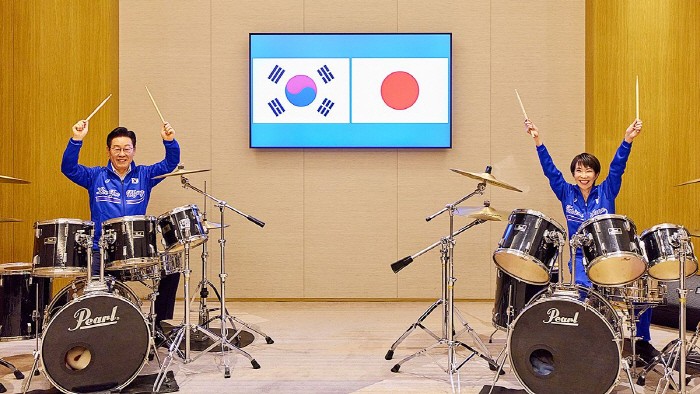 |
| President Lee Jae-myung plays drums in an ensemble during a friendly conversation with Prime Minister Sanae Takaichi at a hotel in Nara Prefecture, Japan, on January 13. / Blue House Press Corps |
Separating Takaichi's conservative ideology from pragmatic diplomacy is necessary
In Korea-Japan relations, there is a need to distinguish Takaichi's conservative ideological leanings from her actual diplomatic conduct. Japan has consistently identified cooperation with South Korea as a strategic interest. During their summit in January of this year, Prime Minister Takaichi and President Lee Jae-myung discussed the importance of bilateral Seoul-Tokyo and trilateral Seoul-Washington-Tokyo security cooperation. They also agreed to advance economic security cooperation, including supply chains, and agreed to continue shuttle diplomacy involving reciprocal visits between the two leaders. A summit at a Japanese hot spring is expected before the year is out.
On bilateral historical issues, tangible points of cooperation have also emerged. The two leaders welcomed progress in DNA testing consultations to identify human remains discovered at the Chosei coal mine. This created room to build cooperation not only in security, but also on humanitarian issues tied to historical affairs.
However, historical friction has not vanished entirely. On the 17th, Prime Minister Takaichi sent an offering to Yasukuni Shrine in her capacity as prime minister. TV Asahi reported at the time that she opted against a direct, in-person visit in consideration of relations with South Korea and China. This illustrates her position of having to manage domestic politics conscious of Japan's conservative base alongside diplomatic burdens.
Synthesizing these agreements and moves, South Korea and Japan are highly likely to sustain cooperation in areas offering clear, pragmatic benefits, such as security and supply chains. However, solidifying this into a stable bilateral relationship requires translating trust between the leaders into tangible results while keeping historical issues under management. Korea-Japan ties in Takaichi's second year in office will hinge on how effectively she balances conservative domestic politics with pragmatic foreign cooperation.
Choi Young-jae
Most Read
-
1
Celltrion nears additional contract with major U.S..

-
2
Putin proposes trilateral U.S.-China-Russia summit..

-
3
"Aren't those foreigners on welfare?": M..

-
4
U.S. weighs dropping MOAB, world's most powerful n..

-
5
Houthis launch successive attacks on Saudi airport..

-
6
Saudi Arabia, Iran hold first diplomatic talks to..

-
7
Saudi airport in Riyadh struck again, leaving at l..

PEOPLE





HEADLINE NEWS
- [Exclusive] U.S. military steel frame work at Gwangju Airport casts cloud over planned semiconductor industrial complex
- Momentum grows for mid-next month U.S.-China-Russia summit with mounting is..
- Elon Musk formalizes review of SpaceX-Tesla merger
- [Exclusive] 10 SNUs pledged, but three regional universities take half the..

-
Address : In-Young Bldg., 34, Uisadang-daero 1-gil, Yeongdeungpo-gu, Seoul
Copyright by ASIATODAY CO., LTD. All rights resereved