



LG Chem targets precision oncology with AI engine to reshape drug discovery
Oct 21, 2026, 02:57 pm


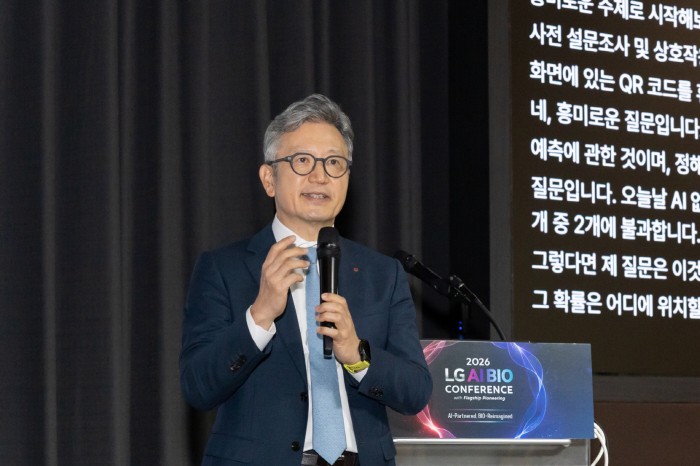 |
| Son Jee-woong, president of LG Chem, delivers a keynote speech at the 2026 LG AI Bio Conference held at the LG Sciencepark ISC Building in Gangseo-gu, Seoul, on the 20th. / LG Chem |
LG Chem is establishing artificial intelligence (AI) as a core engine for drug development, expanding AI-driven decision-making across the entire pipeline from candidate discovery to clinical trial patient stratification. Through this strategy, the company aims to dramatically enhance the probability of drug development success.
LG Chem announced on the 21st that it co-hosted the 2026 LG AI Bio Conference with the LG AI Research Institute and U.S. biotech venture capital firm Flagship Pioneering at the LG Sciencepark ISC Building in Gangseo-gu, Seoul, on the 20th.
The event was held for the first time to foster a South Korea-based AI-bio innovation ecosystem and expand global collaboration. Around 140 officials from leading domestic and international AI-bio enterprises attended to discuss how AI will reshape the future of drug discovery and drive industrial innovation.
LG Chem highlighted the potential of AI applications in clinical development, expressing its determination to spearhead innovation in precision oncology.
Considering the complex biological characteristics of tumors, LG Chem plans to refine biomarker-based clinical trial patient stratification and actively leverage AI in treatment strategy decision-making.
LG Chem also shared progress on its personalized mRNA cancer vaccine, being pursued as a flagship project in AI-driven drug development. The company is developing and optimizing an AI model that precisely predicts individualized neoantigens that induce immune responses against cancer cells.
Plans call for progressing through preclinical studies next year and entering clinical development in 2029. By utilizing AI to identify optimal therapeutic targets for individual patients, the company envisions securing distinctive competitiveness in personalized oncology therapeutics.
Global biotech enterprises gathered at the event also reached a consensus that AI is fundamentally transforming how drugs are developed.
André Andonian, Asia-Pacific chair of Flagship Pioneering, said, "We are using AI to accelerate scientific discovery, grow innovative technologies into new enterprises, and uncover insights that can provide new therapeutic opportunities for patients worldwide," adding, "We share a common belief that AI can advance life science innovation, combining scientific ideas and expertise to translate that potential into tangible results."
Following this, Zu Wang, head of global business development at Insilico Medicine, presented end-to-end AI drug development success stories where drug candidates discovered via generative AI advanced to clinical stages. Ryan Leung, head of life science products at Lila Science, highlighted the concept of "self-driving laboratories" where AI agents iteratively design, synthesize, test, and learn, presenting a forward direction for AI-based research innovation.
During the panel discussion that followed, Lee Jung-seok, CEO of Inocras, discussed patient stratification approaches based on whole-genome cancer sequencing data. Na Kwon-jung, chief medical officer (CMO) of Portrai, drew attention by introducing biomarker discovery and patient stratification strategies leveraging spatial biology-based AI technology.
Son Jee-woong, head of the Life Sciences Company at LG Chem, emphasized, "AI is evolving not merely into a tool for drug development, but into a core engine that determines competitiveness," adding, "Competitiveness in future drug development lies not just in finding structurally superior medicines, but in leveraging AI to identify patients who will derive the highest therapeutic benefit."
Moon Jeong-woo
Most Read
-
1
Celltrion nears additional contract with major U.S..

-
2
Putin proposes trilateral U.S.-China-Russia summit..

-
3
"Aren't those foreigners on welfare?": M..

-
4
U.S. weighs dropping MOAB, world's most powerful n..

-
5
Houthis launch successive attacks on Saudi airport..

-
6
Saudi Arabia, Iran hold first diplomatic talks to..

-
7
Saudi airport in Riyadh struck again, leaving at l..

PEOPLE





HEADLINE NEWS
- [Exclusive] U.S. military steel frame work at Gwangju Airport casts cloud over planned semiconductor industrial complex
- Momentum grows for mid-next month U.S.-China-Russia summit with mounting is..
- Elon Musk formalizes review of SpaceX-Tesla merger
- [Exclusive] 10 SNUs pledged, but three regional universities take half the..

-
Address : In-Young Bldg., 34, Uisadang-daero 1-gil, Yeongdeungpo-gu, Seoul
Copyright by ASIATODAY CO., LTD. All rights resereved