



Takaichi urges BOJ to boost bond buying, fueling controversy over return to Abenomics
Oct 21, 2026, 02:05 pm


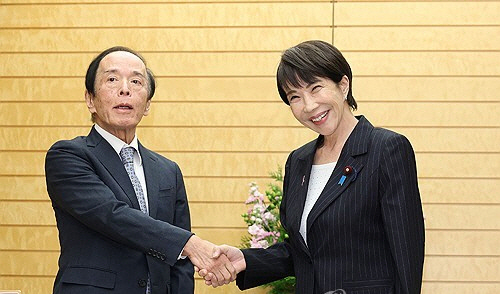 |
| Japanese Prime Minister Sanae Takaichi (right) and Bank of Japan Governor Kazuo Ueda (left) clash over government bond purchases. / Yonhap News |
Japanese Prime Minister Sanae Takaichi and Bank of Japan Governor Kazuo Ueda are clashing over government bond purchases. Governor Ueda has been raising interest rates and trimming bond buying, yet Prime Minister Takaichi has reportedly demanded that the central bank purchase more government bonds. Tensions are surfacing between the prime minister, who seeks to expand fiscal spending while suppressing interest burdens, and the central bank chief, who is scaling back monetary easing to counter inflation and a weak yen.
Prime Minister Takaichi reportedly asked BOJ Governor Kazuo Ueda in May to purchase government bonds to suppress rises in long-term interest rates. In an article on the 21st reviewing the administration's first year in power, the Asahi Shimbun reported that the prime minister made remarks to the effect of calling for an increase in Japanese government bond (JGB) purchases at the time. The newspaper also cited a government official explaining that her intent was to curb rises in long-term rates in exchange for tolerating short-term rate hikes.
The positions of the two figures diverge over how far interest rates should rise. The BOJ led by Governor Ueda has been scaling back monetary easing by raising short-term interest rates applied when financial institutions borrow funds from one another for short periods. Prime Minister Takaichi accepted this, yet moved to block increases in long-term interest rates determined by the market.
Long-term interest rates affect fixed mortgage rates, corporate long-term funding, and government interest payment burdens on national debt. When a central bank buys more government bonds, bond prices rise and yields fall. The prime minister's demand to expand bond purchases is a means to lower long-term interest burdens for both the government and the private sector.
A government official explained to the Asahi that the prime minister framed her remarks around wanting to suppress rises in long-term interest rates instead of conceding to short-term rate hikes. The reason Prime Minister Takaichi is wary of long-term rates connects directly to her signature policy agenda. Financing is indispensable to pursue her "responsible, proactive fiscal policy" of expanding public spending alongside consumption tax cuts. If the funding shortfall is financed through government bond issuance, higher interest rates will impose a heavier fiscal burden on the government.
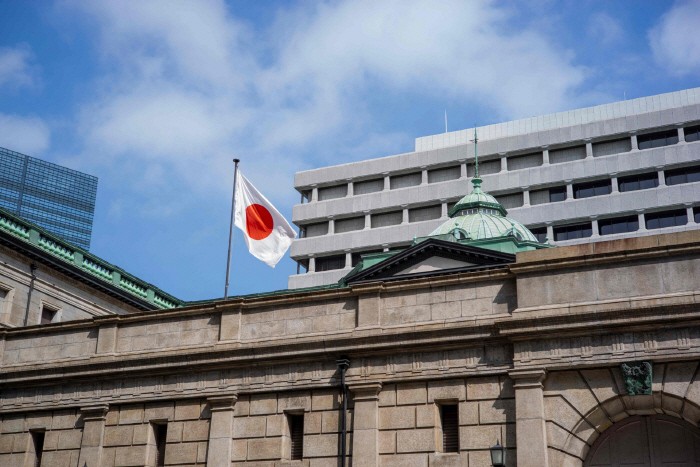 |
| Bank of Japan, Japan's central bank. / Yonhap News |
However, experts assess that Prime Minister Takaichi's policies lie behind the rise in long-term interest rates. The Asahi pointed out that anxiety over funding sources for proactive fiscal policy and consumption tax cuts has fueled the surge in long-term yields since the administration took office. It is a structure where increased spending and tax cuts stoke worries over expanded government bond issuance, and rising interest rates in turn put pressure on fiscal management. The prime minister's demand is seen as asking the BOJ to ease this burden through government bond purchases.
BOJ Governor Ueda is in a position where he must monitor inflation and yen weakness simultaneously. The BOJ has raised interest rates three times between the inauguration of the Takaichi administration and September of this year. It has also trimmed bond purchases. Both measures align in that they steer away from large-scale monetary easing. Increasing bond purchases as requested by the prime minister would effectively reverse course on one of these two pillars.
The policy distance between the two figures is also evident in Prime Minister Takaichi's past remarks. During the Liberal Democratic Party leadership election in September 2024, she fiercely criticized interest rate hikes. While she tolerated rate increases after taking power, this report indicates that her inclination to support the economy and public finances with low interest rates remains unchanged.
This is precisely why the Asahi presented the perspective of a return to Abenomics. The framework where massive central bank bond purchases and low interest rates support fiscal expansion resembles Abenomics. However, the BOJ is currently rolling back monetary easing to counter inflation and a weak yen.
The report did not include whether Governor Ueda accepted the request or how he responded. Nor was any public war of words confirmed. What is clear is a clash of policies. Prime Minister Takaichi wants room to expand fiscal spending. Governor Ueda is scaling back monetary easing. The clash between the two over how many government bonds to buy has become a key focal point for the Japanese economy.
Choi Young-jae
Most Read
-
1
Celltrion nears additional contract with major U.S..

-
2
Putin proposes trilateral U.S.-China-Russia summit..

-
3
"Aren't those foreigners on welfare?": M..

-
4
U.S. weighs dropping MOAB, world's most powerful n..

-
5
Houthis launch successive attacks on Saudi airport..

-
6
Saudi Arabia, Iran hold first diplomatic talks to..

-
7
Saudi airport in Riyadh struck again, leaving at l..

PEOPLE






HEADLINE NEWS
- [Exclusive] U.S. military steel frame work at Gwangju Airport casts cloud over planned semiconductor industrial complex
- Momentum grows for mid-next month U.S.-China-Russia summit with mounting is..
- Elon Musk formalizes review of SpaceX-Tesla merger
- [Exclusive] 10 SNUs pledged, but three regional universities take half the..

-
Address : In-Young Bldg., 34, Uisadang-daero 1-gil, Yeongdeungpo-gu, Seoul
Copyright by ASIATODAY CO., LTD. All rights resereved