



Indonesian students take to streets on 2nd anniversary of Prabowo's inauguration
Oct 21, 2026, 01:46 pm


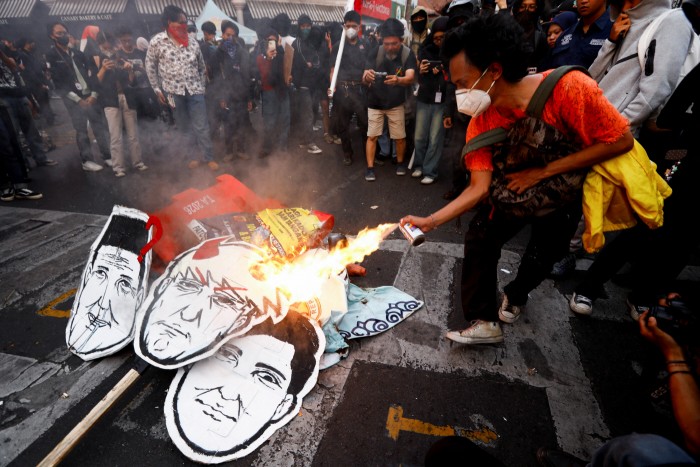 |
| A protester burns caricatures of Indonesian President Prabowo Subianto and other key figures during an anti-government rally held in Bandung, West Java, on the 20th (local time), marking the second anniversary of President Prabowo's inauguration, condemning the government's response to wildfires and calling for the eradication of corruption and cronyism. / Reuters, Yonhap News |
On the 20th (local time), marking the second anniversary of Indonesian President Prabowo Subianto taking office, university students and civil society groups staged protests in major cities, including the capital Jakarta, calling for solutions to wildfires, economic policy improvements, and reductions in education costs. Amid President Prabowo's job approval rating plunging from the 81% range to the 44% range within a single year, controversies over fiscal burdens surrounding flagship welfare initiatives such as free school lunches are also mounting.
According to Reuters and CNN Indonesia, a coalition of university students and civic organizations held a rally in front of the Tugu Tani monument in central Jakarta that afternoon. According to organizers, the coalition included students from nine universities across Java, including the University of Indonesia (UI), Bandung Institute of Technology (ITB), and Gadjah Mada University. In preparation for the protests, authorities deployed 9,505 security personnel to Jakarta, including 7,660 police officers and 1,540 military troops. Demonstrations were also held in Yogyakarta in Central Java, Bandung in West Java, and Makassar on Sulawesi Island; in Makassar, 33 locations across the city became protest sites, with roughly 3,000 military and police personnel deployed.
Jakarta protesters presented five key demands: designating wildfires and floods as national disasters and punishing corporations responsible for environmental damage; restoring market confidence through economic policy revisions; ending restrictions on freedom of expression; rooting out corruption and cronyism; and lowering the costs of education, healthcare, and public services. Yatathalof Imawan, head of the UI Student Executive Board (BEM UI), stated that the group would focus on welfare and rising living costs rather than controversy surrounding Vice President Gibran Rakabuming Raka's academic credentials or calls for impeachment. The UI student council asserted that the recent stock market plunge and the weakening rupiah are warning signs pointing to the "vulnerability of the national economy."
At a rally in front of the Yogyakarta Regional People's Representative Council (DPRD), military interference and flagship welfare programs came under intense scrutiny. CNN Indonesia reported that thousands gathered at the site. Students from the Islamic University of Indonesia (UII) who gathered there demanded seven points, including an end to militarism such as military intervention in civilian affairs, the temporary suspension and reassessment of free school meal programs and village cooperative initiatives, and judicial processing for 13 past severe human rights violation cases. The speaker of the provincial council stated that the demands would be conveyed to the central government, while police reported that the protests proceeded peacefully.
The stock market crash and wildfires that students took issue with have flared up consecutively in recent days. On the 16th, when global index provider Morgan Stanley Capital International (MSCI) proposed reclassifying Indonesia from an emerging market to a "standalone market" citing concerns over market dysfunction, the Jakarta stock market plummeted by more than 11% in a single day, marking its steepest drop since 1998. Furthermore, as wildfires persisting for over two months sent transboundary haze spreading across borders, more than 60,000 firefighting personnel were mobilized. During a cabinet meeting last week, President Prabowo designated the wildfires as one of the top priorities, ordering an immediate response and measures to prevent recurrence.
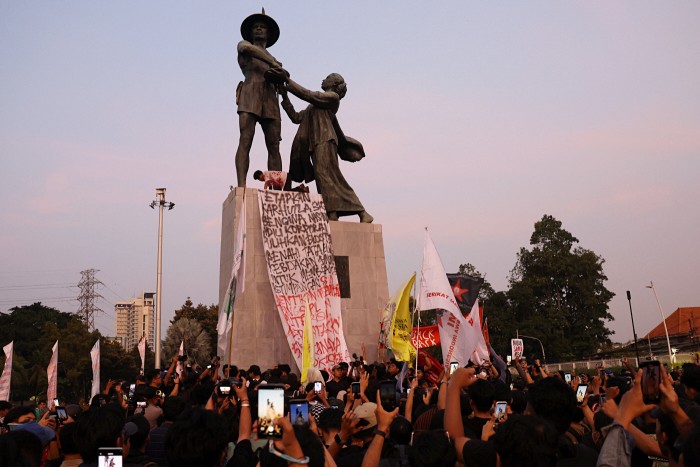 |
| A demonstrator hangs a banner from the National Monument during a protest in Jakarta on the 20th (local time), marking the second anniversary of Indonesian President Prabowo Subianto's inauguration, condemning the government's wildfire response and calling for an end to corruption, collusion, and nepotism. / Reuters, Yonhap News |
The souring public mood is also confirmed by the numbers. In a survey conducted by pollster SMRC from the 1st to the 10th of this month among 1,213 voters, job approval for President Prabowo stood at merely 44.5%. It has steadily declined since recording 81.2% in November of last year, marking the lowest figure since the survey's inception, while negative evaluations exceeded a majority for the first time at 53.4%. Deni Irvani, executive director of SMRC, stated that the drop in approval is tied to deteriorating assessments of the macroeconomy, politics, and law enforcement, as well as negative views on how the administration has handled key pending issues. Respondents who were dissatisfied with the free school meal program showed a stronger tendency to express dissatisfaction with the president as well.
Despite the worsening public sentiment, the government highlighted progress in rice self-sufficiency and energy independence, alongside faster-than-expected economic growth, as key achievements marking the second anniversary. However, the first-half economic growth rate (5.45%) beating expectations was largely driven by government spending. Added to this, the fiscal burden stemming from large-scale welfare expenditures is growing heavier. Beneficiaries of the free school meal program, the core pillar of the welfare agenda, expanded to more than 57 million people despite recurring food poisoning incidents, with at least $15 billion (about 19.91 trillion won) earmarked for this initiative alone in next year's budget. The government also estimated that building a tuition-free national university system, ordered by President Prabowo last month, would require an additional 93 trillion rupiah (about 6.86 trillion won) annually. Some in parliament are even calling for a review of the fiscal rule capping the budget deficit at within 3% of gross domestic product (GDP).
Political currents ahead of the 2029 presidential election also present a variable. Earlier this month, President Prabowo carried out his seventh cabinet reshuffle, the largest since taking office. Djayadi Hanan, head of the political science department at the International Islamic University of Indonesia, told Channel NewsAsia (CNA), "As the gap between the public and the president widens, as evidenced by the extremely low approval ratings, political parties looking ahead to the next election will calculate whether standing by the president is truly worthwhile."
Jeong Ri-na
Most Read
-
1
Celltrion nears additional contract with major U.S..

-
2
Putin proposes trilateral U.S.-China-Russia summit..

-
3
"Aren't those foreigners on welfare?": M..

-
4
U.S. weighs dropping MOAB, world's most powerful n..

-
5
Houthis launch successive attacks on Saudi airport..

-
6
Saudi Arabia, Iran hold first diplomatic talks to..

-
7
Saudi airport in Riyadh struck again, leaving at l..

PEOPLE






HEADLINE NEWS
- [Exclusive] U.S. military steel frame work at Gwangju Airport casts cloud over planned semiconductor industrial complex
- Momentum grows for mid-next month U.S.-China-Russia summit with mounting is..
- Elon Musk formalizes review of SpaceX-Tesla merger
- [Exclusive] 10 SNUs pledged, but three regional universities take half the..

-
Address : In-Young Bldg., 34, Uisadang-daero 1-gil, Yeongdeungpo-gu, Seoul
Copyright by ASIATODAY CO., LTD. All rights resereved