



KT conducts Korea's first public UAM trial in island region
Oct 21, 2026, 10:02 am


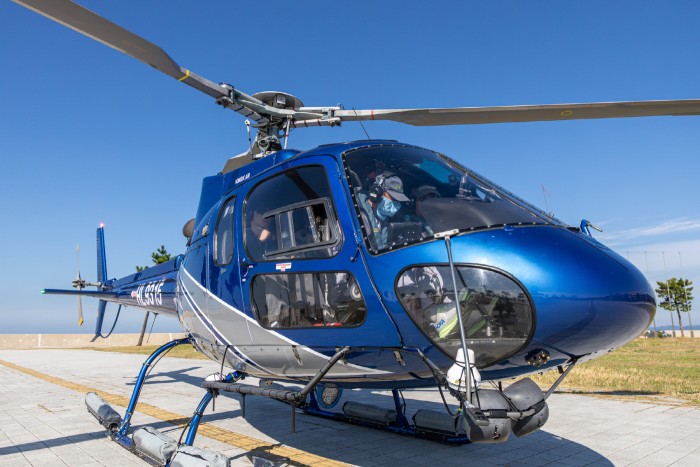 |
| Scene of the public urban air mobility demonstration in the island area of Incheon. / KT |
KT, together with Incheon Metropolitan City, the Incheon Aerospace Campus, and the K-UAM One Team (KT, Hyundai Motor, Hyundai E&C, Incheon International Airport Corporation, and Korean Air), has successfully completed a demonstration of public urban air mobility (UAM) in island areas of Incheon. This marks South Korea's first case of demonstrating public UAM in an island region. Expectations are emerging as it represents a new mode of transportation supplementing conventional vessel-centered transit in island regions.
On the 21st, KT announced that it fleshed out public UAM flight routes to improve transit accessibility for island residents and verified operational feasibility through actual flights. It also inspected an urban air data distribution system that shares information necessary for safe flight operations among relevant agencies. KT explained, "In cooperation with the Ministry of Land, Infrastructure and Transport and the Korea Aerospace Research Institute, we applied the integrated operational capabilities accumulated through the K-UAM Grand Challenge to the routes connecting Yeongjongdo (Geojampo, Wangsan Marina) and Deokjeokdo."
In this demonstration, KT linked its proprietary "UAM Agent-based Traffic Management AX Platform" with a 5G-satellite hybrid aerial network and the urban air data distribution system, verifying the stability and operational feasibility of AI-based traffic management technology and communications networks in real island and maritime flight environments.
When UAM is commercialized, as numerous aircraft operate simultaneously at relatively low altitudes, a traffic management system that identifies flight plans, aircraft locations, weather information, and the operational status of vertiports—the takeoff and landing facilities—in real time and responds swiftly to situational changes is indispensable. The UAM Agent developed by KT analyzes such flight information using artificial intelligence (AI) to suggest optimal departure and arrival times, and presents standard operating procedures (SOPs) and response plans for different situations to support decision-making by traffic managers.
In addition, because dead zones where communication fails can occur in island and maritime areas, securing a communications network capable of stably transmitting aircraft location data and communicating with pilots in real time is vital. To this end, KT established a hybrid communications system combining an 800 MHz-band 5G aerial network dedicated to UAM with satellite communications. As a result of conducting the demonstration in cooperation with KT SAT, it recorded a 100% communications success rate, transmitting aircraft location information to the UAM traffic management AX platform across the entire flight section.
Beyond this, it supported real-time communications between pilots and traffic management personnel while maintaining stable voice communication quality over maritime airspace. Won Man-ho, head of KT's AX Platform Business Division, said, "This is a meaningful achievement in which the Ministry of Land, Infrastructure and Transport, local governments, and private enterprises joined together to confirm the potential of a public UAM operational model to resolve regional transportation issues," adding, "We will lead the expansion of public UAM services and the commercialization of UAM in South Korea."
Choi In-gyu
Most Read
-
1
Celltrion nears additional contract with major U.S..

-
2
Putin proposes trilateral U.S.-China-Russia summit..

-
3
"Aren't those foreigners on welfare?": M..

-
4
U.S. weighs dropping MOAB, world's most powerful n..

-
5
Houthis launch successive attacks on Saudi airport..

-
6
Saudi Arabia, Iran hold first diplomatic talks to..

-
7
Saudi airport in Riyadh struck again, leaving at l..

PEOPLE






HEADLINE NEWS
- [Exclusive] U.S. military steel frame work at Gwangju Airport casts cloud over planned semiconductor industrial complex
- Momentum grows for mid-next month U.S.-China-Russia summit with mounting is..
- Elon Musk formalizes review of SpaceX-Tesla merger
- [Exclusive] 10 SNUs pledged, but three regional universities take half the..

-
Address : In-Young Bldg., 34, Uisadang-daero 1-gil, Yeongdeungpo-gu, Seoul
Copyright by ASIATODAY CO., LTD. All rights resereved