



Blue House likens wartime OPCON transfer to Korea taking wheel with U.S. in passenger seat
Oct 21, 2026, 09:56 am


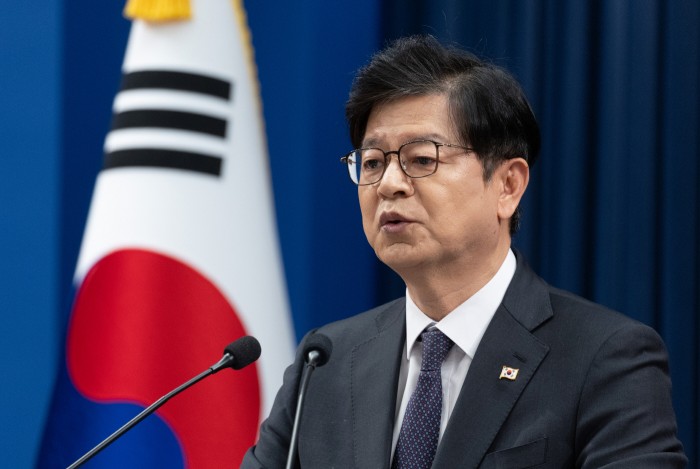 |
| Senior Secretary to the President for Public Communication Sung Ki-hong gives a briefing regarding personnel appointments at the Blue House press briefing room on the 1st. / Yonhap News |
Senior Secretary to the President for Public Communication Sung Ki-hong emphasized on the 20th regarding the transition of wartime operational control (OPCON), "This is by no means telling the U.S. side to get out of the taxi or bus we are riding in together."
Appearing on SBS's Joo Young-jin's News Briefing that day, Senior Secretary Sung made the remarks, saying, "Currently, the U.S. is sitting in the driver's seat and we are in the passenger seat, but now we are going to take the wheel and the U.S. will sit in the passenger seat. Swapping roles in this manner is what the wartime OPCON transfer means."
President Lee Jae-myung held a press conference at the Chunchugwan press hall the previous day, emphasizing, "We must achieve the wartime OPCON transfer early without fail."
He continued, "One of the most foundational constituent elements of sovereignty is military sovereignty," adding, "I believe it must be returned swiftly for the Republic of Korea to fulfill the minimal prerequisites as a sovereign nation."
Senior Secretary Sung said, "Our operational command authority has remained transferred to the U.S. for 76 years, and out of inertia, this has been taken for granted," adding, "However, as a power possessing this level of national strength, South Korea is likely the only nation that does not independently exercise wartime OPCON."
Regarding analyses suggesting that recent remarks by USFK Commander Xavier Brunson addressing changes in conditions for OPCON transfer effectively put the brakes on the transition, Sung stated, "I understand that Commander Brunson's remarks do not represent the official stance of the entire U.S. government."
He also added, "I can tell you that bilateral consultations are underway between the two countries for the wartime OPCON transfer."
Hong Sun-mi
Most Read
-
1
Celltrion nears additional contract with major U.S..

-
2
Putin proposes trilateral U.S.-China-Russia summit..

-
3
"Aren't those foreigners on welfare?": M..

-
4
U.S. weighs dropping MOAB, world's most powerful n..

-
5
Houthis launch successive attacks on Saudi airport..

-
6
Saudi Arabia, Iran hold first diplomatic talks to..

-
7
Saudi airport in Riyadh struck again, leaving at l..

PEOPLE






HEADLINE NEWS
- [Exclusive] U.S. military steel frame work at Gwangju Airport casts cloud over planned semiconductor industrial complex
- Momentum grows for mid-next month U.S.-China-Russia summit with mounting is..
- Elon Musk formalizes review of SpaceX-Tesla merger
- [Exclusive] 10 SNUs pledged, but three regional universities take half the..

-
Address : In-Young Bldg., 34, Uisadang-daero 1-gil, Yeongdeungpo-gu, Seoul
Copyright by ASIATODAY CO., LTD. All rights resereved