



Hyundai Motor and Kia to test Level 4 autonomous trucks
Oct 20, 2026, 05:32 pm


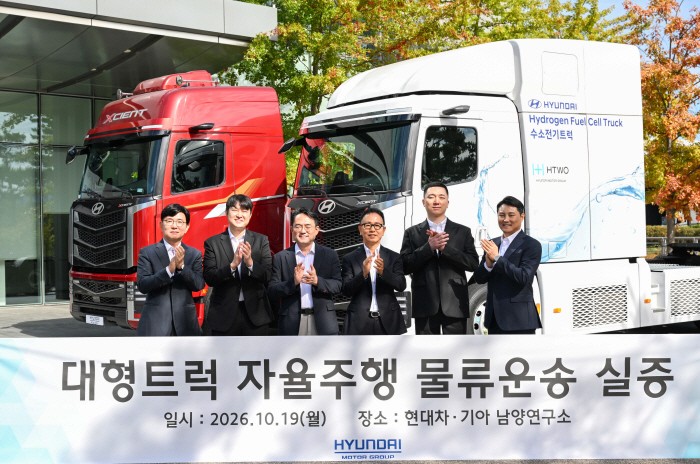 |
| At a memorandum of understanding (MOU) signing ceremony for a Level 4 autonomous truck logistics transport business demonstration, (from left) Han Kyu-yeon, vice president of the Future Logistics Technology Center at Hyundai Glovis, Park Joong-hee, CEO of RideFlux, Park Chul-yeon, senior vice president of the Global Commercial & LCV Business Division at Hyundai Motor, Park Sang-hyun, executive vice president in charge of Commercial LCM at Hyundai Motor and Kia, Park Il-soo, CEO of Mars Auto, and Nam Seok-yoon, vice president of the Integrated Purchasing Division at Hyundai Mobis, pose for a commemorative photograph. / Hyundai Motor Group |
Hyundai Motor and Kia are embarking on real-world trials to commercialize Level 4 autonomous heavy-duty trucks. Collaborating with domestic autonomous driving software companies, the automakers will operate vehicles on actual logistics routes and verify the integrated performance of autonomous driving systems and vehicle control technologies.
Hyundai Motor and Kia announced on the 20th that they signed a memorandum of understanding (MOU) with Hyundai Mobis, Hyundai Glovis, Mars Auto, and RideFlux at the Namyang R&D Center in Hwaseong, Gyeonggi Province, for the Level 4 Autonomous Truck Logistics Transport Demonstration.
This agreement was pursued to verify the technical reliability and operational safety of autonomous heavy-duty trucks on actual logistics routes operated by Hyundai Motor Group, while securing data necessary for commercialization.
For the demonstration, Hyundai Motor and Kia will develop a total of two specialized vehicles: one Xcient fuel cell electric truck and one Xcient diesel truck. Both vehicles will feature customized controllers and vehicle interfaces compatible with autonomous driving systems, and are slated for delivery early next year.
The trials will run through the end of next year across two transport environments: a combined highway and urban section spanning roughly 100 km, and a highway-centered long-distance route covering about 400 km. The group plans to evaluate the performance of the autonomous driving system under differing road conditions, ranging from mixed urban-highway transit to long-haul freight operations.
Mars Auto and RideFlux will each deploy their proprietary autonomous driving software onto the demonstration vehicles, while Hyundai Mobis and Hyundai Glovis will support the trial operations by utilizing existing logistics routes.
Through this demonstration, Hyundai Motor and Kia intend to secure technologies that interface various autonomous driving software with vehicle control systems. The plan is to combine internal advanced development with technologies from external specialist companies to build a vehicle platform capable of accommodating multiple autonomous driving systems going forward.
In particular, based on data collected from real-world operations, they will advance vehicle control technology and safety redundancy systems that allow auxiliary systems to take over should anomalies occur in primary vehicle systems. This is regarded as a pivotal technology for ensuring autonomous driving safety in heavy-duty trucks, which frequently operate over long distances and at night.
Park Sang-hyun, executive vice president in charge of Commercial LCM at Hyundai Motor and Kia, said, "Autonomous trucks are a key future mobility solution that can enhance the safety and efficiency of logistics transportation." He added, "Through this collaboration, we will secure the vehicle control technology and operational data required in actual logistics environments, progressively laying the technological foundation to commercialize Level 4 autonomous heavy-duty trucks."
Nam Hyun-soo
Most Read
-
1
Celltrion nears additional contract with major U.S..

-
2
U.S. weighs dropping MOAB, world's most powerful n..

-
3
"Aren't those foreigners on welfare?": M..

-
4
Putin proposes trilateral U.S.-China-Russia summit..

-
5
Houthis launch successive attacks on Saudi airport..

-
6
Saudi Arabia, Iran hold first diplomatic talks to..

-
7
Saudi airport in Riyadh struck again, leaving at l..

PEOPLE





HEADLINE NEWS

-
Address : In-Young Bldg., 34, Uisadang-daero 1-gil, Yeongdeungpo-gu, Seoul
Copyright by ASIATODAY CO., LTD. All rights resereved