



[Market Power] Cuchen's slump rattles parent Bubang, putting third-generation heir Lee Joong-hee to the test
Oct 20, 2026, 02:15 pm


 |
 |
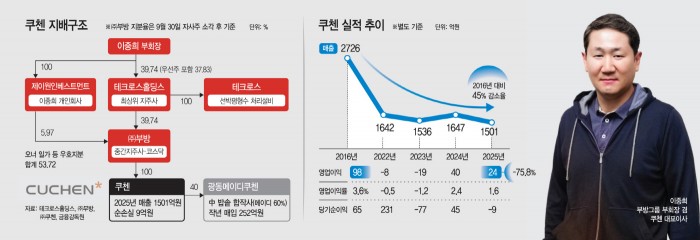
The governance structure of Bubang Group, which houses renowned rice cooker maker Cuchen, is being reshuffled around third-generation owner-family scion Vice Chairman Lee Joong-hee. With parent company Bubang canceling treasury shares, the controlling shareholder group's stake has crossed the 50% mark, and the center of gravity in the businesses once divided between the brothers has shifted to the second son, Vice Chairman Lee. In contrast, Cuchen remains mired in sluggish performance, with its operating profit shrinking to a quarter of its 2016 level. While his grip on control has solidified, the challenge of restoring competitiveness to the core business has grown all the more burdensome.
According to the Financial Supervisory Service on the 19th, Cuchen posted 150.1 billion won in revenue last year, an 8.9% decrease from 164.7 billion won the previous year. Operating profit dropped 40.2% from 4 billion won to 2.4 billion won, while net profit swung to a deficit of around 900 million won. Compared to 2016, when revenue stood at 272.6 billion won and operating profit reached 9.8 billion won, revenue fell by roughly 45% and operating profit contracted by about 76%.
Cuchen's downturn also weighed on the earnings of parent company Bubang. Bubang posted 319.5 billion won in consolidated revenue last year, with Cuchen accounting for nearly half of the total. Bubang's operating profit also stood at merely 1.8 billion won, a 64% drop from 4.9 billion won the previous year, leaving its operating profit margin at around 0.5%.
Conversely, the group's governance structure has consolidated further around Vice Chairman Lee. Lee is the largest shareholder of Techcross Holdings, the group's apex holding entity. Techcross Holdings holds a 39.74% stake in Bubang, while Bubang owns 100% of Cuchen. Through J-One Investment, a wholly owned personal company, Vice Chairman Lee holds a 5.97% stake in Bubang, alongside 1.08% under his own name.
Bubang's cancellation of treasury shares also served to enhance the owner family's corporate control. In two tranches across August and September, Bubang retired all 6,385,779 shares, or 10.63% of its total issued stock. As a result, Techcross Holdings' stake in Bubang climbed from 35.52% to 39.74% without additional purchases. The combined stake held by the largest shareholder and affiliated parties, including subsidiaries and executives, also rose from 48.01% to 53.72%, surpassing the 50% threshold. A measure intended to enhance shareholder value effectively bolstered management control as well.
The group's succession landscape has also undergone changes. Initially, Bubang Group operated under a divided management structure where Chairman Lee Dong-gun's eldest son, former Vice Chairman Lee Dae-hee, oversaw Cuchen and Bubang, while second son Vice Chairman Lee Joong-hee managed Techcross affiliates. However, amid Cuchen's persistent earnings slump, former Vice Chairman Lee Dae-hee stepped down from frontline management in 2020. At the time, he transferred his 30.04% stake in Bubang to Techcross for approximately 45 billion won.
Former Vice Chairman Lee returned as a shareholder after about six years by purchasing 305,000 shares of Bubang on the open market in July and August of this year, but his stake remains at just 0.57%. In contrast, Vice Chairman Lee Joong-hee expanded his influence over Bubang and Cuchen leveraged on his status as the largest shareholder of Techcross Holdings. The management structure once split between the brothers has effectively reshuffled around the second son.
Earnings scorecards across business units within the group also diverge. Techcross, which manufactures ballast water treatment systems, generated 174.4 billion won in revenue and 20.6 billion won in net profit last year. Water treatment affiliate Techcross Water & Energy also logged 200.8 billion won in revenue and 6.8 billion won in net profit. By contrast, Cuchen posted a net loss of around 900 million won. Unlike the maritime and water treatment businesses yielding profits, the home appliances division continues to struggle with restoring profitability.
This reality is also reflected in corporate valuations. As of that day, Bubang's market capitalization stood at approximately 53.7 billion won, falling short of the 64.7 billion won book value of its stake in Cuchen. The market value of the entire listed parent company remains lower than the book value of its equity holding in a single key subsidiary.
In response, Vice Chairman Lee is pursuing premium product enhancements and business diversification to drive a turnaround at Cuchen. Cuchen proclaimed Vision 2030, its mid- to long-term growth strategy, this year and presented a target of more than doubling revenue by 2030. Recently, the company has also stepped up its push into the high-value-added product market by launching the Titan Collection, which features a titanium inner pot.
The crux lies in whether tightening corporate control can translate into tangible managerial performance. Based on last year's revenue, doubling top-line sales by 2030 requires a compound annual growth rate of roughly 15% over the next five years. While the controlling family's grip has solidified, the challenges of reversing a flagship affiliate's slump and recovering corporate value persist. Restoring Cuchen's growth trajectory is projected to serve as a litmus test for evaluating Vice Chairman Lee Joong-hee's leadership.
A Cuchen official said, "An economic slowdown, depressed consumer sentiment, and rising raw material costs combined to impact last year's performance," adding, "Under CEO Lee Joong-hee's leadership, we will bolster the competitiveness of premium products, expand into new businesses, and innovate cost structures to improve profitability." The official added, "We expect Cuchen's growth and profitability improvements to contribute positively to parent company Bubang's consolidated earnings as well."
Jang Ji-young
#Cuchen #Bubang #Lee Joong-hee
Copyright by Asiatoday
Most Read
-
1
Celltrion nears additional contract with major U.S..

-
2
U.S. weighs dropping MOAB, world's most powerful n..

-
3
"Aren't those foreigners on welfare?": M..

-
4
Putin proposes trilateral U.S.-China-Russia summit..

-
5
Houthis launch successive attacks on Saudi airport..

-
6
Saudi Arabia, Iran hold first diplomatic talks to..

-
7
Saudi airport in Riyadh struck again, leaving at l..

PEOPLE






HEADLINE NEWS

-
Address : In-Young Bldg., 34, Uisadang-daero 1-gil, Yeongdeungpo-gu, Seoul
Copyright by ASIATODAY CO., LTD. All rights resereved