



Dropping Caspian Sea water levels sound alarm, with islands at risk of connecting to mainland
Oct 20, 2026, 01:55 pm


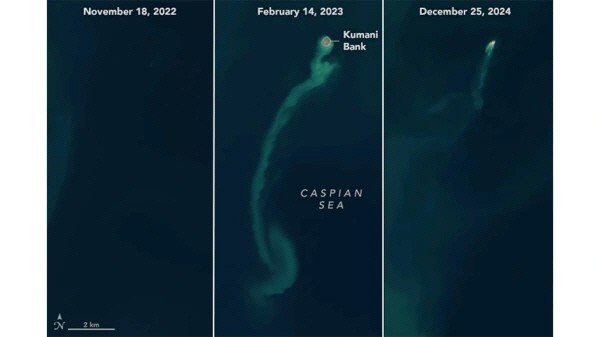 |
| An island formed in February 2023 off the coast of Azerbaijan in the Caspian Sea due to dropping water levels was mostly submerged by December 2024. The island was analyzed to have been created by a mud volcano eruption before disappearing due to wave action and erosion. / NASA Earth Observatory |
Possibilities have been raised that an island in the Caspian Sea could connect to the mainland following decades of declining water levels. As changes in water levels impact maritime logistics and regional economies as well as ecosystems, the need for littoral states to respond is growing.
Russian media outlet RBC reported on the 19th (local time) that Caspian Sea water levels continue to drop, and if this trend persists, Nordovy Island in Dagestan, Russia, could connect to the mainland and turn into a peninsula.
Experts explained that Caspian Sea water levels have dropped by an annual average of about 23 cm over the past five years, falling by approximately 29.4 cm last year.
Changes are also evident along the coast of Kazakhstan. According to local observational data, the water level of the Caspian Sea fell by about 2.45 meters from 1996 to 2025. This past July, the water level measured at the Kulaly Island observation station stood at -29.42 meters relative to sea level.
A satellite observation study published this year also confirmed that coastlines in parts of the northeastern Caspian Sea receded by more than 20 kilometers between 2016 and 2025.
New islands have also emerged. In waters roughly 30 kilometers off the village of Bautino in Kazakhstan's Mangystau Region, a previously submerged sandy bottom was exposed by the dropping water levels, forming a new island.
A local tourism industry official explained that similar topographical changes are being observed around several islands in the northern Caspian Sea. As water levels fall, existing islands are altering their shapes while new landmasses are concurrently emerging.
Dropping water levels are also weighing on port operations. Shallow depths can impose constraints on ship cargo capacity and navigation conditions, while port operations can also incur additional costs.
On the 5th, Kazakhstan's Ministry of Transport began operations to remove about 1.3 million cubic meters of seabed sediment at the Port of Aktau, a core hub along the Trans-Caspian International Transport Route, to secure water depths of 6 to 7 meters.
The government expects this work to boost port handling capacity and increase freight transit volumes by up to 30%. The dredging is scheduled for completion by the end of this year.
Ecological damage is also a concern. Dropping water levels are altering the environments of islands and shallow waters used by seals for breeding and resting.
The Caspian seal, an endemic species found only in the Caspian Sea, is estimated to have dwindled from about 1 million to several hundred thousand over the past century.
Rising temperatures driving increased evaporation and changes in river inflow volumes are cited as factors behind the water level decline. In particular, the discharge volume of the Volga River, which accounts for a substantial portion of the river water flowing into the Caspian Sea, serves as a key variable.
The government stated that it will pursue Caspian Sea conservation programs in cooperation with Russia, Azerbaijan, Iran, and Turkmenistan, which share the body of water.
Kim Min-kyu
Most Read
-
1
Celltrion nears additional contract with major U.S..

-
2
U.S. weighs dropping MOAB, world's most powerful n..

-
3
"Aren't those foreigners on welfare?": M..

-
4
Putin proposes trilateral U.S.-China-Russia summit..

-
5
Houthis launch successive attacks on Saudi airport..

-
6
Saudi Arabia, Iran hold first diplomatic talks to..

-
7
Saudi airport in Riyadh struck again, leaving at l..

PEOPLE






HEADLINE NEWS

-
Address : In-Young Bldg., 34, Uisadang-daero 1-gil, Yeongdeungpo-gu, Seoul
Copyright by ASIATODAY CO., LTD. All rights resereved