



NIS expands into economic security, stepping up response to tech leaks and supply chain threats
Oct 20, 2026, 01:09 pm


 |
The National Intelligence Service (NIS) is expanding its operational scope by making economic security a core mission. The intelligence activities of the NIS, which in the past placed primary weight on countercommunist and counterintelligence operations, are expanding into areas that individual companies cannot tackle solely through internal security, such as foreign industrial technology theft and state-sponsored hacking. As interstate competition over cutting-edge technologies like semiconductors intensifies, the NIS—equipped with overseas intelligence collection and counterintelligence capabilities—is cementing its role as a pivotal institution in economic security.
According to the Ministry of Government Legislation on the 19th, the revised National Intelligence Service Act, promulgated on September 29, will take effect on December 30. The core of the revised law is that it explicitly stipulates "economic security" as a statutory duty of the NIS. While the NIS has so far carried out duties in the economic security realm directly and indirectly, including preventing domestic technology leaks and securing global supply chains, this marks the first time that an explicit legal foundation has been established.
The revised law encompasses stabilizing the supply chain for economic security items and services, bolstering the competitiveness of the materials, parts, and equipment industries, national resource security, protecting national high-tech strategic industries and core technologies, and the import and export of strategic materials. This measure reflects shifts in the security environment where interstate competition is expanding beyond military and diplomatic realms into technology and industry. Core technologies such as semiconductors, artificial intelligence (AI), and batteries have become strategic assets that dictate national competitiveness beyond individual corporate profits.
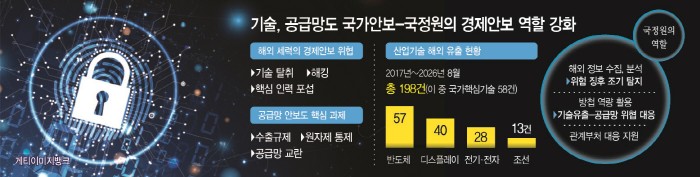
Economic security is broadly divided into preventing the leak of industrial technologies and stabilizing supply chains. It differs from general corporate security particularly in that foreign governments or intelligence agencies may be involved in the threats. To counter technology theft by foreign actors or state-level economic coercion, there is a need to utilize overseas intelligence collection and counterintelligence functions alongside corporate security capabilities.
It is difficult to recover from the damage of industrial technology theft through ex post response alone. Even if the individuals involved are apprehended, fully recovering technologies or research achievements that have already been transferred abroad is not easy. This is why intelligence operations that proactively identify overseas recruitment of key personnel and attempts to steal technology before they occur are crucial, rather than merely uncovering perpetrators after leaks take place.
In fact, overseas leaks of industrial technologies are occurring on a substantial scale. According to data submitted by the Ministry of Trade, Industry and Energy to the office of People Power Party Representative Kim Do-eup, overseas leaks of industrial technology uncovered by the NIS from 2017 to August of this year totaled 198 cases. Among them, 58 cases involved national core technologies. By industry, semiconductors accounted for the largest share at 57 cases, followed by displays (40 cases), electrical and electronics (28 cases), and shipbuilding (13 cases).
Supply chain security is another domain where the NIS is widening its scope of activity. South Korea experienced Japan's export controls on key semiconductor materials in 2019 and disruptions in the supply of diesel exhaust fluid originating from China in 2021. These serve as examples demonstrating that when reliance on a specific country for raw materials is high, shifts in foreign policy can affect domestic industry and logistics as a whole.
Supply chain stabilization policies are primarily handled by industrial and trade authorities. Key examples include diversifying import sources, developing alternative materials, and stockpiling strategic items. Separately, the NIS can support policy decision-making by collecting and analyzing security-related risk intelligence, such as foreign moves to control strategic resources and the possibility of economic coercion.
Yeom Heung-youl, a professor in the Department of Information Security at Soonchunhyang University, said, "With the revision of the National Intelligence Service Act, the activities to prevent overseas leaks of industrial technology that the NIS has carried out so far will be promoted more systematically based on a legal foundation." He added, "I expect this will help prevent overseas leaks of national strategic technologies such as semiconductors, artificial intelligence (AI), quantum technology, and cybersecurity."
He went on to emphasize, "If technologies where our country maintains a technological edge, such as semiconductors, are leaked abroad, it could significantly impact not only national interests but also economic security. Proactive prevention, ex post detection, and emergency response activities to block technology leaks are critical."
Kim Tae-hoon
Most Read
-
1
Celltrion nears additional contract with major U.S..

-
2
U.S. weighs dropping MOAB, world's most powerful n..

-
3
"Aren't those foreigners on welfare?": M..

-
4
Houthis launch successive attacks on Saudi airport..

-
5
Saudi Arabia, Iran hold first diplomatic talks to..

-
6
Putin proposes trilateral U.S.-China-Russia summit..

-
7
Saudi airport in Riyadh struck again, leaving at l..

PEOPLE






HEADLINE NEWS

-
Address : In-Young Bldg., 34, Uisadang-daero 1-gil, Yeongdeungpo-gu, Seoul
Copyright by ASIATODAY CO., LTD. All rights resereved