



Cracks in French welfare model spur political maneuvering ahead of presidential election
Oct 20, 2026, 10:01 am


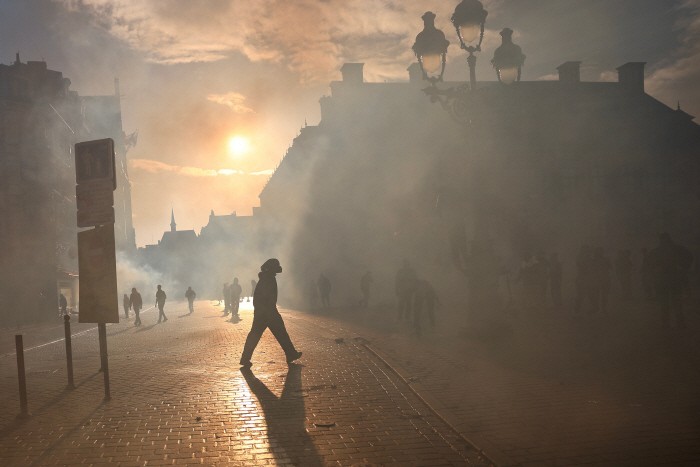 |
| A demonstrator walks through smoke as protests against high living costs continue at Place de l'Opera in Lille, northern France, on the 17th (local time). / AFP Yonhap |
A demonstrator walks through smoke as protests against high living costs continue at Place de l'Opera in Lille, northern France, on the 17th (local time). / AFP Yonhap
In France, which has long operated an extensive social welfare system, citizens' discontent over living cost burdens, weakening public services, and fiscal austerity is erupting.
According to foreign media including Le Monde and AFP, massive demonstrations that broke out across France on the 17th (local time) escalated into violence in some areas, with shops and public buildings coming under attack and arson breaking out.
The starting point lay in problems on the school grounds. Protests that began with student dissatisfaction over teacher shortages, dilapidated facilities, and overcrowded classrooms broadened into a backlash against rising living costs, deteriorating public service quality, and social inequality. With household burdens mounting due to rising living costs, grievances accumulated that even the public services citizens have come to expect—such as education, healthcare, and transportation—are not being adequately provided.
France's welfare state model faces realistic limits in the form of fiscal pressure. The Economist pointed out that France's fiscal deficit this year is projected at 5.4% of gross domestic product (GDP), ranking among the highest in the Eurozone. Next year, national debt is expected to exceed 120% of GDP. While social security spending on pensions and healthcare has snowballed due to population aging, reform attempts by successive governments have been thwarted time and again by pushback from labor unions and the political arena.
Meanwhile, political circles are interpreting and politically leveraging these protests according to their own interests ahead of the presidential election next spring. The government claimed that La France Insoumise (LFI), led by far-left leader Jean-Luc Melenchon, is inciting protests to rally its base ahead of the presidential election. French President Emmanuel Macron stated on the 18th that he felt "anger" and "shame" over the looting and violence, holding far-left activists responsible for the violence.
Marine Le Pen, a lawmaker from the far-right National Rally (RN), criticized that "the legitimate demands of the protesters are being held hostage by Melenchon and others," while Melenchon shifted blame onto the government, saying, "The disorder exists because Prime Minister Lecornu ordered indiscriminate crackdowns."
As political sparring over who is to blame for the protests takes precedence over discussions to alleviate citizens' cost-of-living hardships and grievances over public services, observers point out that even social conflict is being reduced to a tool in the presidential campaign.
Lee Jeong-eun
Most Read
-
1
Celltrion nears additional contract with major U.S..

-
2
U.S. weighs dropping MOAB, world's most powerful n..

-
3
"Aren't those foreigners on welfare?": M..

-
4
Putin proposes trilateral U.S.-China-Russia summit..

-
5
Houthis launch successive attacks on Saudi airport..

-
6
Saudi Arabia, Iran hold first diplomatic talks to..

-
7
Saudi airport in Riyadh struck again, leaving at l..

PEOPLE






HEADLINE NEWS

-
Address : In-Young Bldg., 34, Uisadang-daero 1-gil, Yeongdeungpo-gu, Seoul
Copyright by ASIATODAY CO., LTD. All rights resereved