



China faces backlash in Southeast Asia as rumors swirl over expulsion of envoy to Philippines
Oct 20, 2026, 09:58 am


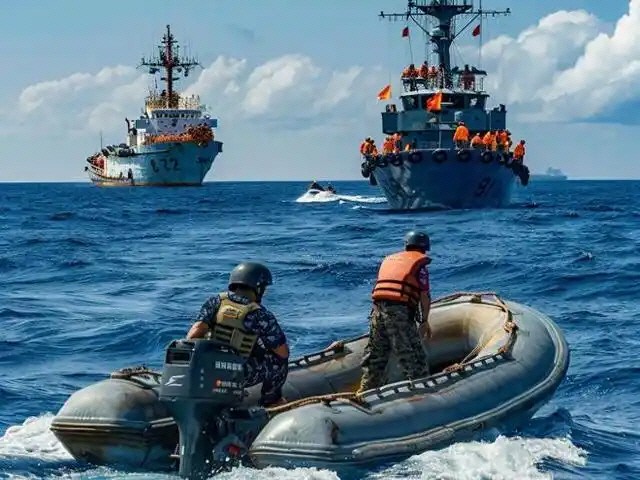 |
| Chinese and Philippine coast guards engaged in territorial disputes in the South China Sea. Such conflict between the two nations is cited as a driver stoking rising anti-China sentiment in Southeast Asia. / The Beijing News (Xinjingbao) |
Driven by rapidly escalating anti-China sentiment across Southeast Asia, China is being driven into a situation similar to that of Japan, which suffered immense backlash following the explosive eruption of anti-Japanese sentiment that peaked in the 1970s and 1980s. Judging by the prevailing atmosphere, projections suggest that breaking free from this dynamic will be difficult for a considerable time to come. In short, it is hardly an exaggeration to say that China faces the risk of becoming a "second Japan" in Southeast Asia.
Synthesizing reports from media outlets including The Beijing News, it can be stated with confidence that various "Made in China" products have recently been rapidly taking over Southeast Asian markets, leveraging so-called cost-effectiveness as their weapon. For China, which has been grappling with the reality of the U.S. and European Union (EU) nations substantially ramping up checks on Chinese products—spearheaded by electric vehicles—through tariff barriers and other measures, this could be seen as a situation warranting inward cheers.
Yet having to bear the considerable burden of an explosive rise in anti-China sentiment—what could be called an inevitable backlash—also appears to be an unavoidable reality. Analysis suggesting that China is becoming a "second Japan" is by no means an exaggeration. This is particularly true in the Philippines and Vietnam, where relations have been on a continuous downward spiral over South China Sea territorial disputes. No matter how much China may look down on these nations given the wide gap in national power, it is a situation that demands considerable attention.
Nor does it stop there. Having to prepare for the possibility that conflicts with Vietnam, Cambodia, Laos, Myanmar, Thailand, and others over Mekong River water usage could redouble anti-China sentiment is also a matter of deep concern for China. This is especially true considering its plans to source a substantial portion of the water and electricity required for semiconductor and artificial intelligence (AI) industries—sectors cultivated with near-total mobilization of national power over recent years—from the Mekong River.
That the atmosphere is ominous can be read directly from the sharp exchanges between China and the Philippines on the 15th and 16th regarding their South China Sea territorial dispute. The side that took the offensive first was China, which views the U.S.-backed Philippines as a thorn in its side. Chinese Ambassador to the Philippines Jing Quan provoked tensions on the 15th by remarking, "If a military conflict breaks out between the two countries, China will easily win." In response, Philippine President Ferdinand Marcos Jr. immediately criticized Ambassador Jing's remarks the following day on the 16th, stating, "To me, it sounds very threatening. That is not the language of a diplomat."
It does not end here. Figures across the political spectrum in the Philippines are calling Ambassador Jing's remarks an act of disrespect akin to a declaration of war, going so far as to demand his expulsion. While the likelihood of an actual expulsion materializing remains quite low, considering that the Philippines is confronting China directly without shying away from broader conflict, the calls for expulsion represent a remarkably high level of intensity. They can be seen as vividly reflecting anti-China sentiment across Southeast Asian nations. It could also point to the possibility of a full-scale storm brewing. Concerns appear set to deepen for China, which has long treated Southeast Asian nations as little more than its backyard.
Hong Soon-do
Most Read
-
1
Celltrion nears additional contract with major U.S..

-
2
U.S. weighs dropping MOAB, world's most powerful n..

-
3
"Aren't those foreigners on welfare?": M..

-
4
Houthis launch successive attacks on Saudi airport..

-
5
Saudi Arabia, Iran hold first diplomatic talks to..

-
6
Saudi airport in Riyadh struck again, leaving at l..

-
7
Five ASEAN countries welcome Myanmar coup leader

PEOPLE






HEADLINE NEWS

-
Address : In-Young Bldg., 34, Uisadang-daero 1-gil, Yeongdeungpo-gu, Seoul
Copyright by ASIATODAY CO., LTD. All rights resereved