



Macron faces late-term crisis over French violence as approval drops to 15%
Oct 20, 2026, 09:47 am


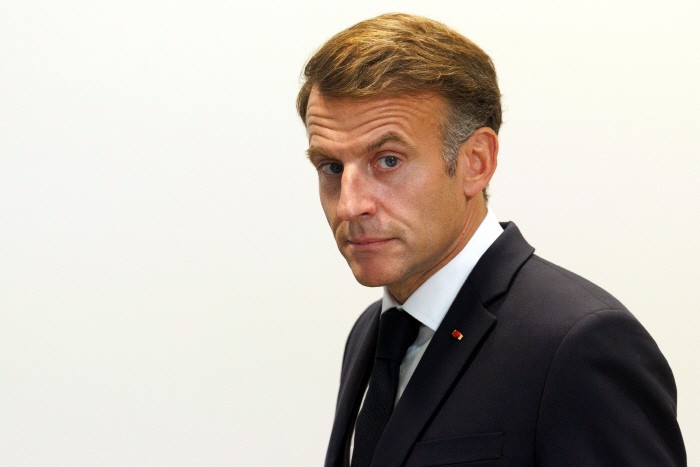 |
| French President Emmanuel Macron attends a press conference during the European Council summit held in Brussels, Belgium, on the 16th (local time). / EPA, Yonhap |
Violence sweeping across France is further compounding the political crisis for President Emmanuel Macron in the twilight of his presidency.
With his approval rating sinking to the lowest level since taking office, successive acts of looting and arson have placed both the government's governance grip and its law enforcement response capabilities under scrutiny.
According to foreign media reports including Le Monde and AFP on the 19th (local time), a survey conducted by polling agency Ipsos prior to the outbreak of the recent violence showed President Macron's approval rating at 15%, marking the lowest level since he first took office in 2017.
Leading a minority government, President Macron was already seeing his political standing severely shaken amid political clashes over the national budget and financial market instability, compounded by weeks of persistent high school student protests.
Taking place just six months ahead of next year's presidential election, the latest crisis is also rapidly escalating into political sparring. Marine Le Pen of the far-right National Rally (RN) launched an intensive offensive targeting the government's failure in public safety responses.
She criticized, "Our country is trapped between violence and helplessness," while the National Rally declared it would end the chaos caused by the Macron government and "restore order."
Jean-Luc Melenchon, leader of the far-left La France Insoumise (LFI), likewise aimed his criticism at the government.
He placed the blame on the government's hard-line measures, saying, "The disorder exists because Prime Minister Lecornu ordered indiscriminate crackdowns."
Conversely, the government argued that LFI is inciting protests to rally its base ahead of the presidential election.
Indeed, Melenchon has been actively voicing support for high school student protests, dedicating significant effort to expanding his backing among young voters.
In a poll conducted last month, more than 40% of respondents aged 18 to 24 expressed intention to vote for Melenchon in the next presidential election, underscoring youth voters' emergence as his core support base.
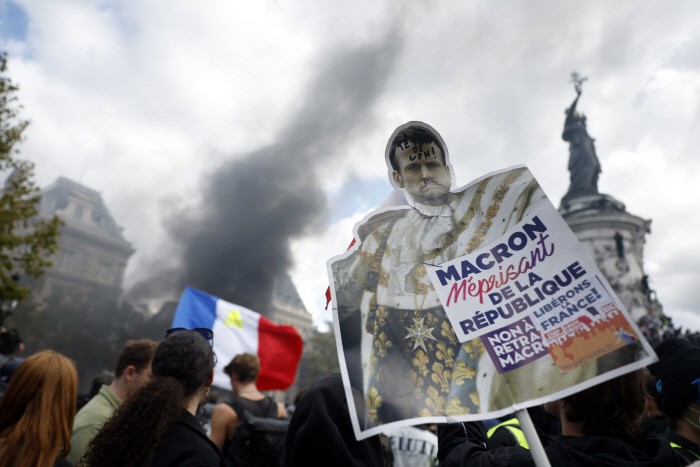 |
| A demonstrator holds a poster depicting French President Emmanuel Macron during a protest denouncing rising living costs and public service cuts in Paris, France, on the 17th (local time). Diverse groups, including "Yellow Vest" activists, middle, high school, and university students, and labor unions, rallied for the nationwide mass mobilization, where grievances over surging living costs, skyrocketing fuel prices, and deteriorating public services intersected with demands for improvements to the educational environment. / EPA, Yonhap |
What further adds to the political burden is that the range of law enforcement responses available to the government is narrow.
Mounting a hard-line response against violence and looting makes it difficult to avoid controversies over excessive force, yet lowering the intensity of response risks facing accusations of policing failures and paralyzed public authority.
In Paris, clashes continued as protesters hurled bottles and stones in response to police firing tear gas and flash-bang grenades into crowds.
The BBC reported that police officers were witnessed in multiple locations beating demonstrators with batons, and that water cannons were also deployed.
According to the French Ministry of the Interior, grenades and smoke canisters, alongside tear gas and water cannons, were mobilized during the crowd suppression process.
Criticism surrounding the intensity of the police response is also mounting.
Jean-Marie Godard, an expert specializing in French policing affairs, told the Associated Press, "Ill-equipped and undertrained police are being deployed to scenes of violent protests," pointing out the risk that officers, easily agitated by anger and fear, could be drawn into direct physical confrontations.
Conversely, damage on the side of law enforcement has also been substantial, with around 1,000 police officers injured, including seven who suffered severe injuries.
Lying at the foundation of this crisis are fiscal troubles for which the French government has struggled to find a solution.
British current affairs weekly The Economist forecast that France's fiscal deficit this year stands at 5.4% of gross domestic product (GDP), among the highest in the Eurozone, and that national debt will exceed 120% of GDP next year.
While social security expenditures such as pensions and healthcare continue to climb due to population aging, reforms pursued by successive administrations to ease the fiscal burden have repeatedly collided with pushback from labor unions and the political arena.
Nam Mi-kyung
Lee Jeong-eun
Most Read
-
1
Celltrion nears additional contract with major U.S..

-
2
U.S. weighs dropping MOAB, world's most powerful n..

-
3
"Aren't those foreigners on welfare?": M..

-
4
Houthis launch successive attacks on Saudi airport..

-
5
Saudi Arabia, Iran hold first diplomatic talks to..

-
6
Saudi airport in Riyadh struck again, leaving at l..

-
7
Five ASEAN countries welcome Myanmar coup leader

PEOPLE






HEADLINE NEWS

-
Address : In-Young Bldg., 34, Uisadang-daero 1-gil, Yeongdeungpo-gu, Seoul
Copyright by ASIATODAY CO., LTD. All rights resereved