



Access to Iguazu Falls restricted for days as heavy rains close the 'Devil's Throat'
Oct 16, 2026, 03:11 pm


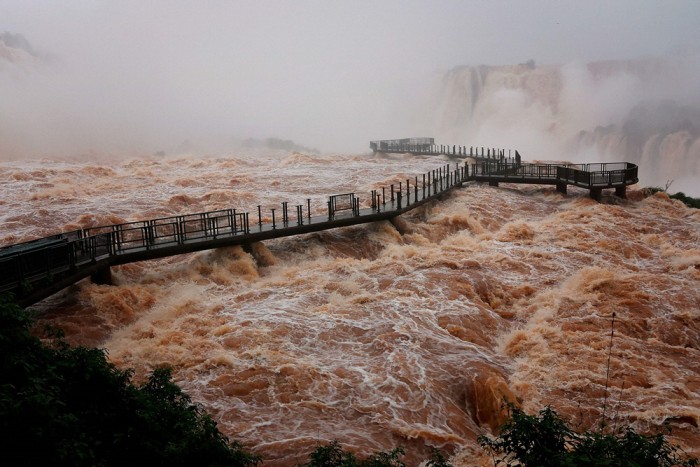 |
| Raging torrents flow around walking trails at Iguazu Falls in Foz do Iguaçu, Paraná State, Brazil, on the 13th (local time). / AFP, Yonhap |
Oh Hyeon-gyu (Beşiktaş) battles for the ball with a Hoffenheim defender during Matchday 2 of the 2026–2027 UEFA Europa League (UEL) league phase held at PreZero Arena (SNP Arena) in Hoffenheim, Germany, on the 15th (local time). / AFP, Yonhap
Tourism at Iguazu Falls, one of South America's representative tourist attractions, has been restricted for several days. This comes as the water flow of the falls swelled to near-record levels under the influence of El Niño, increasing the risk of accidents.
According to local media including Radio Mitre on the 15th (local time), Iguazú National Park in Argentina opened its entrance routes on that day while keeping the flooded upper walkway of the falls closed. With El Niño intensifying, the Argentine park has repeatedly restricted and lifted access due to surging water flow.
Iguazú National Park in Argentina completely banned visitors from entering the falls on the 12th, opened the following day, but barred tourists again on the 14th. Although it reopened on the 15th, it did not open the upper walkway of the falls.
Visitors were able to use the lower walkway, but they had to forgo experiencing the "Devil's Throat," the highlight section of Iguazu Falls.
The "Devil's Throat," the largest of the 275 waterfalls, is where the greatest number of tourists gather, and its walkway is installed only above the falls. As the water volume in the area surged, the risk of accidents from below increased.
Officials from Iguazú National Park in Argentina stated, "We have no choice but to decide whether to permit or prohibit tourism at Iguazu Falls depending on the situation each day," adding, "Tourists wishing to visit must check the park's notices."
Heavy rain fell on the Brazilian side of Iguazu Falls over the past weekend. The water flow of Iguazu Falls, which normally stands at around 1.5 million liters per second, reached about 12 million liters per second—an eightfold increase—as river waters swelled this time.
Iguazu Falls, comprising a collection of 275 waterfalls, straddles the border between Argentina and Brazil. The source of these falls is the Iguazu River, which flows from Brazil into Argentina.
The swelling water flow of Iguazu Falls is due to higher rainfall in Brazil compared to previous years. Weather experts pointed to El Niño as the primary cause.
Depending on the region, El Niño either induces drought or brings heavier rainfall than usual. Argentina and Brazil belong to the latter category.
Iguazu Falls, recognized as one of the world's three greatest waterfalls, was inscribed as a UNESCO World Natural Heritage site in 1986. Around one million tourists visit the site each year.
Son Young-sik
Most Read
-
1
Celltrion nears additional contract with major U.S..

-
2
"Aren't those foreigners on welfare?": M..

-
3
Houthis launch successive attacks on Saudi airport..

-
4
Saudi Arabia, Iran hold first diplomatic talks to..

-
5
Saudi airport in Riyadh struck again, leaving at l..

-
6
U.S. weighs dropping MOAB, world's most powerful n..

-
7
Five ASEAN countries welcome Myanmar coup leader

PEOPLE






HEADLINE NEWS

-
Address : In-Young Bldg., 34, Uisadang-daero 1-gil, Yeongdeungpo-gu, Seoul
Copyright by ASIATODAY CO., LTD. All rights resereved