



S. Korea and U.S. diverge on interpretation of accelerating OPCON transfer
Oct 16, 2026, 09:57 am


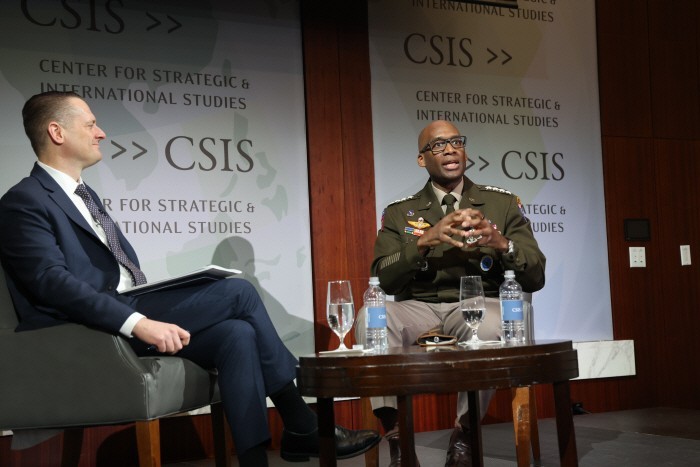 |
| Gen. Xavier Brunson, commander of United States Forces Korea (right), speaks during a discussion at the Center for Strategic and International Studies (CSIS) in Washington, D.C., on the 13th (local time). / Washington Correspondent Ha Man-joo |
Regarding moves to expedite the transfer of wartime operational control (OPCON), current and former commanders of the South Korea-U.S. Combined Forces Command have repeatedly stressed that meeting military conditions must take precedence over shortening timelines. Current and former officials from both South Korea and the U.S. also drew a line against the perspective viewing OPCON transition as the restoration of military sovereignty, stating that OPCON is a matter of military effectiveness rather than sovereignty.
Gen. Xavier Brunson, commander of the United Nations Command, ROK-U.S. Combined Forces Command, and U.S. Forces Korea, said in a keynote speech on the 14th (local time) at the Indo-Pacific Summit co-hosted in Washington, D.C., by the Gold Institute for International Strategy and the Korea-U.S. Alliance Foundation, "I am a proponent of OPCON transition," while emphasizing, "What I am against is violating the conditions established years ago." He underscored that the transfer must proceed according to the conditions and procedures agreed upon by South Korea and the U.S.
Gen. Robert Abrams, former commander of the ROK-U.S. Combined Forces Command, also pointed out at a Korea Defense Veterans Association (KDVA) event on the 10th that his U.S.-style interpretation of accelerating OPCON transition differs from how some South Korean policymakers view it. He explained that while some in South Korea may understand acceleration as advancing the transfer timeline by taking risks even if conditions are not fully met, the U.S. view of acceleration means focusing resources on securing critical military capabilities to meet 100% of the conditions while shortening the schedule.
Gen. Brunson stated that North Korea's military threats and the security environment on the Korean Peninsula have changed compared to when the transition plan was established in 2015, remarking, "Conditions have changed, and because we changed the plan, there are now new standards to adhere to." Gen. Abrams also said that the original 26 critical military capabilities remain essential for deterrence and defense, stressing, "We must stick to the plan."
Gen. Brunson emphasized that the actual capability to execute military missions is more important than transition deadlines. In a dialogue at CSIS the previous day, he also noted that if an order to transfer OPCON were issued before conditions are met, he would carry it out while reporting the military risks to higher authorities.
Gen. Abrams stated that he recently received a closed-door briefing on the matter in South Korea and found that "several shortcomings still remain" regarding transition conditions. In particular, he noted that certain critical items have shown no progress at all, but added that it is difficult to disclose specifics because doing so could expose military vulnerabilities.
Gen. Abrams also took issue with the perspective viewing OPCON transition as an issue of South Korea reclaiming its military sovereignty. He explained that during wartime, operational control over South Korean and U.S. forces is assigned not to any single country but to the commander of the Combined Forces Command, while each nation maintains its own national command authority over its respective armed forces.
Ha Man-joo
Most Read
-
1
Celltrion nears additional contract with major U.S..

-
2
"Aren't those foreigners on welfare?": M..

-
3
Houthis launch successive attacks on Saudi airport..

-
4
Saudi Arabia, Iran hold first diplomatic talks to..

-
5
Saudi airport in Riyadh struck again, leaving at l..

-
6
Five ASEAN countries welcome Myanmar coup leader

-
7
32 Western nations condemn Iran over terror plot t..

PEOPLE






HEADLINE NEWS

-
Address : In-Young Bldg., 34, Uisadang-daero 1-gil, Yeongdeungpo-gu, Seoul
Copyright by ASIATODAY CO., LTD. All rights resereved