



Lee's approval rating rebounds to 39% after hitting a low of 37%
Oct 16, 2026, 01:21 pm


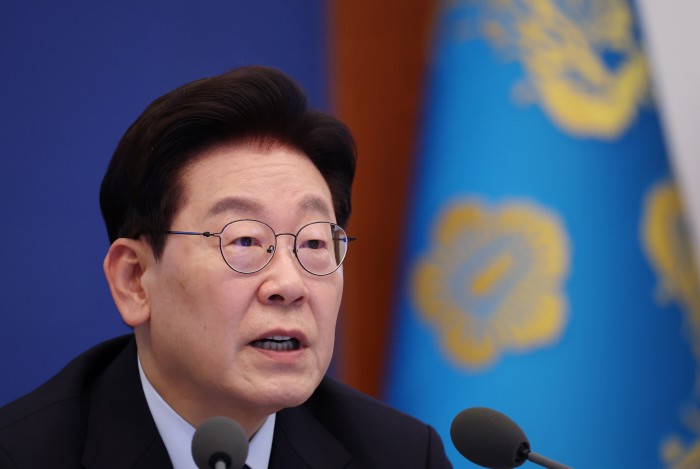 |
| President Lee Jae-myung speaks during a meeting of senior secretaries held at Cheong Wa Dae on the 15th. / Yonhap News |
Public opinion poll results released on the 16th showed that President Lee Jae-myung's job approval rating halted its decline and rebounded to 39%. However, negative ratings also rose slightly to 52%, continuing to significantly outpace positive assessments.
According to a presidential job performance survey conducted by Gallup Korea on October 13-15 among 1,003 voters aged 18 and older nationwide, positive ratings for President Lee stood at 39%, up 2 percentage points from the previous week.
Negative evaluations were tallied at 52%, up 1 percentage point from the prior week. Positive ratings for President Lee, which had continued a downward trend following the local elections and dropped to 37% last week—his lowest since taking office—bounced back in this survey.
By region, positive evaluations in Daejeon, Sejong, and the Chungcheong provinces saw a marked increase, climbing 12 percentage points from 28% the previous week to 40%. Negative ratings in the region stood at 53%.In Busan, Ulsan, and South Gyeongsang Province, positive evaluations led at 46%, compared to 43% negative.
In contrast, Seoul recorded 29% positive and 62% negative, while Daegu and North Gyeongsang Province posted 27% positive and 62% negative. Negative ratings outweighed positive assessments across all regions except Honam and the Busan-Ulsan-South Gyeongsang area.
By age group, positive evaluations led among respondents in their 40s at 53%, against 42% negative. Negative ratings were higher across all other age brackets. Positive assessments stood at 31% among those aged 18 to 29 and 32% among those in their 30s.
By political ideology, positive ratings reached 65% among progressives and 40% among moderates. Positive evaluations among moderates rose by 3 percentage points from the previous week.
Among the reasons cited for positively evaluating President Lee's job performance, diplomacy was the highest at 20%, followed by the economy and livelihoods at 11%, and communication at 7%.
For negative assessments, real estate policy topped the list at 19%. Responses regarding the economy, livelihoods, and the stock market followed at 12%, while national defense, security, and North Korea issues stood at 11%.
The survey was conducted via telephone interviews with human interviewers, with a margin of error of plus or minus 3.1 percentage points at a 95% confidence level. The response rate was 10.4%.
More details can be found on the National Election Commission website.
Park Young-hoon
Most Read
-
1
Celltrion nears additional contract with major U.S..

-
2
"Aren't those foreigners on welfare?": M..

-
3
Houthis launch successive attacks on Saudi airport..

-
4
Saudi Arabia, Iran hold first diplomatic talks to..

-
5
Saudi airport in Riyadh struck again, leaving at l..

-
6
Five ASEAN countries welcome Myanmar coup leader

-
7
32 Western nations condemn Iran over terror plot t..

PEOPLE





HEADLINE NEWS

-
Address : In-Young Bldg., 34, Uisadang-daero 1-gil, Yeongdeungpo-gu, Seoul
Copyright by ASIATODAY CO., LTD. All rights resereved