



Local production becomes vital for K-defense as Europe consolidates defense alliance
Oct 16, 2026, 10:43 am


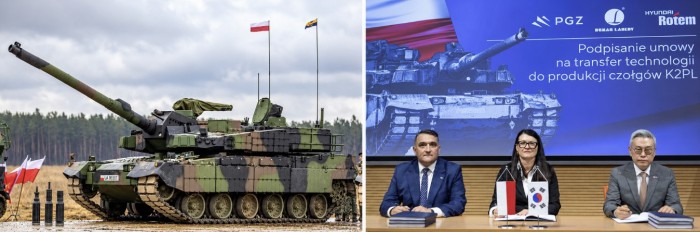 |
| On the left is the Polish-variant K2 main battle tank. On the right is a ceremony held on October 28, 2025, at the headquarters of Poland's state-owned defense group PGZ, where Hyundai Rotem and Polish defense contractor Bumar-Labedy signed an agreement on technology transfer and local production cooperation for the K2PL tank. / Photo = Polish Ministry of National Defence, Hyundai Rotem |
In the face of Russian threats, Europe is accelerating the establishment of a "defense alliance" that links joint weapon development, production, and procurement beyond individual national defense buildups. As the European Union (EU) activates joint defense procurement loans worth up to 150 billion euros (in the 250 trillion won range), the competitive landscape of the European arms market is shifting. For K-defense, which had made inroads into countries like Poland on the back of competitive prices and rapid delivery timelines, local production and supply chain integration have become a new litmus test determining export success.
Andrius Kubilius, EU Commissioner for Defense and Space, emphasized at the Warsaw Security Forum on the 13th (local time) that the defense of Ukraine is directly linked to the security of Europe as a whole. He stated that he is looking into the possibility of establishing a European Security Council, an initiative proposed in September by European Commission President Ursula von der Leyen. The concept involves adding the UK, Ukraine, Norway, and Canada alongside member states, U.S. defense outlet Breaking Defense reported.
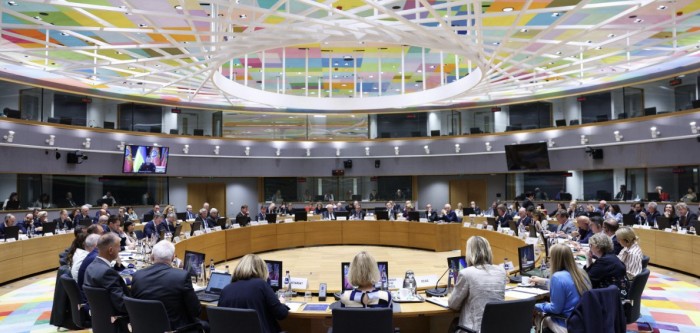 |
| Officials from European Union (EU) member states discuss security and defense issues in the EU Council meeting room in Brussels, Belgium. The EU is pursuing 150 billion euros in joint defense procurement financial assistance and the expansion of its regional weapons production base in response to Russian military threats. / EU website |
The core of the defense alliance is bringing the initiative in weapons production and procurement into Europe. According to the European Commission, Security Action for Europe (SAFE) provides up to 150 billion euros raised on capital markets as long-term loans to member states. Components sourced from outside the EU, the European Economic Area (EEA)-European Free Trade Association (EFTA), and Ukraine cannot exceed 35% of the estimated cost of components in the end product. In effect, this means that more than 65% of the components must be procured from within the region.
Missile defense cooperation is also taking shape. Ten nations, including Ukraine, the UK, and Norway, launched a joint anti-ballistic missile coalition in Paris last July, and Poland joined on the 18th of last month, bringing the total to 11 countries (Reuters). Established under the framework of a "coalition of the willing" rather than the EU, the initiative is currently at the stage of establishing joint operational requirements and a roadmap.
Poland became a European bridgehead for K-defense by procuring large quantities of K2 tanks, K9 self-propelled howitzers, Chunmoo multiple launch rocket systems, and FA-50 light attack aircraft. Hanwha Aerospace's K9 and Chunmoo can secure long-term competitiveness if they broaden local component procurement and maintenance, repair, and overhaul (MRO) cooperation. However, local production does not immediately translate into SAFE qualification.
Although South Korea signed a security and defense partnership with the EU in 2024, participation in SAFE requires separate negotiations. It is reported to have submitted a letter of intent to participate in September 2025. Third countries must form a joint procurement team with two or more countries, including EU member states, and eligibility is limited to companies that possess production facilities within Europe. While Europe's missile defense initiatives are mentioned as potential cooperation opportunities for Cheongung-II and L-SAM, there has not yet been any official mention indicating South Korean participation.
Chae Woo-seok, chairman of the Korea Association of Defense Industry Studies, emphasized on the 14th, "The decisive battlefield in the European defense market is shifting from 'who can produce faster and cheaper' to 'who can produce alongside Europe and take responsibility for the supply chain,'" stressing, "The government and industry must swiftly establish local joint ventures and component procurement systems in countries like Poland alongside negotiations to participate in SAFE."
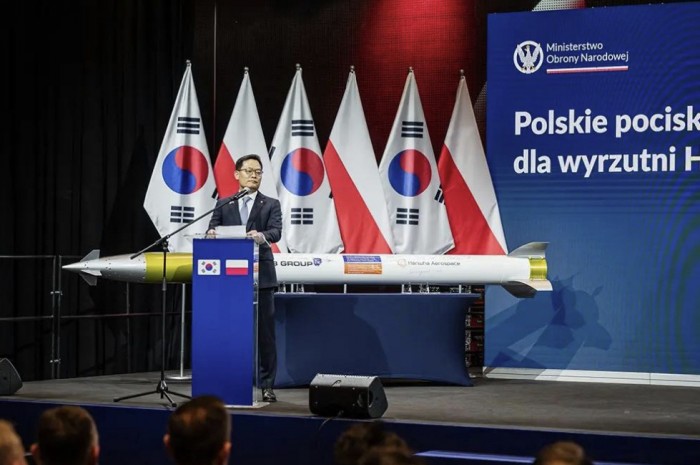 |
| At the Polish Army Museum in Warsaw, Poland, on December 29, 2025, Hanwha Aerospace CEO Son Jae-il explains cooperation plans for the local production of guided rockets for the Chunmoo (HOMAR-K) multiple launch rocket system at an event venue where the national flags of South Korea and Poland hang side by side. / Photo = Provided by Hanwha Aerospace |
Ku Pil-hyun
Most Read
-
1
Celltrion nears additional contract with major U.S..

-
2
"Aren't those foreigners on welfare?": M..

-
3
Houthis launch successive attacks on Saudi airport..

-
4
Saudi Arabia, Iran hold first diplomatic talks to..

-
5
Saudi airport in Riyadh struck again, leaving at l..

-
6
Five ASEAN countries welcome Myanmar coup leader

-
7
32 Western nations condemn Iran over terror plot t..

PEOPLE





HEADLINE NEWS

-
Address : In-Young Bldg., 34, Uisadang-daero 1-gil, Yeongdeungpo-gu, Seoul
Copyright by ASIATODAY CO., LTD. All rights resereved